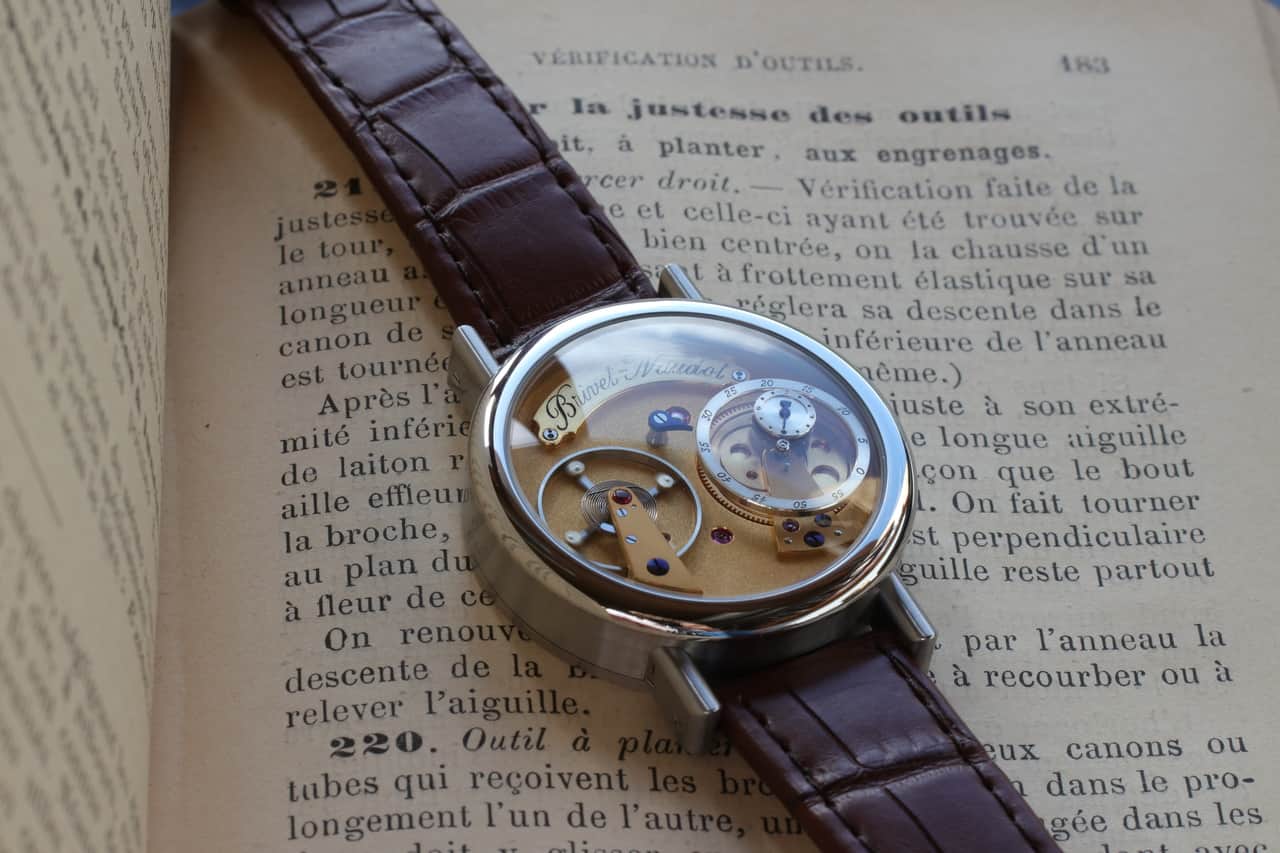
Cyril Brivet-Naudot
Cyril Brivet-Naudot is French watchmaking's purest keeper of the hand-made flame — a young artisan whose motto, 'Manibus Factum' (hand-made), is meant in its original, literal sense, and whose work stands as an explicit act of resistance against the CNC machine. A grandson and great-grandson of watchmakers, his attraction to what was once called the art of watchmaking was, in his words, almost genetically derived: he is as delighted by Édouard Phillips' theory of terminal curves as by the artistic masterpieces of the Boulle era, and admires the 16th-century Julien Couldray and George Daniels in equal measure, alongside the chronometers of Pierre Le Roy. His philosophy is a manifesto worth reading in full: computer-controlled machining, however capable, threatens the crafting skills handed down over countless generations and produces what he calls the 'devitalization' of modern creations — cold, dispassionate perfection examined under forty-power magnification, where the old artisans strove instead for harmony. He regards imperfection — the wandering file, the over-enthusiastic hammer blow, the roving saw — as the watchsmith's personal hallmark, lending soul and character without altering the piece, and cites Jules Verne's Master Zacharius, whose clocks stopped in pace with his slowing heartbeat because passion had put a little of him inside each one: 'a noble and inspiring philosophy, and one I modestly seek to follow.'
The proof is the Eccentricity, his first creation — a single copy that consumed almost three years including a full year of manufacture, and won him the AHCI's Young Talent Competition in 2018. The vast majority of its components were made in-house, including the screws, pins, and case that even prestigious ateliers typically buy from catalogues; only the mainspring, balance-spring, and some jewels came from outside, being trades in their own right. Its beating heart is an entirely hand-crafted, custom-built free eccentric escapement ('échappement libre excentrique') — a detached escapement of his own construction, beating at a stately 18,000 vph with the balance displayed on the dial side. The display is equally unorthodox: hours and minutes read from a rotating dial, and — most romantically of all — the watch has no crown: it is wound and set with a key, like the pocket watches of the golden age, in a 39mm case with 40 hours of reserve. A subsequent evolution, the Eccentricity 'Réserve de Marche,' added a power reserve indication to the architecture.
Because the work is genuinely artisanal, no two of his watches can ever be the same — nothing is interchangeable or uniform, with enormous amounts of shaping done by file and gauged by eye as much as by plan. His commissions embrace this: clients define the complications, display, materials, escapement, even the layout of parts, in a style that remains his — 'as I can see no point in doing the same thing twice, I am delighted to have no identical clients and be free to create afresh with each new order.' Alongside creation he practices museum-grade restoration of antique timekeepers, which he describes as plunging into the astonishing savoir-faire of past masters — humbling work, achieved by those masters without modern technology, materials, or electricity. At perhaps one or two watches a year, entirely by hand, Cyril Brivet-Naudot is among the very few living watchmakers of whom it can truly be said: the machine did not make this.