Dann Phimphrachanh
Dann Phimphrachanh — the surname is pronounced 'fin-fra-chan,' inherited from a Laotian grandfather who was a political figure in Laos — is one of the most compelling new voices in independent watchmaking, and one of the most unlikely in terms of biographical trajectory. Born in France, holding Portuguese citizenship and of Laotian heritage, he moved to Portugal at the age of eight and encountered watchmaking by chance at fourteen, when a school visit to a technical college intended for enrolment in blacksmithing or electronics led him instead through the watchmaking department's door. What he saw there — the beauty of crafted pieces and movements — redirected his life entirely. He studied at the Watchmaking School in Lisbon, in the Belém district, where teachers with direct Swiss industry experience passed on both technical foundations and deep admiration for the great independent watchmakers who shaped the tradition. He then moved to Switzerland at twenty-four, drawn by the ambition to master the art fully.
The career that followed placed him at the bench of some of the most demanding ateliers in Swiss horology. He worked at Daniel Roth, in the complications department at Bulgari, at Parmigiani Fleurier, Greubel Forsey, and Jaeger-LeCoultre — a trajectory covering nearly two decades of haute horlogerie at the highest level. Yet despite working alongside extraordinary colleagues on exceptional products for the most renowned brands, he describes arriving in Switzerland with a persistent sense of impostor syndrome as a graduate of a school in Lisbon rather than a Swiss institution. This quietly drove the central ambition of his independent project: to create a watch that was technically challenging beyond reproach — built not with CNC machines or surface treatments or industrial shortcuts, but entirely on traditional manual equipment, as the early masters had worked, and using materials chosen for longevity and repairability rather than expediency. Since 2018 he has worked almost entirely alone, a choice he has come to understand not as isolation but as freedom. Solitude, he says, became his truest teacher. He recently moved his workshop from Yverdon-les-Bains to Saint-Blaise, Neuchâtel — five minutes from his home, allowing him to save hours each week and be closer to his family.
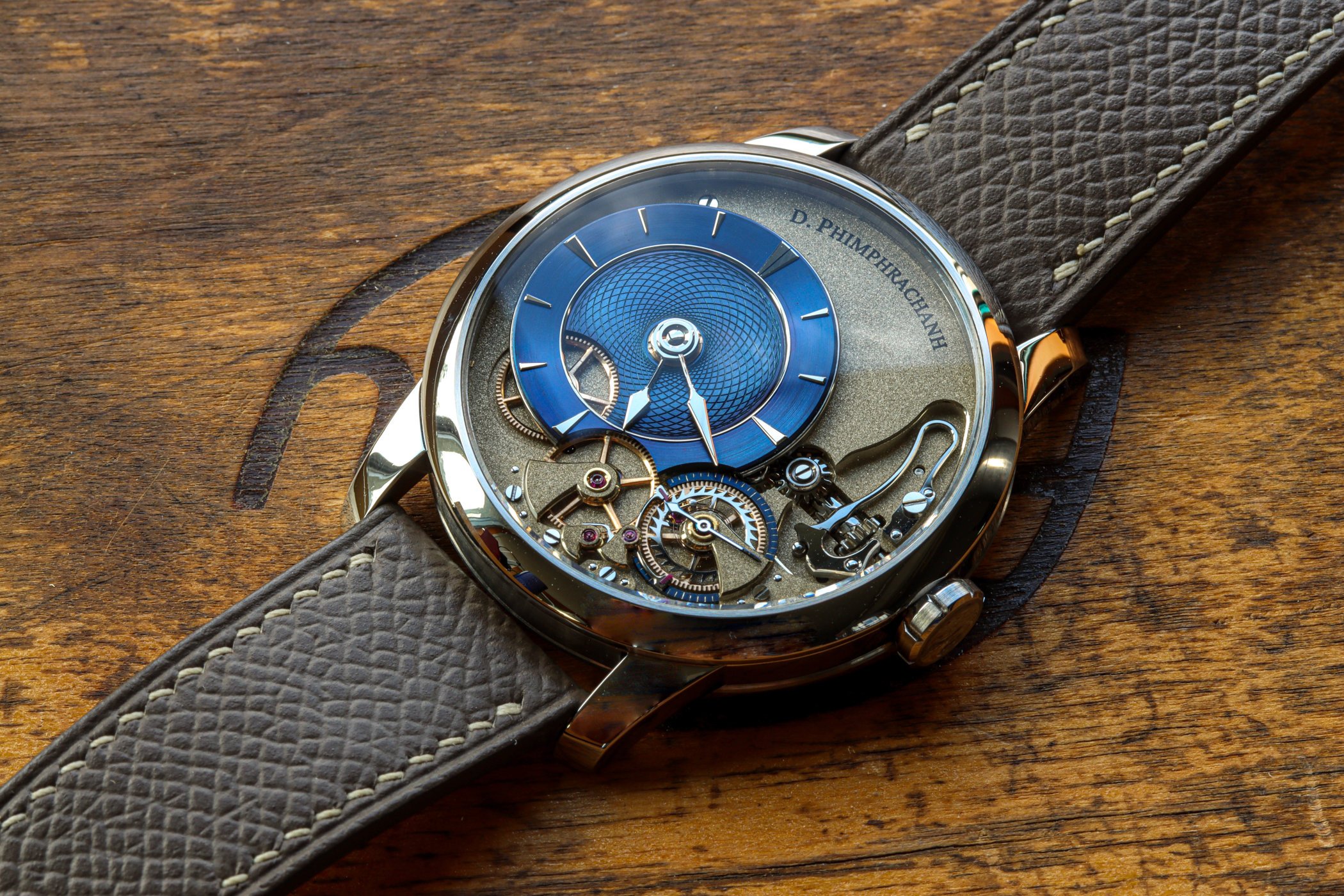
The Seconde Vive — translating as 'lively seconds' — is his debut wristwatch and the culmination of years of solitary work. The name perfectly describes the mechanism at its heart: a seconds hand that jumps 60 discrete times per minute, creating a visible, rhythmic animation that feels immediately alive to anyone who watches it. Dann was clear from the outset that this would not be a conventional deadbeat seconds mechanism. The Seconde Vive is not a chronometric device but a horological statement: a mechanical animation created for its own sake, a wink to the craft that anyone, regardless of technical background, can perceive and appreciate. The gear train and escapement are mounted on the dial side — visible through the front — while the main timekeeping train sits quietly on the reverse, revealing itself through the caseback. The mechanism multiplies the motion of the minute hand by a factor of ten, then uses a Reuleaux triangle cam — a geometric form known from engineering for its constant-width rotation, used historically by Derek Pratt and more recently by Luca Soprana in watchmaking contexts — to generate 30 steps per minute, which a custom anchor then doubles to achieve the 60 discrete jumps. Three attempted mechanisms preceded the Reuleaux solution; two were abandoned for consuming too much energy. The final design required three major modifications to the triangle geometry and four radical reworkings of the entire seconds system — including three successive reductions in pivot size — before the movement reached the fluid, snapping rhythm Dann had envisioned. He first tested two prototypes on his bicycle, on the forest trails and pavements of his town, watching them tick and jump against real vibrations.
Every component between the barrel spring and balance spring was designed, developed, and manufactured by Dann himself using pre-CNC traditional manual machines — lathes, mills, and tools, many sourced secondhand and restored by hand. The plates and bridges are maillechort (German silver), chosen for its workability and ability to be refinished generations from now; structural parts are hardened S20AP steel; springs are silvered steel, all left untreated. The case — 39.5mm diameter, 9.8mm height, 316L stainless steel — was made by Dann himself, as were the dial (hand-guilloché decorated), hands, and buckle. The plates carry a corundum-blasted frosted finish. The movement beats at 2.5Hz (18,000 A/h). The only externally sourced components are the barrel spring, balance spring (hairspring), rubies, and the three setting mechanism parts — a decision made both from pragmatic necessity (these are only viable at industrial scale) and from a commitment to long-term serviceability: any good watchmaker will be able to find and replace them in the future. Tolerances throughout are held to five microns, achieved through the intimate knowledge of each machine's individual behaviour that only years of working alone on restored equipment can develop. When the Seconde Vive was first presented as an AHCI candidate piece at the Masters of Horology exhibition during Watches & Wonders 2025 in Geneva, it was received with immediate enthusiasm and a promising order book. His mentors within the AHCI are Raul Pagès and Bernard Lederer. Maximum output is six watches per year; the first three years of production were reserved on presentation. A waiting list of over ten years exists if all certified collector requests were fulfilled.