Eberhard & Co.
Eberhard & Co. is one of the last of Switzerland's great chronograph specialists to have survived the 20th century in genuinely independent hands — privately owned for 138 years and counting, with no conglomerate ever in its cap table. Georges-Lucien Eberhard founded the Manufacture d'Horlogerie Eberhard & Co. in La Chaux-de-Fonds in 1887 at just 22 years old; by 1907 the house had grown large enough to occupy an entire Beaux-Arts block on the city's main avenue, crowned with an eagle that still marks its historic headquarters, the Maison de l'Aigle, today home to the Eberhard & Co. Museum. The house built its identity on chronograph firsts: the first wrist chronograph in 1919, a dust-and-damp-protecting patented case in 1921, the double-pusher start-stop-without-reset chronograph in 1935, the first chronograph with an hours counter in 1938, and a split-seconds rattrapante chronograph in 1939 — the 'Sistema Magini' version of which timed the first Rome–Tokyo visual flight in 1942. Following the deaths of Maurice Eberhard's designated successors in a 1962 accident, the family sold the house in 1972; visionary Italian entrepreneur Palmiro Monti acquired it in 1969 on the conviction that mechanical watchmaking would outlast the coming quartz crisis, and under his and later Mario Peserico's stewardship — Peserico remains managing director today — that bet paid off in full.
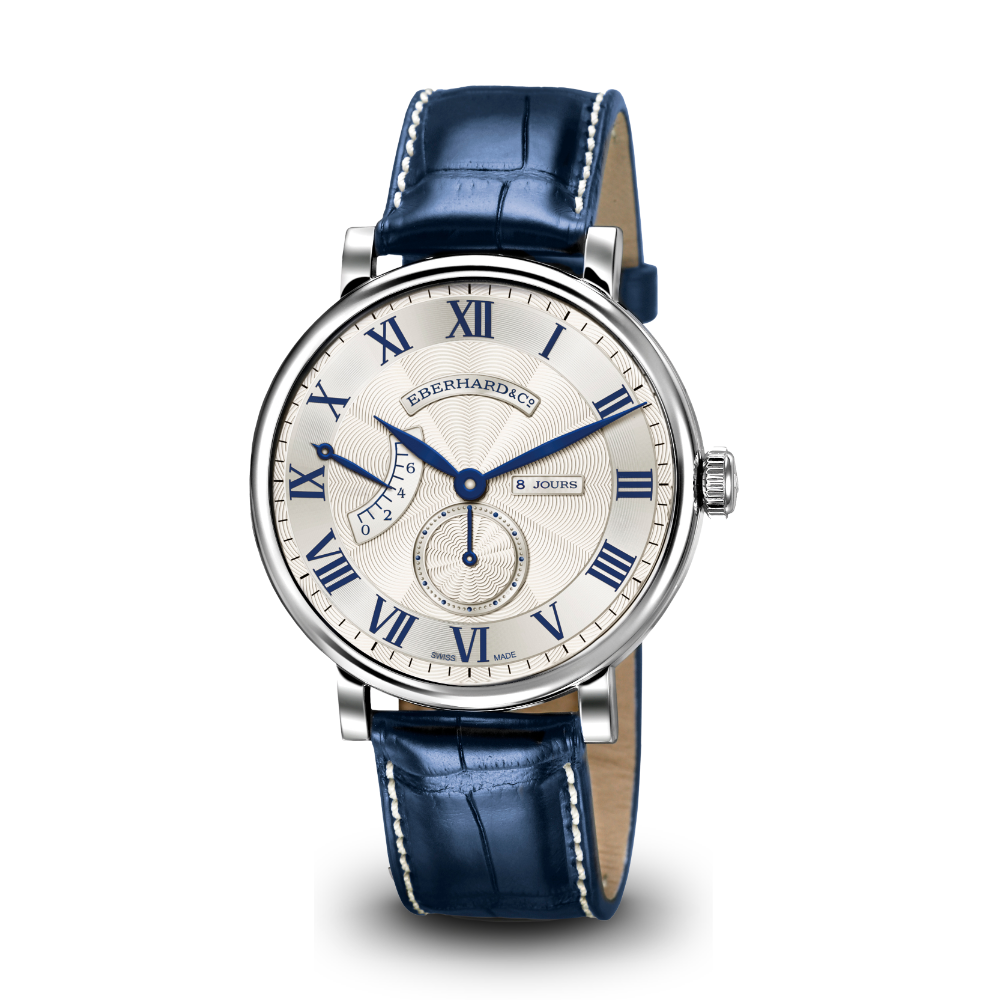
The watchmaking itself has rarely stood still. The Extra-Fort, launched at the end of the 1950s with a chronograph seconds hand reset by a sliding pusher rather than a conventional button, remains one of the house's most representative lines and returned in Grande Taille form in 2011. The Scafograf diving collection traces to 1959's Scafograf, updated across decades into today's Scafograf 200. The 8 Jours, launched in 1997, holds a genuinely unusual patented power reserve of eight days from two overlapping mainsprings totaling more than 1.5 meters in length — with a hand-driven days-remaining indicator borrowed from the world of marine chronometry. But the house's most celebrated modern invention is the Chrono 4, unveiled in 2001: the first and only chronograph in watchmaking history to arrange all four counters — hours, minutes, small seconds, and 24-hour — in a single horizontal row, a patented, registered-design mechanism built on 53 jewels that reimagined how a chronograph could be read at a glance. The Tazio Nuvolari collection, honoring the legendary Italian racing driver since 1992, and the anti-magnetic Scientigraf, revived from its 1961 original, round out a catalogue still built almost entirely around the chronograph complication the house has spent over a century refining.
Recent years have brought the house full circle. The 1887 collection, launched in 2019 on the exclusive in-house EB 140 caliber, pays direct tribute to the founding date, followed in 2024 by a 250-piece Chronographe 1887 Édition Limitée and an automatic companion, both running further exclusive Eberhard & Co. calibres. The 2025 Contodat, inspired by a 1970s Eberhard original, brought a compact 39mm integrated-bracelet case to both chronograph and time-only formats, while 2026 saw fresh interpretations of the Scafograf 200 and Tazio Nuvolari drawn directly from the Maison's own archives. Alongside its historic partnership as official timekeeper of the Gran Premio Nuvolari vintage rally and its long association with the Italian Royal Navy and the Frecce Tricolori aerobatic team, Eberhard & Co. remains exactly what it was in 1887: a chronograph house, still family- and privately-held, still building most of its own patents — not the largest name in Swiss watchmaking, but among the very few of its age never once absorbed into someone else's group.