Gelfman
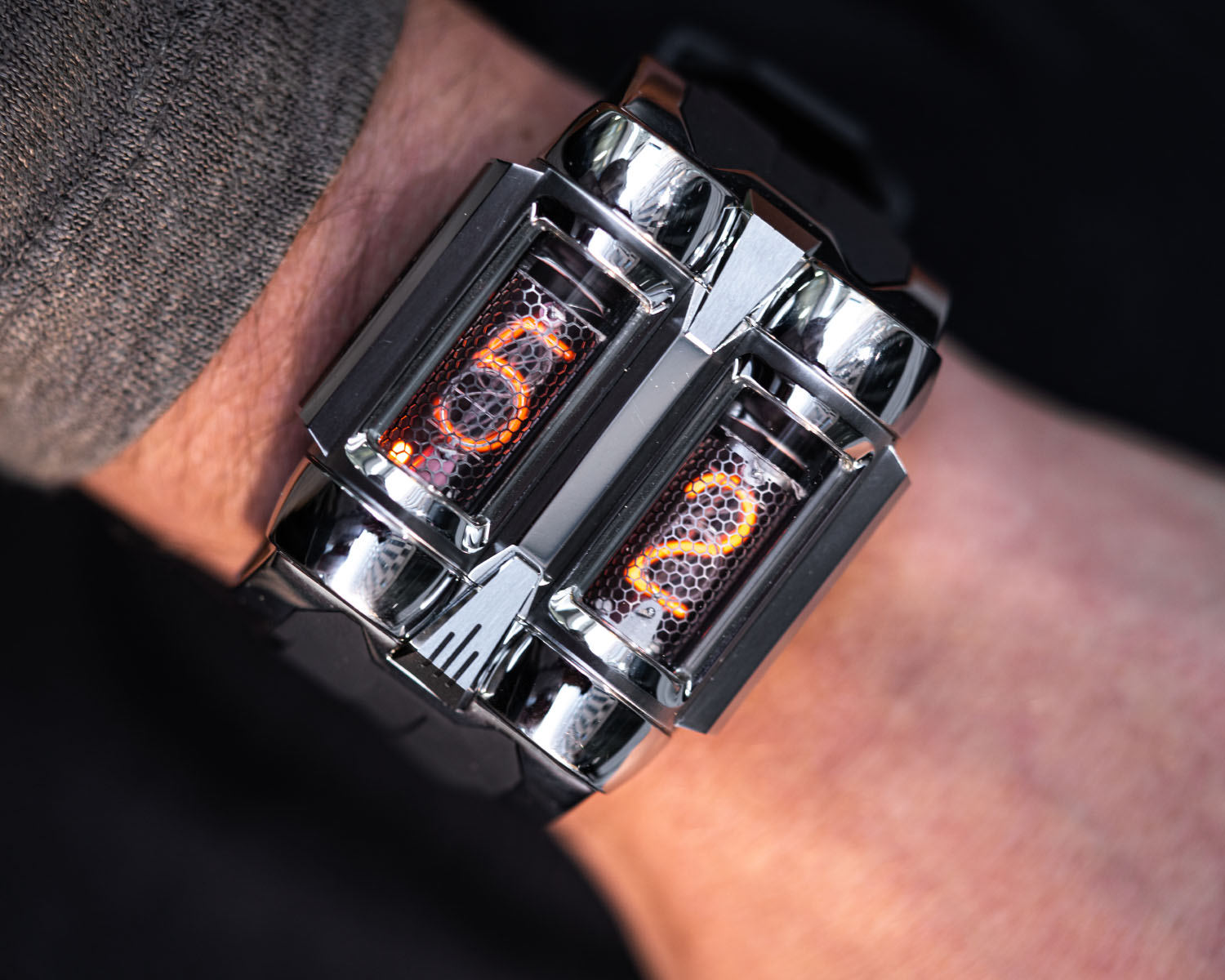
Gelfman is the singular creation of Ilya Gelfman, a Moscow-based entrepreneur and watch collector since 2007, whose seven-year journey toward founding the brand began in an attic outside Moscow in 2012, where he showed visiting watch journalist Ariel Adams boxes upon boxes of new-old-stock Soviet Nixie tubes — the cold-cathode neon readout displays once used in everything from submarines to power-plant instrumentation. Gelfman had already been fascinated by these tubes for years, and by 2014 he had settled on the idea that would define his brand: a retro-futuristic wristwatch that told the time not with hands or a printed dial but with two genuine vintage Nixie tubes glowing behind sapphire-coated crystals. It took roughly a decade of patient development, refined through prototypes Gelfman wore and tested on his own wrist, before the finished IN-16 Nixie — named after the original Soviet part designation for the tubes themselves — finally reached production in 2022, designed in Zurich and hand-assembled in Moscow. Gelfman frames the brand's mission explicitly as a search for a bolder, more avant-garde Haute Horlogerie, positioned deliberately outside the traditions of mechanical fine watchmaking — an avant-garde gesture the brand has likened to asking who watchmaking's own Basquiat might be, following Gérald Genta's informal crowning as its Picasso.
A Nixie tube works on the same glow-discharge principle as a neon lamp: at least ten wire-mesh cathodes, each shaped like a digit and set at a slightly different depth inside the tube, light up individually when voltage is applied, with the illuminated digit appearing to float at its own distance behind the glass — the effect that gives the IN-16's display its distinctive layered, sculptural glow. Each watch uses two dedicated tubes, their digits roughly 13mm tall, housed in a hand-polished stainless steel case measuring a deliberately oversized 45.9 x 47.8mm and 20.5mm thick, water-resistant to IPX6 and finished with the model name and individual limited-edition number engraved into either flank. A single pusher between the tubes cycles the display — one press for hours and minutes, two for date and month, three for remaining battery life — while a built-in accelerometer lets the wearer simply flick their wrist to wake the display instead of always reaching for the pusher. The whole system is run by more than 100 electronic components and a rechargeable 320mAh lithium-ion battery good for up to twelve days, charged and reprogrammed via a magnetic USB cable connected to dedicated Mac or PC software that lets owners adjust brightness, backlight colour, and display behaviour; Gelfman rates the vintage tubes themselves, sourced from 1980s Soviet stock, for over 10,000 hours of further service life. Production is capped at 999 pieces, each delivered in a rocket-inspired presentation case.
The IN-16 Nixie earned a nomination in the Petite Aiguille category of the 2022 Grand Prix d'Horlogerie de Genève, an unusual honour for a battery-powered watch and one that brought the project mainstream attention within the independent scene; the very first numbered example, No. 001, then tripled its pre-sale estimate to sell for CHF 21,000 at Ineichen's Independents auction in Geneva in May 2023. Critical reception has been consistently polarised but engaged: reviewers at Monochrome, aBlogtoWatch, and Time+Tide have all singled out the quality of the hand-finished case and the genuinely polished companion software as setting the IN-16 apart from the DIY Nixie-watch kits that have circulated in hobbyist circles for years, even as several described the watch's imposing, unapologetic proportions and retro-futuristic design as a deliberately love-it-or-hate-it proposition — one comparison likened owning it to commissioning a Ford GT40, an object whose entire point is spectacle rather than subtlety or comfort. Encouraged by the watch's reception and its GPHG recognition, the Gelfman team has said it is now developing further projects in the same bold, uncompromising spirit as the brand's first release — a rare case of an outsider's idea, incubated for over a decade in a Moscow attic, finding a genuine audience among collectors who value invention over convention.