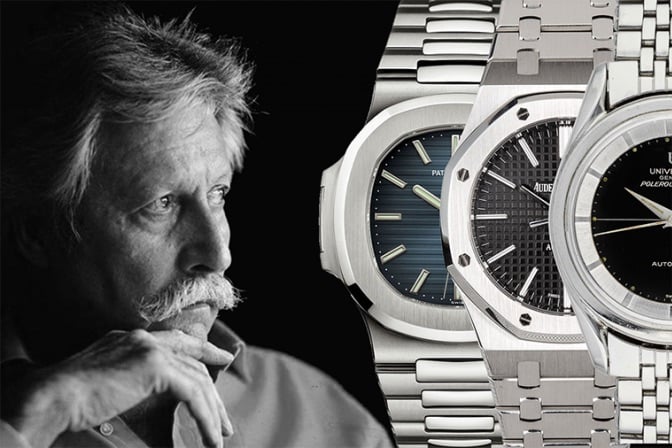
Gérald Genta
Gérald Genta was the legendary master designer and watchmaker widely considered the godfather of the modern luxury sports watch and among the founding fathers of independent watchmaking. The hand behind the Polerouter, the Golden Ellipse, the Royal Oak, the Nautilus, the Ingenieur, and the Pasha, he founded the eponymous Gérald Genta house in 1969, making him one of the first watchmakers of the modern era to build a brand under his own name, and that house is no longer independent. It belongs to LVMH, which took control of Bulgari, then owner of the Genta name, in 2011. After two decades of near silence the name was relaunched in 2023 as a stand-alone house, with its watches made at La Fabrique du Temps, the Louis Vuitton manufacture, under Jean Arnault, a son of LVMH chairman Bernard Arnault. Genta's widow, Evelyne, supports the revival and has given its team access to his archives of sketches, including hundreds of unrealised designs. It is catalogued here for the man: Genta designed some of the most important watches of the twentieth century and, from 1969, ran his own house making small numbered series of highly complicated watches, an early model of the independent brand.
Genta was born in Geneva on 1 May 1931, to a Swiss mother and an Italian father, and came from a poor family, according to the heritage site run by his widow. He trained as a goldsmith and jeweller, earned a Swiss federal diploma, and began designing around 1952, at first for suppliers of cases and bracelets, sometimes for very little money per design (Chrono24 says as little as 15 Swiss francs, and dates his diploma to 1951). In 1954, at 23, he drew the Universal Genève Polerouter for the Scandinavian airline SAS's polar routes. From about 1959 he worked with Omega on the Constellation, whose pie-pan dials and C-shaped case made his name as a designer, and in 1960 Omega's head of creation, Pierre Moinat, gave him his first exclusive contract; the Seamaster line followed, and he drew for a long list of houses including Cartier, Chaumet, Van Cleef & Arpels, Hamilton, Bulova and Seiko.
The designs that made his name came in the 1970s. Audemars Piguet's managing director Georges Golay asked him for a luxury steel sports watch around 1969 to 1970, and the Royal Oak, with its octagonal bezel and eight visible screws, was introduced at Basel in 1972 in steel at a price then thought extravagant (sources give CHF 3,300 or CHF 3,750), as the ref. 5402 'Jumbo' on the Calibre 2121. Genta later said he designed the Patek Philippe Nautilus, shown at Basel in 1976 and inspired by a ship's porthole, in a restaurant and perhaps two years before its launch; the often-told napkin sketch is called apocryphal by Sotheby's. The Nautilus stayed in production for about thirty years. The IWC Ingenieur SL arrived the same year, followed by the Seiko-made Credor Locomotive of 1979, with its repeating hexagon, the Bulgari Bulgari, drawn on an ancient Roman coin (dated 1975 or 1977 depending on the source), the Cartier Pasha in 1985, an update of Louis Cartier's 1932 original. One famous watch is often misattributed to him: Vacheron Constantin has confirmed that the 222 was designed by Jörg Hysek.
A fuller list of the designs credited to him, in the order they were introduced and drawing on Wristler's survey and the sources above, shows how wide his range was. The Universal Genève Polerouter of 1954 was a 35 mm steel case with crosshair dials, first on the bumper-winding calibre 138SS and from 1955 on the Microtor calibre 215. In 1959 he gave the Omega Constellation its 'C' case and pie-pan dial. Universal Genève's ultra-thin elliptical Golden Shadow and White Shadow followed in the 1960s, and the Patek Philippe Golden Ellipse arrived in 1968, with an elliptical gold case that peaked in popularity through the 1970s. The 1970s were extraordinarily productive. The Audemars Piguet Royal Oak was designed in 1970 and launched in 1972, a 39 mm steel case with the ultra-thin automatic Calibre 2121 derived from a Jaeger-LeCoultre base, said to have been sketched in a single night as the quartz crisis loomed. The Audemars Piguet Cobra ref. 5403, with its serpentine bracelet, dates from the early 1970s. The Bulgari Bulgari came in 1975 (some sources say 1977), with a bezel drawn from an ancient Roman coin. Two more icons followed in 1976: the Patek Philippe Nautilus, first the ref. 3700 in 42 mm with its porthole-shaped case, side 'ears' and horizontal-groove dial, later joined by the 3700/1A, the mid-size 3800 and the 40 mm 5711, which uses Patek Philippe's own calibres; and the IWC Ingenieur SL (ref. 1832, 'Jumbo'), drawn around 1974, a 40 mm steel case with five bezel screws, an integrated bracelet and an antimagnetic automatic calibre 8541ES. The decade closed with the Credor Locomotive of 1979, its hexagon repeated across case, dial and bracelet. In the 1980s came the Disney-licensed Mickey Mouse watches under his own name, the bronze Gefica Safari of 1984, and in 1985 the Cartier Pasha, with oversized Arabic numerals and a screw-down crown cap chained to the case; in 1994 came his own Grande Sonnerie. Some attributions are contested: Wristler lists the Rolex King Midas (ref. 3580) as his, though another source says he worked with nearly every major house except Rolex, and it treats the Bulgari Octo Finissimo and the Patek Philippe Cubitus as inspired by him rather than designed by him.
In 1969 Genta also decided to produce under his own name, and the company he built was both a design studio and a laboratory. Seiko's president Reijiro Hattori encouraged him to put his name on six perpetual-calendar prototypes shown at Wako in Tokyo, which the brand's own chronicle treats as its real birth. The house grew from seven craftsmen to about 250, with a movement division in Le Brassus and cases and dials made in Geneva, and its watches earned the Poinçon de Genève in 1979. Its achievements include a skeletonised self-winding minute repeater developed with the movement maker Pierre-Michel Golay around 1980 to 1981, only 2.72 mm thick, and in 1994, for the company's 25th anniversary, the first automatic grande et petite sonnerie wristwatch with Westminster chime, some with perpetual calendar and tourbillon, after about five years of development, with more than 1,000 parts, a perpetual calendar and a Westminster four-hammer chime, reportedly made in a series of 23 to 25 (sources differ) at roughly $900,000 to CHF 1 million each. Alongside came playful lines such as the Retro Fantasy jumping-hour and retrograde-minute watches, a Disney licence with Mickey Mouse and Donald Duck on the dial, the bronze Gefica Safari of 1984, said to be the first bronze-cased watch, with a moon phase and a compass in the clasp, commissioned by three hunters, and royal commissions for the Sultans of Oman and Brunei and the Kings of Morocco, Spain and Saudi Arabia. From 1983 to 1999 Genta and his wife Evelyne travelled to promote the brand, she concentrating on Asia, Europe and the Middle East.
The sale came in the 1990s. The Hour Glass, the Singapore retailer, bought a 51% stake in 1996 (some sources say 1998 or 1999 for the sale of the company), merged Genta with Daniel Roth into one company, and sold both to Bulgari in 2000, one of Genta's former clients. Bulgari made Genta watches only sporadically, reissuing the Gefica in 2007 and a Gérald Genta Collection in 2018 and 2019, and in 2010 folded the name into its own line. Chrono24 dates the Hour Glass purchase to 1998; Bulgari's 2019 Arena Bi-Retro was a fiftieth-anniversary tribute. Genta, after selling the rights to his name, launched the Gerald Charles brand, under his middle name (accounts of its start vary from 1998 to 2001), turned to painting, and died on 17 August 2011, aged 80 (Chrono24 gives 2012; the heritage site, SJX and others give August 2011). In 2021 Christie's Dubai sold Grande Sonnerie No. 1 for about $500,000. In 2022 Sotheby's offered a c. 1972 Royal Oak prototype that sold for CHF 565,500, a Nautilus prototype that sold for HK$5.7 million, and Genta's own two-tone Royal Oak from his personal collection, which far outran its estimate.
Since the 2023 relaunch the brand has been led through La Fabrique du Temps by Jean Arnault, with veteran watchmakers Michel Navas and Enrico Barbasini, who worked for Genta in the 1980s and 1990s, overseeing complications, and the focus is on high complications in small quantities. The 2025 Oursin Fire Opal revived a piece from the 1994 Gentissima range. The Geneva Minute Repeater followed in September 2025, in a 40 mm cushion case with the hand-wound GG-002 calibre and an 80-hour power reserve, and a Golden Obsidian version was shown at Geneva Watch Days 2026, with production estimated by press at ten or fewer a year. In January 2026 came the 38 mm Geneva Time Only in rose gold or white gold at CHF 25,000, on a reworked Zenith Elite movement. These are the work of a new team rather than of Genta, and this listing gives the present ownership and current production while keeping its focus on the designer and the house he built from 1969.