Grandeur Watches
Grandeur is the work of Belal Shaher, a Houston-based entrepreneur who built his first fortune manufacturing apparel for Nike, Puma, and The North Face before a business trip to China introduced him to his future wife, whose family owns one of the country's established watch-movement manufactures. Shaher spent three years learning movements and complications there directly at the bench, without formal watchmaking-school training, before buying the factory outright in 2016 — half cash, half loan. That factory now also produces watches for 53 other brands, but every Grandeur design is Shaher's own, and he wears each one himself before it reaches a customer.
The brand runs without a fixed collection or house design language by design: pieces are conceived because someone said a particular idea was impossible, or impossible at the price, and once a run sells out it is retired permanently rather than reissued. Grandeur watches are designed in the United States and manufactured at that Hangzhou factory; a second facility now under construction in Miami is intended to produce the brand's first genuinely American-made watch, a version of its Five-Minute Repeater, with deliveries targeted from 2027 and an eventual goal of sourcing every component, down to the hairspring, domestically. The brand markets itself on the absence of paid reviews or sponsorships, and runs an active WhatsApp community whose members vote on finishing details before certain batches go into production.
Grandeur's range leans heavily on unusual case materials machined at aggressive price points: the TorQ line offers a 7.4mm ultra-thin, hand-finished skeleton manual movement (22 jewels, 28,800vph, 40-hour reserve) in a 35mm by 43mm titanium tonneau case, with variants in raw tantalum — a metal the brand says broke multiple CNC tools in production — starting around 2,500 USD, and in woven carbon fibre at just 32 grams. The Ætherium line cases watches in solid natural stone, a material prone to cracking during machining, making every finished piece unique by necessity. The TorQ Mechanical Tantalum and the Grandeur Tilt Sapphire have both been selected as competing watches in the 2026 Grand Prix d'Horlogerie de Genève's Challenge category.
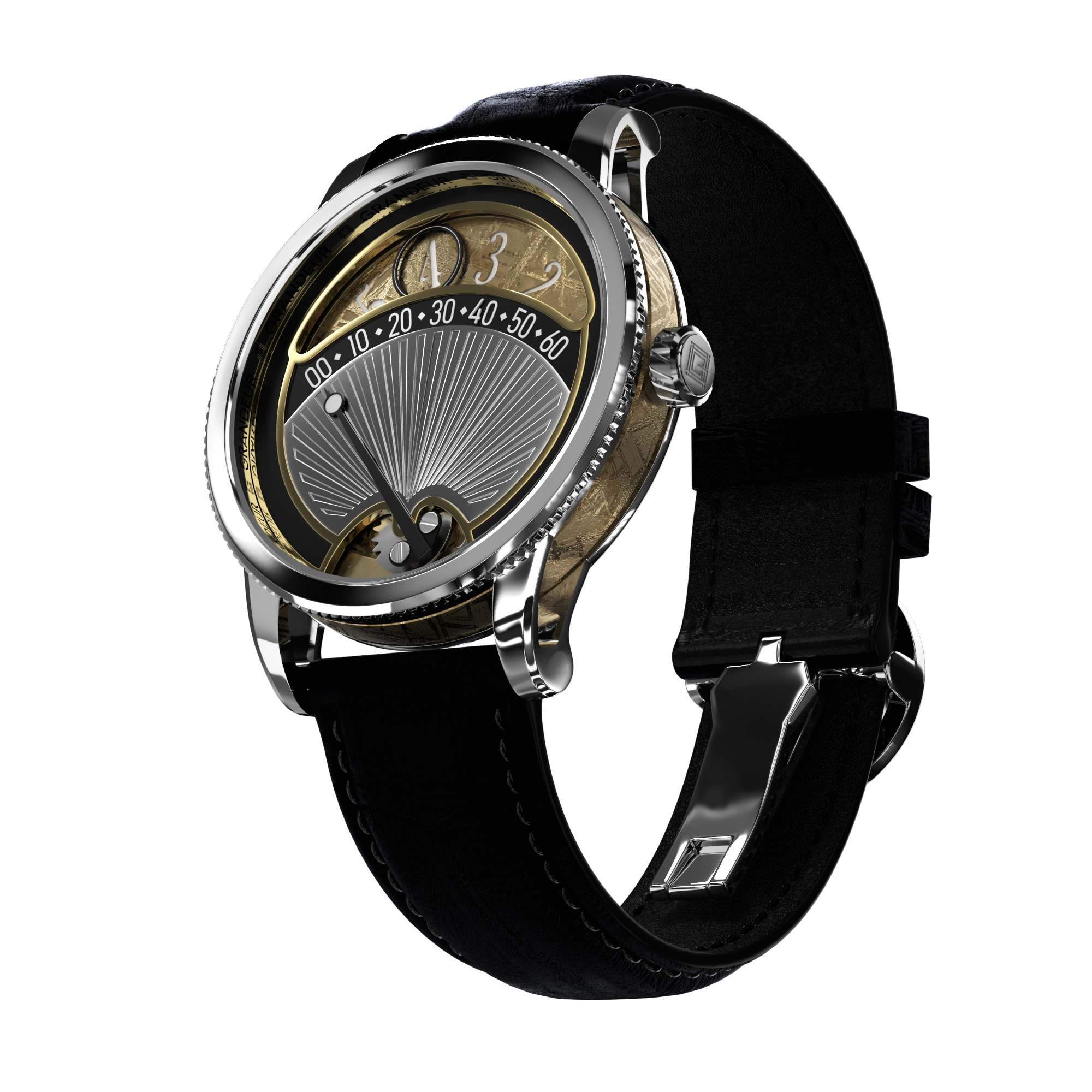
Several pieces push into genuine haute-horlogerie territory. The Monocle combines jumping 'flap' hours with a retrograde minute display — a combination the brand describes as previously unbuilt — wound by a rotor machined from meteorite; a version of it, the Monocle Aureum, along with the Janus, were also selected for GPHG 2026 consideration. Lumillion applies luminous material directly onto a functioning, poised tourbillon balance wheel, offered at 2,100 USD alongside a Damascus-steel Mashrabiya edition referencing Islamic geometric art; both sold out and were themselves GPHG 2026 selections. The Minute Repeater series, sold across ten colourways at 9,500 USD each in editions of 25 pieces, sold out its run before the movement had been publicly demonstrated, based on audio previews alone; the Noir Pulse RG reference was likewise selected for GPHG 2026.
The Grandeur Lyra takes the idea further still: a 42mm tonneau watch built around a changeable, metal-3D-printed music-box cylinder that clients can have engraved with a melody of their choosing, limited to 50 pieces at 21,000 USD with delivery expected in mid-2027. Earlier pieces established the brand's identity in the same spirit: the Strange Hours, a patented in-house jumping-hour movement housed in a Dalí-inspired melting case, launched at 1,300 USD; a ceramic case the brand says glows from within, developed after roughly eight months of work; and the Revolv, also selected for GPHG 2026 consideration — the brand's broader approach being to treat in-house complications and unconventional materials as accessible rather than rarefied, pricing pieces that would typically run into six figures at a fraction of that through vertically integrated, factory-direct production.