H. Moser & Cie.
H. Moser & Cie. is one of the most beloved and genuinely independent watch manufactures in the world — a Schaffhausen-based maison whose history stretches back nearly two centuries, yet whose identity as collectors know it today was forged after 2012 by a family with the audacity, taste, and vision to make it one of the most talked-about brands in contemporary horology. The story begins with Johann Heinrich Moser, born in Schaffhausen on 12 December 1805 into a family of watchmakers — his grandfather and father were both established town watchmakers. After training in Le Locle he moved to St. Petersburg in November 1827 and founded H. Moser & Cie. in 1828, quickly conquering the Russian market with branches in Moscow, Nizhny Novgorod, and Kiev. His watches supplied Russian princes, the Imperial Court, and even powered the ornate table clocks of Peter Carl Fabergé. Dostoevsky cited the name in his writing.
Heinrich was also a remarkable industrialist: returning to Schaffhausen in 1848, he built the Moser Dam on the Rhine between 1863 and 1866 — one of Switzerland's first hydropower stations — channelling energy to local watchmaking factories and laying the industrial foundations that made Schaffhausen a watchmaking hub. In 1868 he helped American Florentine Ariosto Jones found the International Watch Company (IWC) there, using the Moser dam's power. By the middle of the century the enterprise employed several hundred people in Switzerland; approximately half a million watches were produced under the Moser name during Heinrich's lifetime. He died in 1874. After the October Revolution of 1917, the Russian business was nationalised; the Le Locle branch soldiered on under various names and ownership structures through the quartz crisis before being officially dissolved in 1988 and absorbed into Zenith.
Revival came in 2002 when German engineer Dr. Jürgen Lange — who had worked at IWC and Eterna — joined with Roger Nicholas Balsiger, Heinrich Moser's great-grandson, to found Moser Schaffhausen AG. They debuted the revived brand at Baselworld 2005, built a manufacture in Schaffhausen, and won the GPHG Complicated Watch Prize in 2006 for their Perpetual Calendar. But the brand struggled to articulate a clear identity, and by 2012 it was financially fragile and little known. Then came the decisive change: MELB Holding, the family investment group of Georges-Henri Meylan — himself a seasoned industry veteran and former CEO of Audemars Piguet — acquired the Moser Group. Edouard Meylan, Georges-Henri's son, became CEO on 1 April 2013. His brother Bertrand Meylan joined to oversee sales. The connection is not merely financial: Octave Meylan had been a co-owner and director of H. Moser's original Russian business — and was ruined when the Bolsheviks expropriated it in 1917. The Meylan family's acquisition in 2012 was, in a very real sense, a recovery of a birthright.
Under Edouard Meylan, sales increased eight-fold, production five-fold. Sixteen manufacture calibres were developed, five new collections launched, and H. Moser & Cie. was transformed from an obscure revival into one of the most discussed independents in the world. Three things define the brand's identity absolutely. First: the fumé dial — a gradated, smoked colour that deepens toward the periphery, leaving the centre luminous and the edge intensely saturated. Moser did not invent the fumé effect, but they perfected it, commodified it, and made it their signature to such a degree that the whole category is now associated with them. The fumé palette has expanded from classic grey and blue into an extraordinary spectrum: Funky Blue, Midnight Blue, Salmon, Burgundy, Frost Blue, Spiced Aqua, Matrix Green, and many more.
Second: movements of genuine manufacture quality, produced in Schaffhausen with in-house calibres developed and assembled entirely on-site. The acquisition of Precision Engineering AG — a maker of hairsprings, escapements, and movement components — made Moser one of very few brands at any price level capable of producing its own hairsprings, including the extraordinarily rare cylindrical hairspring that is hand-shaped at Precision Engineering and takes ten times longer to produce than a conventional flat spring. Third: a brand personality of irreverent intelligence — sharp, self-aware, and willing to make pointed comments about the industry and the absurdities of luxury at its most cynical. Edouard Meylan has said repeatedly that Moser is not a luxury brand: it is an independent manufacture that makes exceptional watches and happens to charge a lot for them. This attitude, combined with the fumé dials and the quality of the movements, built the brand's cult following.
The provocations have been legendary. When Apple introduced the Apple Watch in 2015, Meylan called the Moser Endeavour Perpetual Calendar 'the original smartwatch' in a pitch-perfect video before launching the Swiss Alp Watch in 2016 — a rectangular, tonneau-cased mechanical watch whose proportions directly mimicked the Apple Watch, powered by the in-house HMC 324 manual-wind movement developed for the rectangular case format, with a modular plug-and-play escapement and a power reserve indicator on the movement side (keeping the dial uncluttered). The Swiss Alp Watch became a genuine hit across multiple editions, culminating in the Swiss Alp Watch Final Upgrade (2021, 50 pieces), whose Vantablack® dial — coating made of carbon nanotubes that absorbs 99.965% of visible light — reproduced the 'black mirror' look of a smartwatch in standby mode, while its small seconds was redesigned as a spinning disc of apertures that evoked the Mac 'beachball' loading indicator.
When new Swiss Made legislation made it easier than ever to label a watch Swiss Made with minimal actual Swiss content, Moser removed 'Swiss Made' from its dials entirely in 2016 — one of the most subversive acts in recent Swiss watchmaking — while claiming that over 95% of their components by value are made in Switzerland, a far higher standard than the label actually requires. The Swiss Mad Watch — a one-of-a-kind unique piece with a case made from 100% Swiss cheese, selling for over CHF 1 million at auction for charity — was the reductio ad absurdum of that argument. The Swiss Icons Watch combined design cues from multiple famous Swiss watch brands on a single dial as a tongue-in-cheek pastiche. The Endeavour Centre Seconds Concept — blank dial, no logo, no indices, only leaf-shaped hands — was a quietly radical statement that a watch's quality speaks for itself without any identifying marks at all. The 'Concept' aesthetic then spread across multiple models.
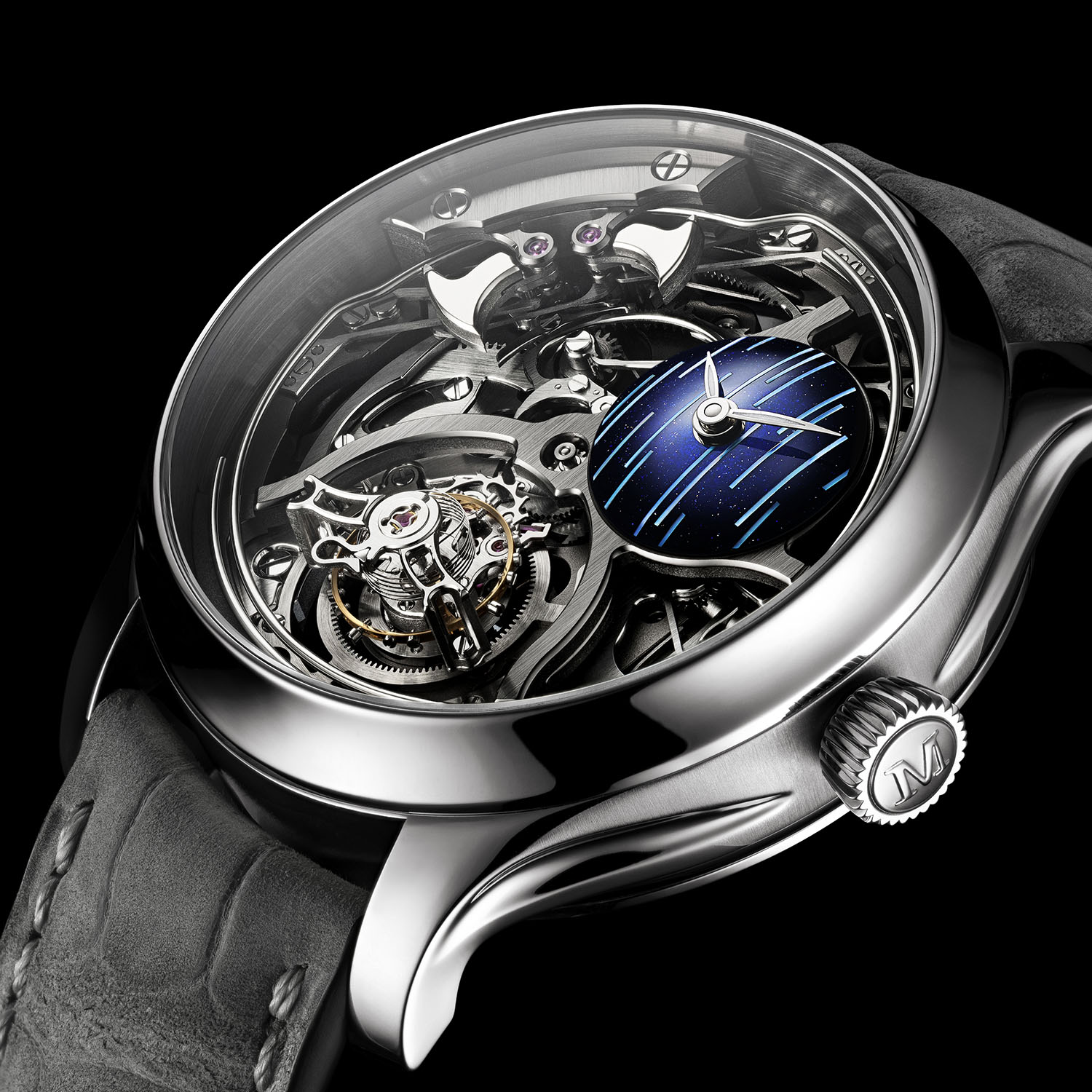
The current collection comprises four permanent families. The Endeavour is the flagship — the heart of the brand, named for the spirit of the original H. Moser enterprise, housed in a refined round case with the brand's most distinctive leaf-shaped hands and carrying the broadest range of complications. The Endeavour family encompasses: Centre Seconds (in-house automatic HMC 200 with central seconds and 3-day power reserve — the most accessible Endeavour entry); Small Seconds; Flying Hours (a retrograde hour display jumping between 0 and 12 at 12 o'clock, driving the minute in a retrograde arc); Perpetual Calendar (HMC 800, 7-day power reserve, the leap year indicator moved to the caseback to preserve dial purity); Perpetual Moon (HMC 801, perpetual calendar plus moon phase accurate to one day's deviation every 1,027 years, presented with Vantablack dial in the Concept version); Chinese Calendar (the only Swiss watch brand to offer an in-house perpetual Chinese calendar displaying lunar months, leap months, and the Chinese Stem-Branch cycle); Minute Repeater (chiming hours, quarter-hours, and minutes on demand); Tourbillon; and the extraordinary Endeavour Minute Repeater Cylindrical Tourbillon Skeleton (HMC 909, unveiled Watches & Wonders 2026 — 415 components, 35 jewels, 3Hz flying tourbillon with cylindrical hairspring, 90-hour power reserve, fully skeletonised, hammers and gongs moved to the dial side, 40mm titanium case hollowed to act as a resonance sound box).
The Streamliner, launched in 2020 and immediately acclaimed as a modern classic of integrated-bracelet sports watchmaking, was inspired by the aerodynamic 'Streamliner Moderne' design movement of the 1920s–1930s — the era of streamlined locomotives and ocean liners. Its cushion-shaped case with integrated bracelet and fluid, ergonomic lines established an immediate visual identity that distinguished it from every other sports watch on the market. The Streamliner family has expanded to include: Centre Seconds, Small Seconds, Flyback Chronograph Automatic, Tourbillon, Perpetual Calendar, Perpetual Moon, Cylindrical Tourbillon Skeleton (debut 2024), and — at Watches & Wonders 2026 — the Streamliner Mini in 34.2mm and 28.3mm, with frosted fumé dials and no logo or indices; and the Streamliner Pump, born from the Moser Exploration LAB™, in collaboration with Reebok, replacing the crown entirely with an anodised aluminium pusher that transmits energy directly to the barrel spring — a mechanical transposition of the iconic Reebok Pump sneaker gesture.
The Pioneer is the sports and adventure collection, rated to 120 metres water resistance, available in 42.8mm steel. It has housed the Perpetual Calendar, multiple tourbillon variants, and the standout Pioneer Cylindrical Tourbillon Skeleton (2022, HMC 811 automatic, skeletonised with gold oscillating weight, funky blue fumé subdial at noon, Globolight luminescent indices). The Heritage collection draws from H. Moser's historical pocket watch designs, offering a broader selection of case shapes and dial configurations.
Discontinued lines that remain beloved by collectors include the Venturer — the collection that bridged the entry-level Pioneer and the more elaborate Endeavour. The Venturer Small Seconds (launched Baselworld 2014) was the first model in the family, a 39.2mm watch with convex case lines, domed sapphire crystal, and design elements referencing 19th-century pocket watches and 1920s Bauhaus aesthetics, powered by the HMC 327 manual-wind calibre (32mm). It was dedicated to Heinrich Moser himself and came in argenté, fumé, and ardoise dials in red gold or white gold. The Venturer family expanded to include the Big Date, the Dual Time, and the spectacular Venturer Tourbillon Dual Time Sapphire Skeleton (Baselworld 2015, CHF 1,000,000, fully transparent sapphire crystal case housing a skeletonised movement with a double hairspring Straumann tourbillon — the first watch Edouard Meylan commissioned after taking over, which sold and led to a second commission), as well as the Venturer Swiss Mad (red fumé dial, four white indices referencing the Swiss flag, 50 pieces, born of the Swiss Made legislation response). The Venturer was phased out following the Streamliner's arrival in 2020. Also discontinued is the Swiss Alp Watch, retired with the Final Upgrade edition in 2021.
Collaborations have been an important creative thread. The MB&F × H. Moser Endeavour Cylindrical Tourbillon (2020) — celebrating over a decade of supply relationship between Moser and MB&F through their shared connection with Precision Engineering AG — produced a hybridised pair of watches blending each brand's DNA: a Moser fumé dial with flying tourbillon rising above it at noon, and a tilted sapphire disc displaying time at 6 o'clock in homage to MB&F's LM Flying Tourbillon. The H. Moser × Studio Underd0g 'Passion Fruit' collaboration (2024, 100 box sets at CHF 59,000) paired an Endeavour Perpetual Calendar in purple lacquered and Grand Feu Maracuja enamel with a Studio Underd0g monopusher chronograph — Edouard Meylan having identified Studio Underd0g as 'the British Moser' and deliberately choosing a brand from the opposite end of the price spectrum rather than a peer. The Massena LAB × H. Moser Endeavour Chronograph (100 pieces) brought vintage chronograph sensibility to the Endeavour case. Bryan Ferry designed a limited edition dial. The Alpine Motorsports partnership (from 2024), covering F1 and endurance racing, produced the Streamliner Cylindrical Tourbillon Skeleton Alpine edition and multiple driver editions including the Streamliner Tourbillon Pierre Gasly Edition. The Reebok × Streamliner Pump (2026, Moser Exploration LAB™) is the most technologically playful collaboration to date. The brand's tagline 'Very Rare', adopted in 2013, accurately captures everything that H. Moser & Cie. is: rare in production, rare in its willingness to challenge, and rare in its ability to make watches that are technically exceptional, visually distinctive, and genuinely funny — often simultaneously.