Laventure
Founded in 2017 by Clément Gaud, Laventure remains, by the brand's own description, 'still a one-man show.' Gaud's passion for watches, chronometers, and instruments of measurement dates to childhood, shaped by growing up around antique shops; a design graduate, he spent five years at a Neuchâtel watch design agency working for major Swiss houses before going independent. The project began on Kickstarter with the original Marine collection, whose tonneau-shaped, lugless case and sandwich-construction dial with oversized lumed markers became the brand's signature, carried through nearly every release since.
That design language runs across Marine, Marine II, Sous-Marine, Sous-Marine II, Transatlantique GMT, Transatlantique II GMT, and the Automobile chronograph — eight collections in total once Marine Type 3 is included, all built with the same vintage-tool-watch spirit and, with rare exceptions, long since sold out across every colourway offered. Since 2018, Laventure has gone beyond the standard 60% threshold required for the 'Swiss Made' label to reach 100% Swiss value, with design based in Neuchâtel and production just 18 kilometres away in La Chaux-de-Fonds; limited editions are individually numbered on the caseback and, once sold out, are never reproduced.
Marine Type 3, launched in 2025, marks a deliberate break from that vintage elegance toward something closer to a 1980s marine chronometer: brutalist, instrument-like, with an oversized fixed bezel carrying 60 engraved, lacquer-filled graduations around a deliberately small dial aperture. The case, including the mid-case, back, crown, and bezel, is machined entirely from Grade 23 titanium, the same alloy used by Blancpain, then stonewashed for a worn, hardened finish; at 38mm across, 46.2mm lug-to-lug, and 11.2mm thick, it is rated to 300 metres and fitted with a 'chimney-like' Plexiglas crystal rather than sapphire, a choice Laventure has made since 2019 for its warmth, impact resistance, and local Swiss production. The two-layer dial hides a soft-iron bottom plate that, together with the movement's surrounding ring and cover, forms an anti-magnetic Faraday cage; it comes in black or fully photoluminescent white. Inside is Calibre 4, a Sellita-produced movement on the SW300-1 architecture, decorated with 3N gold plating, thin Geneva stripes, soleillage, and perlage, COSC-certified as a chronometer; delivered on a Swiss rubber strap and a textile-and-elastic strap rather than a metal bracelet, it was limited to 100 pieces per colour for 2025 and priced at CHF 4,200 excluding taxes.
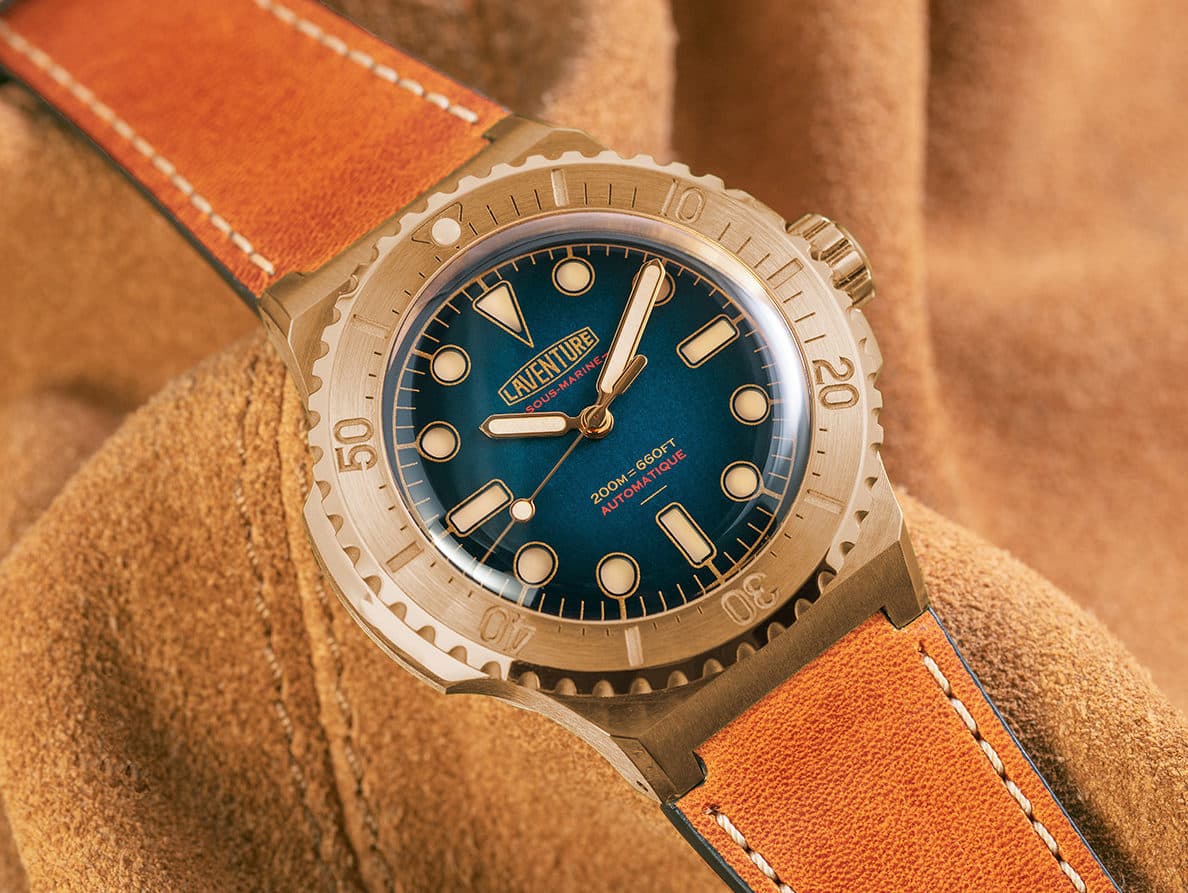
The Sous-Marine, a 41mm dive watch in bronze CuSn8 or steel, stands 10.2mm thick and is rated to 200 metres with a screwed crown and a domed 'Superdome' sapphire crystal; its sandwich-construction dial layers a gradient-lacquered upper plate over a photoluminescent lower one, cut away at the indices for day-and-night legibility, with gilt hands and a unidirectional lume-capsule bezel. Inside is the automatic ETA 2824-2 in TOP grade, adjusted across five positions, 25 jewels, 38 hours of reserve at 28,800 vibrations per hour. Limited to 50 pieces across six steel and bronze colourways, each watch ships in a box inspired by the Hetzel Edition of Jules Verne's Extraordinary Voyages from the late 19th century, alongside a strap-changing tool, user manual, and two-year warranty.