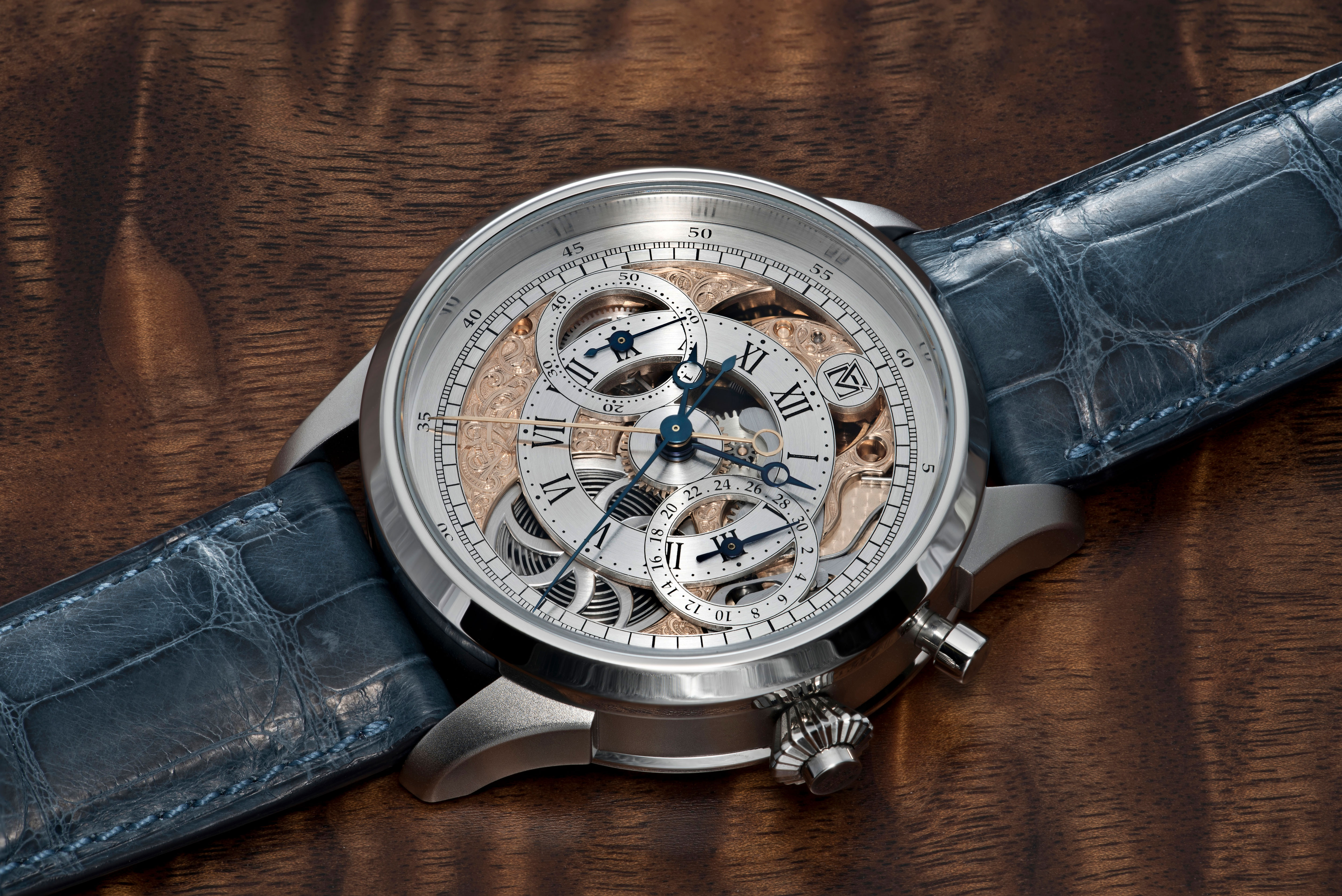
Molnar Fabry
Molnar Fabry is Slovakia's flag-bearer in haute horlogerie — a two-man atelier in Banská Bystrica whose name unites Michal Molnar and Igor Fabry, certified jewellers and goldsmiths who transformed themselves into bespoke watchmakers. Both finished their studies in 1998, met in 2002, and opened their own fine-jewellery boutique in 2005, specializing in bespoke pieces where gemstones and artwork met the highest standard. The turn to watchmaking began in 2006 with a simple wish — to design and build their own personal wristwatches — and a defining spark: the documentary 'Masters of Time,' which revealed to them the hidden world of the independent 'cabinotiers.' They were transfixed by Philippe Dufour's precision and, above all, by Antoine Preziuso's diamond-set Stardust Tourbillon — a piece that spoke directly to their jewellers' hearts and posed the challenge that became their career: to transgress the boundary between jewellery and horology, not by using gems as a decorative afterthought, but by fusing the two art forms into a single harmony of aesthetic and mechanical refinement. Skeletonized watches became their chosen canvas — the heart of the mechanism pulsating in plain view — and, working far from watchmaking's geographic cradle with no direct access to its establishment, they taught themselves by doing, progressing from assembling and decorating pre-fabricated parts to full in-house realization of balance wheels, bridges, screws, hands, cases, and buckles.
Every Molnar Fabry watch is a commissioned pièce unique, built in dialogue with its client (a 50% deposit begins a three-to-twelve-month process) and absorbing between 300 and 800 hours of handwork — which is precisely why the atelier deliberately completes fewer than ten watches a year. The portfolio reads like a cabinet of wonders: the White Lotus; the Majestic and Classic Art Tourbillons; Carpe Noctem; the Lady Art Skeleton; the Tech Art Symmetry; the Architectural Art Piece; the Atlantis Tourbillon, 650 hours of work uniting a Christophe Claret CCR97 one-minute tourbillon with mystery winding, a Damascus steel case, blue stones the color of the sea, a stingray strap, and a hand-engraved gate to lost Atlantis on the movement's back; the Nightingale, the duo's first minute repeater, built around a heavily modified 128-year-old Paul H. Matthey pocket-watch movement (comparable commissions from €120,000); and the Corculum, whose client donated the Omega Co-Axial 8500 from his own Planet Ocean to be reborn amid floral skeletonization. Base calibers have climbed steadily in sophistication — from Unitas and ETA to Christophe Claret tourbillon ébauches (Claret's personal support was instrumental early on) and, most recently, Vaucher: the 2026 Classic Tech Art transforms a Vaucher VMF 5401 micro-rotor — its pink gold rotor cast in-house — inside a fully in-house bi-metal case of 18k pink gold and grade 5 titanium, a 38mm exercise in restraint that SJX praised as refreshingly original, its sub-€50,000 price undercutting Swiss rivals for comparable bespoke craft.
The duo's stated destination is complete autonomy — producing every component in-house, ultimately including their own movement — and full membership of the AHCI. In the meantime their singular blend of hand engraving, creative texturing, gem-setting, high-brilliance polishing, and metalworking mastery (their in-house grade 5 titanium casework alone testifies to serious skill) has earned coverage from SJX, aBlogtoWatch, and Oracle Time, and comparisons to Germany's Benzinger — though with a maximalist, fairy-tale sensibility all their own. From a jewellery bench in central Slovakia, Molnar Fabry has built what few thought possible: world-class bespoke haute horlogerie, one unrepeatable watch at a time.