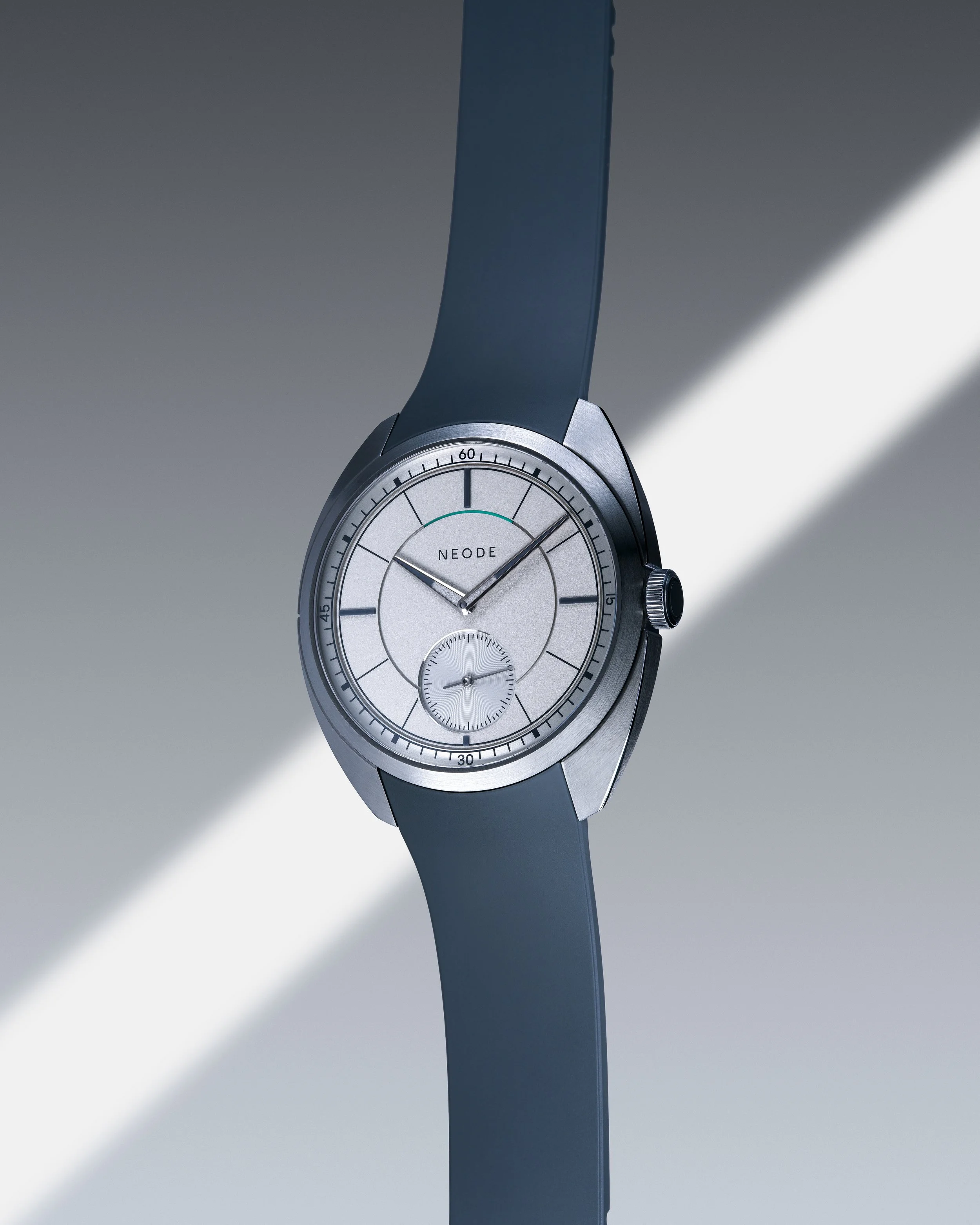
Neode
Neode is the work of Marius-Daniel Dumitrascu, an architect with more than 15 years at studios including Foster + Partners and 10 Design, where his projects ranged from museums and flagship Apple stores to residential towers and high-rises. The brand's name comes from the Old English 'nēod,' meaning both desire and earnest endeavour, and its stated ambition is to translate architectural principles directly into traditional Swiss high horology. Dumitrascu points to Italian architect Ernesto Nathan Rogers's 1952 idea that an architect's ability should span every scale of human living, from 'the spoon to the city'; after years designing at the scale of cities, he describes Neode as his own turn toward the spoon, and has said the project was never about chasing a market or a trend, simply the need to make something to the best of his ability and share it with people who feel the same way.
Neode's debut watch, the N01 First Edition Pure Silver, is limited to just 25 pieces — a sleek, everyday timepiece the brand describes as built to 'unfold slowly,' its details and traditional artisan techniques revealing themselves to the owner gradually rather than announcing themselves at a glance. Wearability was treated as a core design requirement from the outset: over three years, Dumitrascu designed every detail of the watch himself and produced more than 130 three-dimensional printed models of the case, wearing each for weeks at a time — including to sleep — before the final geometry was settled, drawing on a lifelong interest in photography that shaped his sense of light, composition, and shadow.
The watch is a genuinely collaborative project, bringing together some of the most respected names in Swiss haute horlogerie's supplier ecosystem rather than developing everything under one roof. The N01 calibre was engineered with Jean-François Mojon and his team at Chronode — over two decades, Mojon has built some of independent watchmaking's most complex mechanical creations, work that has earned him the GPHG Best Watchmaker prize. The case is executed by Voutilainen & Cattin, a team known for its artisanal approach to complex casemaking; aside from the sapphire crystals and gaskets, every case component is manufactured in-house by their own artisans. The dial comes from Les Cadraniers de Genève, founded in 2000 by François-Paul Journe himself and among the most highly regarded dialmakers in Switzerland, credited with some of the most iconic timepieces released over the past 25 years; the hands are made by GMG Composants Sàrl.
The Calibre N01 is derived from Chronode's own C101 base, hand-wound with twin independent mainspring barrels for a full 192 hours — eight days — of reserve, 28 jewels, just 31.1mm across and only 3.98mm thick, its architecture rigorously designed for absolute symmetry and to maximise the visual space surrounding the balance wheel. That free-sprung balance wheel carries variable-inertia weights (8mg·cm² of inertia) and beats at 21,600 vibrations per hour, held by a cantilevered Grade 5 titanium balance bridge with a rounded bercé profile, black-polished on top and straight-brushed where it meets the mainplate, finished throughout with hand-bevelling, sharp inner anglage, a microbillé treatment, and an anthracite galvanic finish.
The Grade 5 titanium case measures 39.50mm across in the 12-6 o'clock direction, 45.5mm lug to lug, with a 21mm lug width and a genuinely snug 7.9mm thickness (9.9mm including its slightly domed crystal), rated to 5 ATM of water resistance and finished in alternating circular and straight brushing set against mirror-polished surfaces to bring out its geometry. The 925 silver dial, an exercise in restraint, separates each of its sectors with precise architectural shadow gaps rather than printed lines; its minute ring sits higher with a brushed finish, while its seconds ring is recessed with an azurage finish and diamond-cut edges, letting each sector catch and reflect light independently.
Tucked into one of those shadow gaps, the teal power-reserve indicator sits deliberately subtle and recessed, more a detail for the owner's own quiet noticing — of the gauge slowly filling with each turn of the crown during the watch's once-every-eight-days winding — than a display meant to be seen from across a room. Every Pure Silver dial is genuinely unique, frosted entirely by hand using grenage, a traditional technique that textures the silver surface with a mixture of cream of tartar, salt, and silver powder, leaving a finely granular, matte surface that diffuses light into a texture that reads as both matte and luminous at once. Indices are cut from solid blocks of slate-grey ceramic Super-LumiNova beneath a domed, internally anti-reflective sapphire crystal, and the hands, in 18-carat 210 grey gold with matching ceramic lume inserts, complete the dial.