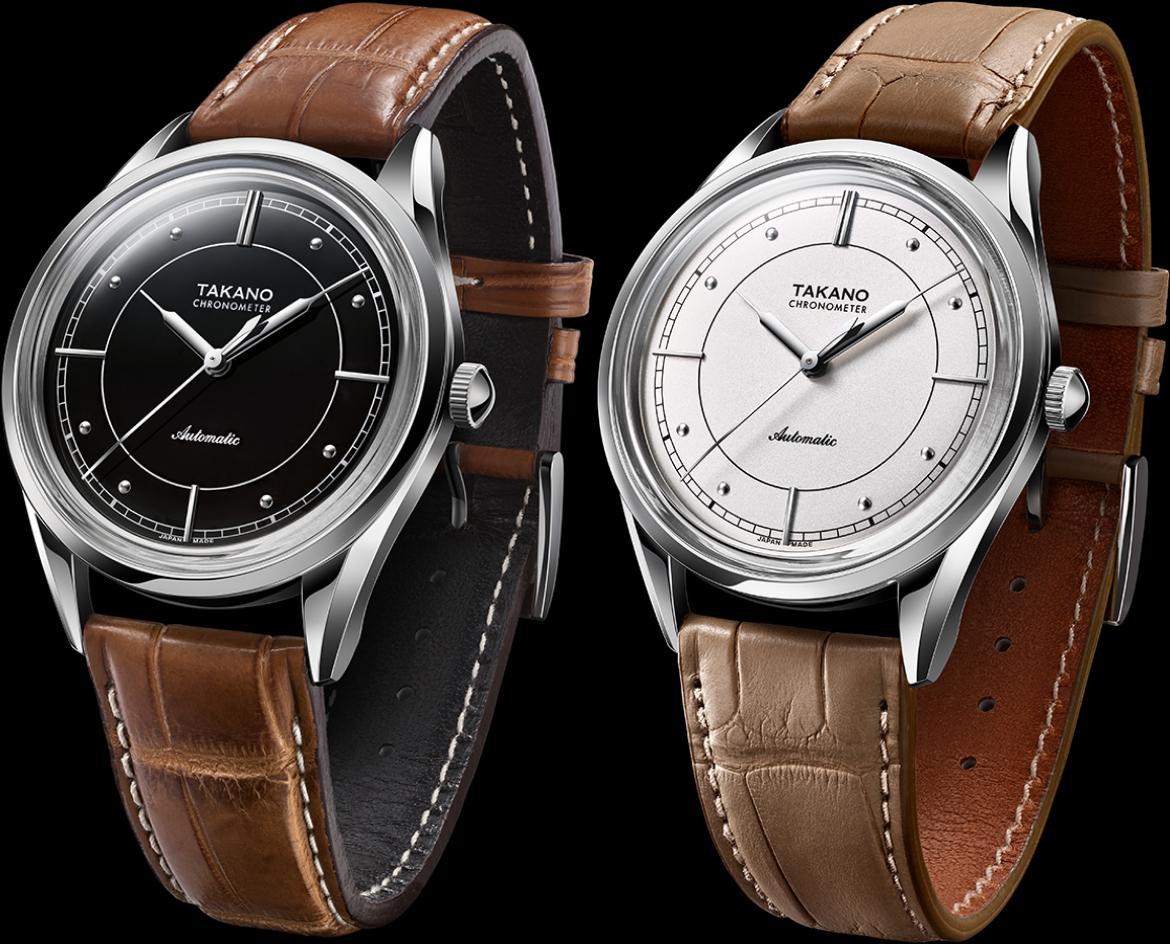
Takano
Takano is one of Japan's most historically resonant watch brands — a Nagoya-based manufacturer whose ambitions in the late 1950s directly challenged Swiss supremacy, whose brief existence produced genuinely exceptional watchmaking, and which was revived in 2024 by Hajime Asaoka — one of Japan's most celebrated independent watchmakers — as a mission to honour that legacy and carry it forward. The original company traces to 1899, when the Takano Metal Goods Factory was established. The name was changed to Takano Seimitsu Kogyo Co., Ltd. in 1938, and wristwatch production under the Takano brand began in 1957 with the 200 series — a refined version of a Dorowe-made calibre previously used by German brand Laco, modified under the technical guidance of Richard W. Slaw, Chief Watchmaker at Hamilton in the United States. Takano's aspirations were expressed with remarkable directness in the inaugural issue of the TAKANO REPORT, a booklet sent to customers: 'We are striving to create an era that challenges the belief that luxury watches can only come from Switzerland.' The factory operated under constant temperature and humidity conditions, housed Swiss precision automatic lathes and vertical drilling and milling machines, and received a visit from Prince Takamatsu in October 1958 — a mark of institutional recognition for its standards.
The Opal (1959) was the smallest Japanese-made watch of its time, featuring a Breguet overcoil hairspring. The Chateau (1960) — named for Nagoya Castle using the French equivalent to evoke elegance — was the brand's technical apex: an entirely in-house self-winding calibre 541, just 3.5mm thick, which was at the time the world's thinnest centre-seconds movement with a co-axial design between the second and fourth wheels. The Chateau Nouvel followed in 1961, adding the Kif-Flector shock-absorbing system. The Chateau Calendar, introduced in February 1962 as the first date model, was the last watch released under the Takano name. On 1 April 1962 — fewer than two months later — management was transferred to Riken Optical Co., Ltd. (later Ricoh), ending the brand after just five years of wristwatch production.
In 2024, Hajime Asaoka — founder of Hajime Asaoka Studio and the creator of the Tsunami, Tourbillon, and Chronograph, widely regarded as the most technically accomplished contemporary Japanese independent watchmaker — undertook the revival of Takano under Tokyo Watch Precision (PWT — Precision Watch Tokyo), the company through which he operates his manufacturing and watchmaking activities. Asaoka's decision to revive Takano rather than simply continue under his own name reflects a belief in the value of the historical legacy the brand carries: its stated ambition to make Japan a world competitor in fine watchmaking, expressed in 1957 and still unrealised when Takano disappeared in 1962, could now be fulfilled with the tools and knowledge of a new century. The revival's first model draws its name directly from the brand's own history: the Chateau Nouvel Chronometer — a direct homage to the 1961 Chateau Nouvel — reconnects the new Takano to the high point of the original brand while adding a technical dimension the original never achieved. The most significant distinction between the revived Takano and a conventional modern watch is where the movement adjustment is performed: Asaoka personally adjusts each balance wheel at PWT, removing it from the movement and carefully removing minute amounts of material from specific points on its rim to minimise positional error — the difference in rate between the watch lying flat versus standing upright in various positions. This delicate hand-calibration is the watchmaker's most exacting individual contribution to each piece's performance, and it is what makes the subsequent Besançon certification meaningful rather than merely administrative.
The Chateau Nouvel Chronometer is a 37mm automatic in stainless steel, water resistant to 3ATM, powered by a 24-jewel movement beating at 4Hz (28,800 vph) with a 40-hour power reserve — available in white or black dial. After Asaoka's personal adjustment at PWT, each movement is placed in a specially designed anti-magnetic transport case and sent to the Besançon Observatory in France — one of the world's most rigorous chronometer certification bodies, with origins in the centuries-old tradition of French observatory testing that dates to the era of John Harrison and the 1714 Longitude Act. The Besançon certification is considered stricter than COSC in several respects, requiring measurements across multiple positions and temperatures against an atomic clock reference. Passing this test as a Japanese domestic watch is, according to Takano, a historic first: no Japanese-made mechanical wristwatch had previously satisfied the Besançon chronometer standard. The initial pass rate at Besançon was approximately 30%, with Asaoka refining his adjustment technique progressively to improve that figure with each production batch. The watches are sold directly through Takano's own online shop at JPY 880,000 including all shipping and handling fees, with the Besançon chronometer certificate accompanying each piece.