A.Birchall Watchmaker
A.Birchall Watchmaker is a Japan-based independent atelier built around a watchmaker who studied the craft formally in France and spent more than fifteen years working professionally as a watchmaker before beginning to create pieces entirely under their own name. That French training and the many years of hands-on professional practice that followed give the work a particular character: it draws on an international lineage of watchmaking tradition, but is now expressed through a deeply personal, manual approach to construction, carried out largely on manual machines rather than automated production equipment. Every stage of the watch — from the smallest regulating components to the case that houses them — passes through the watchmaker's own hands, using lathes and milling machines operated manually rather than by CNC, a working method that most contemporary manufacturing, even at the higher end of independent watchmaking, has long since automated away.
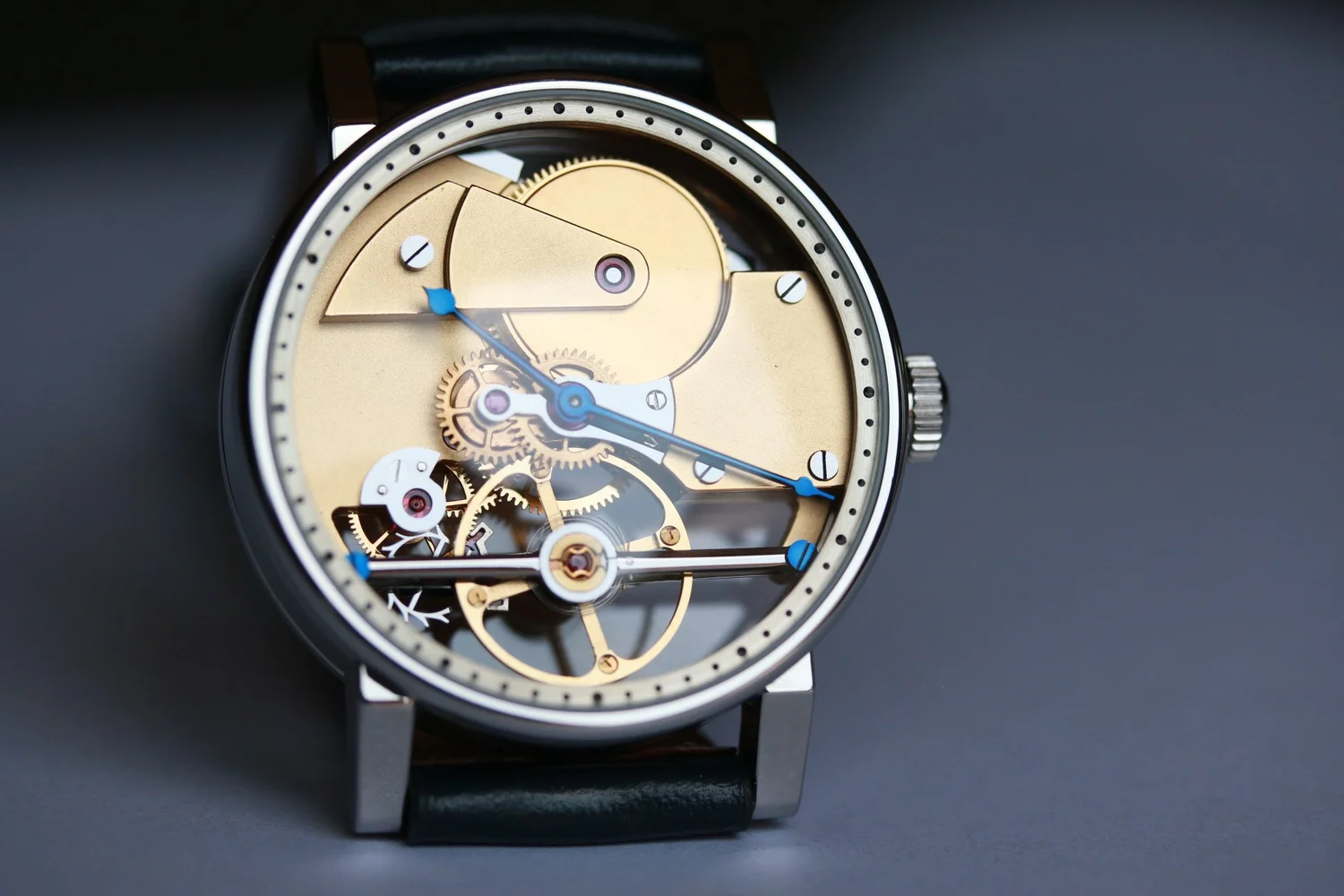
The debut creation is the Pièce d'essai N.00 — French for 'test piece' or 'trial piece,' a name that signals both modesty and intent: this is a first, foundational statement rather than a finished commercial collection, an étude in the truest sense, built to prove out a complete approach to hand construction before further pieces follow. The watch is entirely handmade, built around a 30mm movement with a gold-plated frosted mainplate and bridges — frosting being a traditional finishing technique in which the metal surface is given a fine, matte, granular texture via manual application of an abrasive slurry, producing a soft, non-reflective depth very different from polished or Geneva-striped surfaces. The setting mechanics bridge is made from beryllium copper, prized in fine watchmaking for its combination of strength, corrosion resistance, and non-magnetic properties. The bridges themselves are finished in black polish carbon steel — one of the most demanding hand-finishing techniques in watchmaking, in which a steel surface is polished to such a degree of flatness and refinement that it appears jet black when viewed head-on and brilliantly reflective at an angle, revealing any imperfection instantly and therefore forgiving no shortcuts. The balance wheel is EcoBrass fitted with four gold counterweights for precise poise adjustment, paired with blued steel hands — coloured through traditional heat-bluing rather than chemical treatment. The dial is German silver, also known as nickel silver, a copper-nickel-zinc alloy prized in high-end watchmaking for its hardness, warm tone, and resistance to tarnishing, here finished with a visible pattern of drilled apertures around its circumference. The finished case is 35.40mm in stainless steel.
The Making the Watch section of the atelier's own materials documents this construction process component by component: the balance wheel, described as 'the heart of the watch'; the pallet fork, shaped and fitted by hand under a loupe with fine tweezers and engraving tools; the mainspring barrel; the steel bridges, taken through a multi-stage process from rough-machined blank to finished, inspected component; and the setting mechanism bridges and parts that govern how the crown interacts with the going train. Photographs of the workshop show a green manual lathe and a milling machine as the core tools of production — unautomated equipment that places the accuracy of every cut and every surface directly in the watchmaker's hands, cut by cut, rather than delegated to a programmed machine. This is watchmaking practiced at its most fundamental level: a single craftsperson, trained in the French tradition and matured over fifteen years of professional experience, building a complete mechanical watch from raw stock using manual tools, and presenting the result — for now — as a single, unrepeated trial piece rather than a numbered production series.