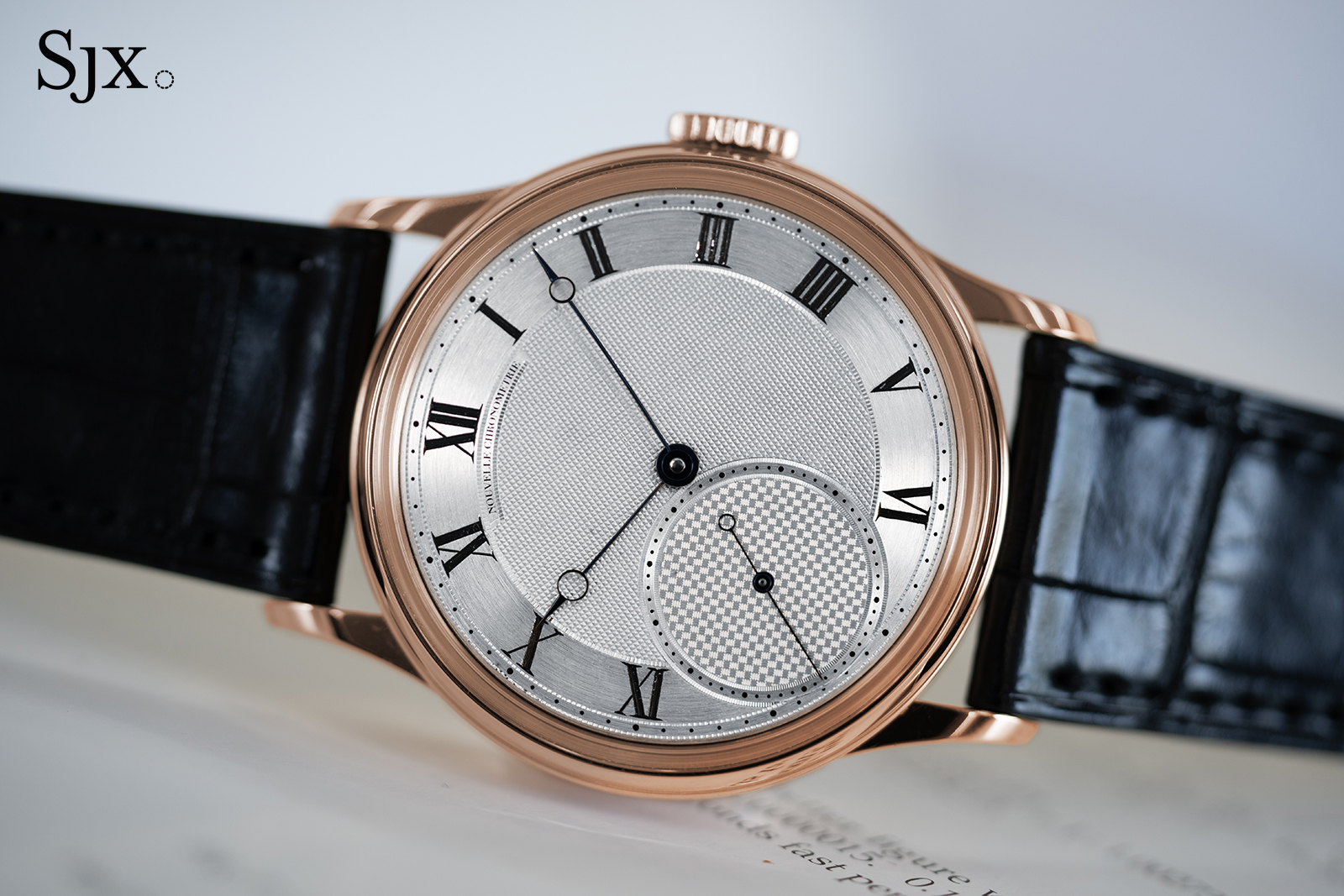
Nouvelle Chronometrie
Nouvelle Chronometrie — French for 'modern chronometry' — is a Japanese independent watch atelier founded by Noritaka Sakurai, a longtime watch collector who had previously served as chief financial officer at Hajime Asaoka's watchmaking outfit until 2020, before leaving to found his own brand alongside a small group of partners he has chosen not to name publicly, in part because some of them work for other watch companies. Sakurai has explained his own motivation simply: he wanted to make the watches he wished he could afford but couldn't, so he built a company to make them himself. The brand's design philosophy is expressed across three Latin principles: Venustas (Beauty), inspired by the exterior grandeur of Abraham-Louis Breguet's pocket watches, translated and recreated within the scale of a 38mm wristwatch, with careful attention paid to 18th- and 19th-century high-end pocket watch proportions — the barrel, gears, and balance wheel maximised within a movement diameter of just 32mm; Utilitas (Utility), pursuing the spirit and precision of observatory chronometers, grounded directly in horological theory that several of the brand's core members received from Shoichiro Komaki, who was responsible for developing competition chronometers at Kameido Seikosha in the late 1960s, expressed through oversized gears and a large-inertia balance wheel comparable to those found in historical pocket watches; and Firmitas (Strength), reflecting the brand's own atelier, staffed by precision machinists — several with prior experience producing components for racing car engines — who bring that same advanced technical skill to the manufacture of movement parts.
The Montre Ordinaire is Nouvelle Chronometrie's debut creation and first in-house tourbillon, and by Sakurai's own account channels the spirit of mid-20th-century Swiss watchmaking with a strong dose of Breguet-derived aesthetics to create a genuinely classical chronometer wristwatch — deceptively 'ordinary' at a glance, in a crowded field of Breguet-influenced 1930s-proportioned independent watches, but distinguished up close by exceptionally fine hands and a movement that pays elegant tribute to 1930s observatory tourbillon architecture. Nouvelle Chronometrie designs and manufactures nearly every part of the case and movement in-house; only the escape wheel, mainspring, and hairspring are sourced from existing components — though even the hairspring carries inner and outer Phillips terminal curves, a refinement well beyond a basic off-the-shelf part. The going train, from second to fourth wheel, is machined from 18-karat rose gold plate, and the ruby bearings are cut from a saturated red material more vividly coloured than pigeon's-blood rubies, evoking the vibrant jewels found in fine 19th-century pocket watches. The dial is made by J.N. Shapiro, densely covered in guilloché engraving that reflects the influence of a Breguet pocket watch Sakurai once personally owned, with a widened small-seconds subdial at 7 o'clock and hour and minute hands made as thin as the design would allow. The steel tourbillon bridge is CNC-milled before being entirely refined and finished by hand; heat treatment and plating are also conducted in-house, and every finished movement is hand-adjusted and assembled by the atelier's watchmakers.
The Montre Ordinaire's calibre NC01 A04 runs at 18,000 vibrations per hour (2.5Hz), hand-wound, with a 52-hour power reserve and 19 jewels, housed in an 18-karat gold case measuring 38mm in diameter and 11mm thick (46.3mm lug-to-lug), with a sapphire crystal and 3 ATM (30m) water resistance. The First Edition is limited to 20 pieces, priced at JPY 30,000,000 excluding tax (approximately USD 200,000), available directly through Nouvelle Chronometrie; production versions carry chronometer markers at the 30- and 40-second positions of the small-seconds subdial, a refinement not present on the earliest prototype dials shown publicly.