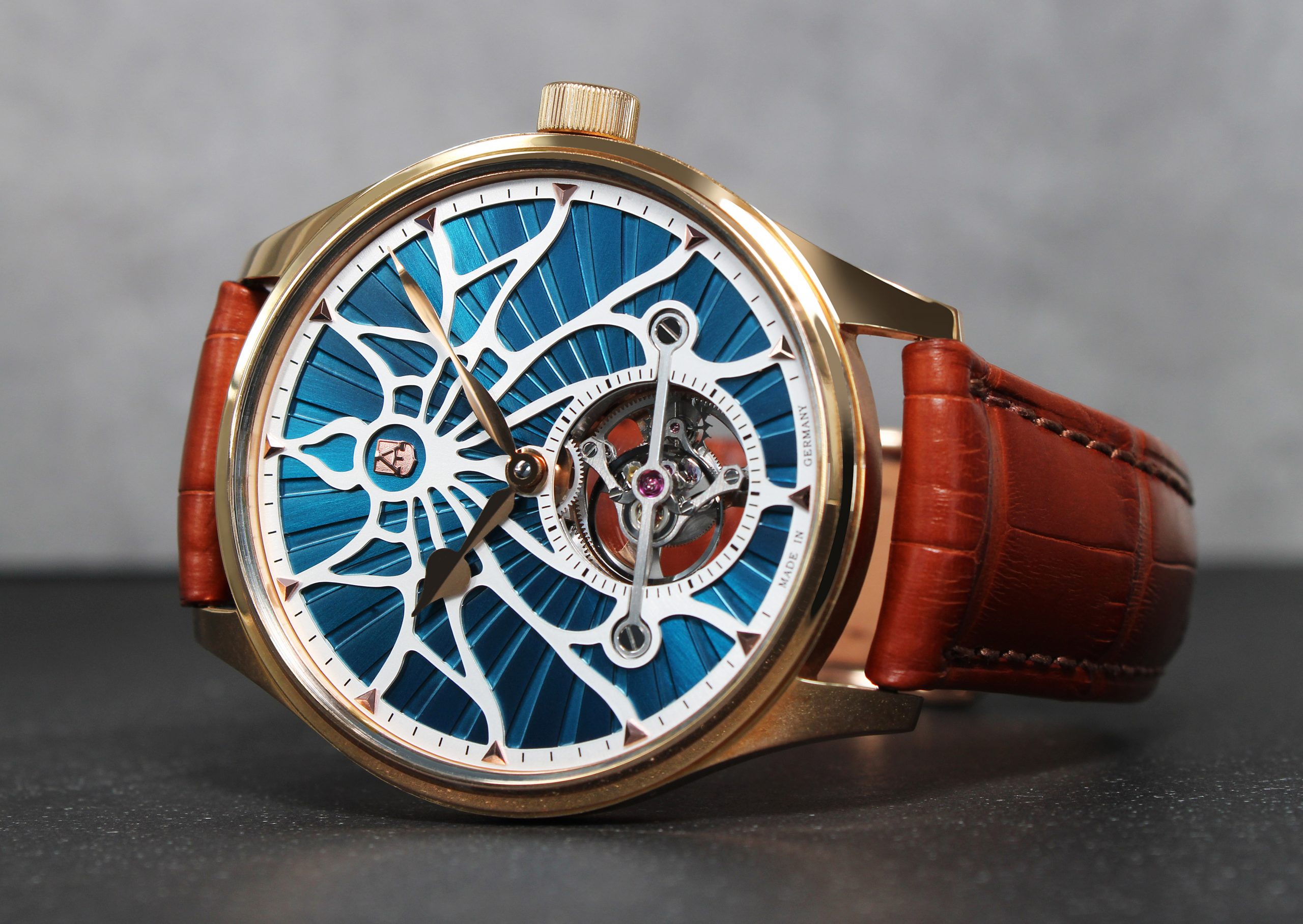
Alexander Shorokhoff
Alexander Shorokhoff is the boldest colorist in German watchmaking — a family-run Bavarian manufactory whose motto, 'Art on the Wrist,' announces watches that are the polar opposite of Germanic minimalism: exuberant, provocative, painterly, and defiantly individual. Founder Alexander Shorokhov was born in Moscow in 1960, trained as a civil engineer, and studied architecture — where he developed his flair for shape and color. His path west came through history itself: in 1991, under an agreement between Chancellor Helmut Kohl and President Mikhail Gorbachev, he was among twenty young Soviet managers sent to Germany to study the free-market economy at the Hessian Ministry of Economics. Within a year he had founded a company distributing Poljot — then Russia's largest and most important watch brand — across Europe, and by 1994 he had launched his own first brand, Poljot-International, designing original dials, hands, and movement decorations around Poljot calibers. But half measures were never his style: in 2003, in the idyllic Bavarian town of Alzenau, he founded the manufactory bearing his own name — with the double 'ff' spelling deliberately preserving his Russian roots. The synthesis is the brand's soul: a thousand years of Russian art and culture fused with German precision, run today as a family affair with his daughter Inga at his side.
The manufactory's methods justify the 'Made in Germany' on every dial: each movement is completely disassembled, overhauled, upgraded, and decorated in-house — hand engraving of rotors, bridges, and cases is the house hallmark — and each master watchmaker is responsible for a watch from start to finish, signing a final certificate recording its rate deviation, amplitude, and water resistance alongside the numbering of the (almost always limited) edition. The catalogue is a museum of inspirations. The Heritage collection honors the giants of 19th-century Russian culture — Tchaikovsky, Pushkin, Tolstoi, and Dostoevsky (whose models wear a roulette motif, a wink at the writer's gambling demons). The Avantgarde collection, launched in 2011 and now nearly forty models strong, was the turning point that made the brand's name: the Kandinsky-inspired Kandy in its rounded 41mm square case, the Klimt-tribute Crazy Eyes and Crazy Balls, the Neva with wave guilloché evoking St. Petersburg's river and an 'N'-shaped seconds hand, the astrology-laced Babylonian, the plaid Karo chronographs, and the bestselling Miss Avantgarde. A signature quirk unites nearly all of them: a large '60' where the '12' should be. Technical ambition scales with the art — from the jumping-seconds Avantgarde Crossing in rose gold to full calendars like the Cadamomo and gold tourbillons around €50,000 — while entry pieces such as the Vintage collection's Lucky 8 keep the door open near €1,300. Bespoke customization and private-label programs extend the atelier's craft to individual clients and other brands.
Recognition has been relentless: competing since 2012, the manufactory has collected nominations and awards every single year — the German Design Award (winner in 2018 with the Camomile; Special Mentions for Barbara in 2016 and Winter in 2017; nominations for Miss Avantgarde, Babylonian I, and Kandy), the iF Design Award, the New York Design Award, third place in the prestigious Goldene Unruh readers' poll (2017, Regulator AS.R02-1), and a 2024 International Architecture and Design Award for the Cadamomo Full Calendar. Robert Redford wore an Alexander Shorokhoff chronograph on screen. At roughly 2,000 watches per year, with prices from about €1,300 to €5,000 for most models, the brand has cracked a code few even attempt: genuinely artistic, hand-finished mechanical watches, in small numbered editions, at prices real collectors can reach — an explosion of Russian soul, built with German hands.