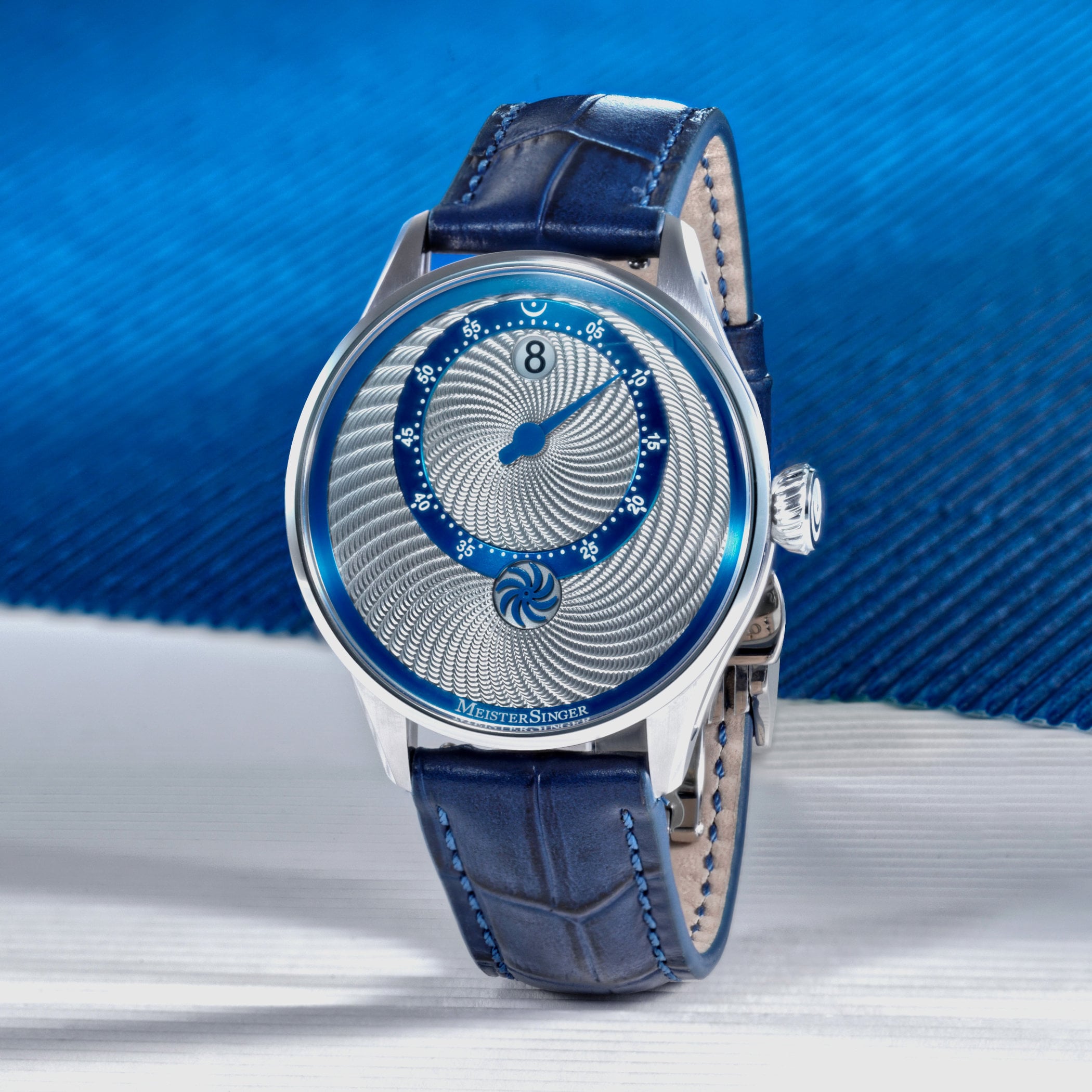
MeisterSinger
MeisterSinger is a German independent watch brand founded in 2001 by Manfred Brassler in Münster, the bicycle-oriented university city in Westphalia, and built entirely around one radical, historically grounded proposition: the single-hand watch. Brassler — a self-taught designer who came to watchmaking from outside the industry — set out to create a brand that returned to the very beginnings of the art of timekeeping, before the pressures of industrialisation added minute and second hands and transformed clocks from instruments of daily orientation into instruments of anxiety. Up to the 18th century, all clocks and watches — church towers, townhouses, table clocks, wall clocks, the first portable timepieces — were fitted with just one hand. Historical single-hand tower clocks survive to this day at Westminster Abbey in London, Toledo Cathedral, Delft City Hall, and the Freiburg Minster. MeisterSinger's founding insight was that this original way of experiencing time is not a limitation but a liberation: a relaxed, intuitive approach to reading the moment itself rather than the relentless minute-by-minute countdown of modern life.
Telling the time on a MeisterSinger takes only a little practice before becoming instinctive. A single hierarchically designed scale of 144 five-minute lines runs around the edge of the dial; the hour hand's tapered needle tip points to this scale, allowing the time to be read to within five minutes in a single glance — or, with attention to the shorter quarter-hour and half-hour markers between each pair of numerals, to the nearest minute. The scale uses double-digit hour numerals with preceding zeros for single-digit hours (01, 02, 03 and so on), referencing the aesthetics of early measuring instruments. All MeisterSinger dials carry the fermata — the musical pause symbol — as a distinctive hallmark on both dial and crown, embodying the brand's core philosophy: that a glance at the watch should prompt a moment of stillness rather than urgency. The case design, originated with the N° 01 of 2001 and still recognisable across every model in the range, uses a classic body with a one-sided domed front glass that visually pulls the dial beneath the crystal. These individual details combine to form an amazing visual experience; as Chronos magazine wrote at the brand's launch, one senses that if any one of those details were missing, the overall impression would no longer be quite the same.
The brand's administrative and design headquarters remain in Münster; all watches are individually manufactured in Switzerland to strict Swiss Made standards, powered exclusively by high-quality Swiss movements including Sellita calibres. Brassler has also fulfilled a deeper ambition by developing MeisterSinger's own in-house movements: the MSH01 (hand-wound, twin mainspring barrels, 120 hours power reserve), MSH02, and MSA01 (automatic equivalent), whose bridge architecture is designed to resemble the silhouette of an old German oak tree and whose rotor merges the technical and aesthetic ideals of the brand. The MSH01, when launched, became the first hand-wound movement ever to win the German Design Award. MeisterSinger has also developed proprietary technical modules including the large central moon phase of the Lunascope and Stratoscope models, and the 'sonnerie au passage' chiming complication of the Bell Hora — a gentle chime that sounds as time passes from one hour to the next, a nearly forgotten complication given contemporary form.
Since its founding in 2001, MeisterSinger has received 36 awards from the most prestigious design bodies — an extraordinary record for a specialist independent brand. These include multiple Red Dot Design Awards (N°01/1Z 2004, Singular 2009, Perigraph 2009, Singulator 2010, Pangaea Day Date 2013, Adhaesio 2016, MSH01 2015, Salthora Meta X 2018, Lunascope 2019, Unomat 2021, Bell Hora 2021, Edition Singularis Enamel 2023), iF Design Awards, German Design Awards, and Good Design Awards across more than two decades of consistent recognition. Key awarded models include the Astroscope (German Design Award, Red Dot, and iF 2020–21), the Lunascope (Red Dot, iF, German Design Award), the Circularis (iF 2015, German Design Award 2016), the Kaenos (iF Design Award 2025), and the Perigraph which also won Watch of the Year 2012. The current collection spans a wide range of case sizes, dial executions, and complication levels: the foundational N° 01 and N° 03 ranges; the Circularis and Circularis Power Reserve; the Pangaea Day Date; the Lunascope and Stratoscope (moonphase); the Bell Hora (sonnerie au passage); the Primatic; the Unomat; the Astroscope; the Neo and Neo Plus with pointer date; the Vintago; the Singularis (housing the in-house MSH01 and MSA01 calibres); the Kaenos; and the Souscription series. A collaboration with the celebrated French watch designer Alain Silberstein produced the Kaenos Editions — two limited runs of 225 pieces each (Grand Date and Open Date), combining Silberstein's Bauhaus-influenced bold colours and geometric shapes with MeisterSinger's disciplined single-hand design language, on a jet-black dial with a golden second hand, in the new 40mm Kaenos case with integrated bracelet.