Andreas Strehler
Based in Sirnach, Switzerland, Andreas Strehler is one of the most quietly inventive minds in independent watchmaking — a watchmaker who finds creative solutions to horological problems like no one else. He apprenticed in Frauenfeld and at the watchmaking school in Solothurn from 1987, then spent four years as head prototypist at Renaud et Papi, the legendary complications atelier, before going independent in 1995, initially restoring clocks and antique watches. His own inventive streak surfaced almost immediately: the 1998 Tischkalender, exhibited at Baselworld, was the first watch with a mechanical memory, a fresh interpretation of Breguet's Sympathique, and earned him his first patent (CH693155, for alternative display); the Zwei (1999) followed as the first mechanical pocket watch with switching indications, and a second patent (CH695174, for a compensating carbon balance) arrived in 2000. In 2005 he founded UhrTeil AG, the engineering and manufacturing arm behind both his own watches and, discreetly, some of the finest movements in the industry: the Chronoswiss Chronoscope (2002, Watch of the Year 2003), the perpetual calendar movement that became H. Moser & Cie.'s calling card (development begun 2003), Maurice Lacroix's first manufacture movement, Le Chronographe (2006), and the digital-style Harry Winston Opus 7 (2007), built on his own alternative-display patent.
His signature is the 'Papillon' (butterfly) — a distinctive butterfly-shaped main bridge running through his movements, an emotional design meant to make the movement feel like a living organism, introduced in 2008. Five years later came the Sauterelle (2013), incorporating his patented remontoir d'égalité — a constant-force mechanism attached to the seconds wheel rather than the escape wheel, where torque is weakest, delivering identical energy to the escapement every second while simultaneously displaying dead-beat seconds. That same year, Strehler received the Prix Gaïa in the Artisanat-Création category — one of watchmaking's most prestigious honors, previously awarded to Philippe Dufour — for movements its jury called true living organisms. His crowning technical achievement followed in 2014: the Sauterelle à Lune Perpétuelle, a moon phase indication accurate to within one day after 2,060,000 years, calculated by Professor Robert Baggenstos and turned into a gear train by Strehler, earning a Guinness World Record that stood for a decade.
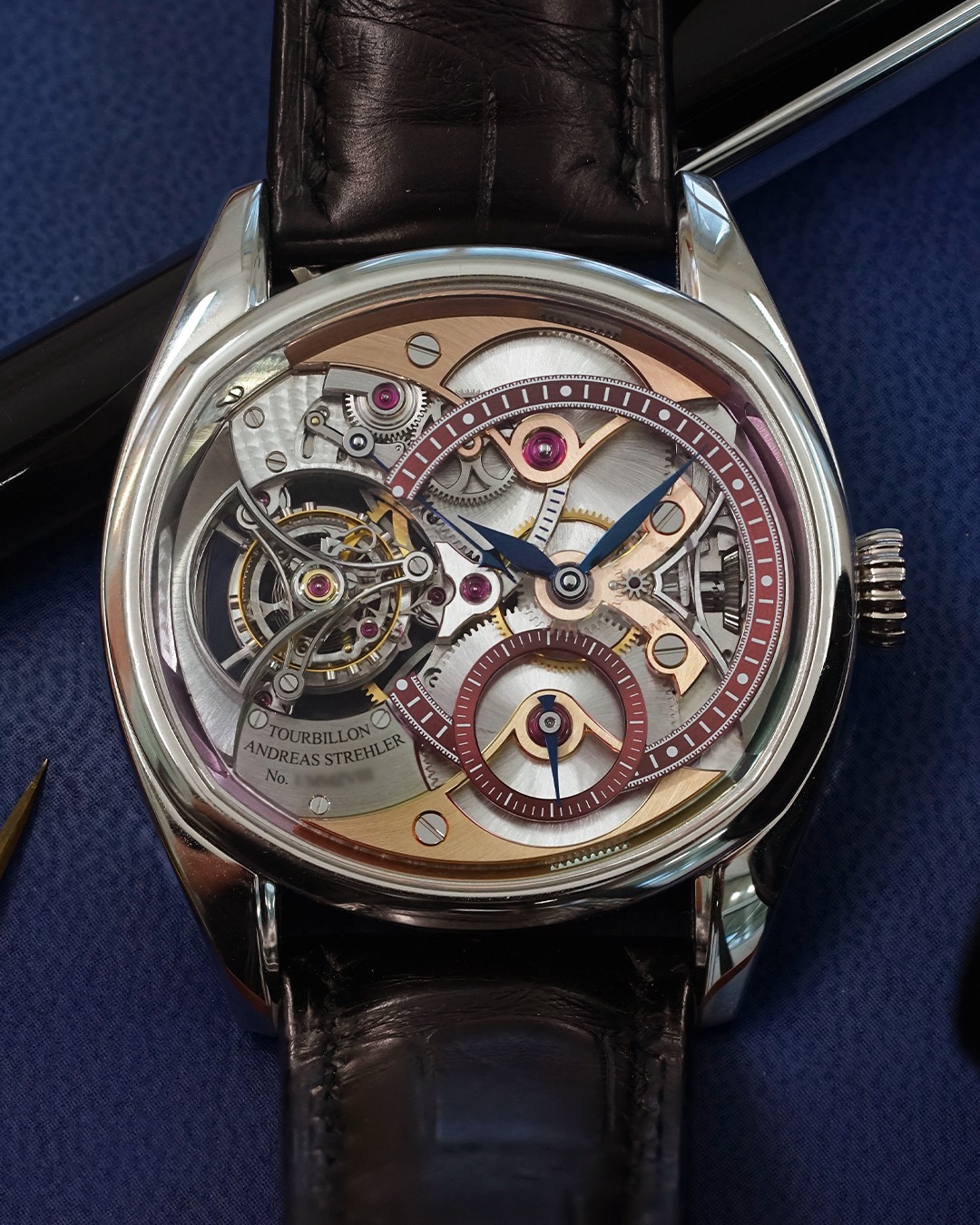
The Lune Exacte (2016) solved moon phase legibility itself with a patent-pending Vernier-scale indication readable and settable to within three hours at any time, not just at new or full moon; the Time Shadow (2016, limited to 8 pieces marking his 8 movements to date) reimagined how time is read entirely; the Sauterelle à Heure Mondiale (2017) added a 3D northern-hemisphere GMT display and a worldtime disc to the same remontoir architecture; and the Trans-Axial Tourbillon (2018) combined a tourbillon and remontoir d'égalité on a single axis, the remontoir seated beneath the tourbillon to produce a dead-beat seconds visible through the caseback. Along the way he collaborated with fellow independent Kari Voutilainen on the Chapter Three Reveal for Maîtres du Temps (2012).
Beyond his own name, Strehler undertakes rare bespoke commissions — the Jardin des Papillons and Etang des Koï among them, nature-themed pieces built entirely to a client's own vision. And in 2023, wanting to share his passion more broadly, he launched a second, distinct brand called simply STREHLER: more attainable, in-house-developed watches built in the same Sirnach workshop by his team of watchmakers, aimed at 'belle horlogerie' rather than the high-horology marvels bearing his own name. Its debut, the Sirna, pairs a 40mm steel case with the in-house SA-30 automatic caliber (60-hour reserve) and a laser-engraved, hand-polished titanium dial anodized in a fade-resistant blue, its pattern designed with Eric Giroud. STREHLER is a genuinely separate house — with its own listing in this catalogue — but its DNA, like everything to come out of Sirnach, traces back to one uncommonly inventive watchmaker. All watches bearing the Andreas Strehler name remain entirely hand-made and hand-finished by Strehler personally, in extremely limited numbers.