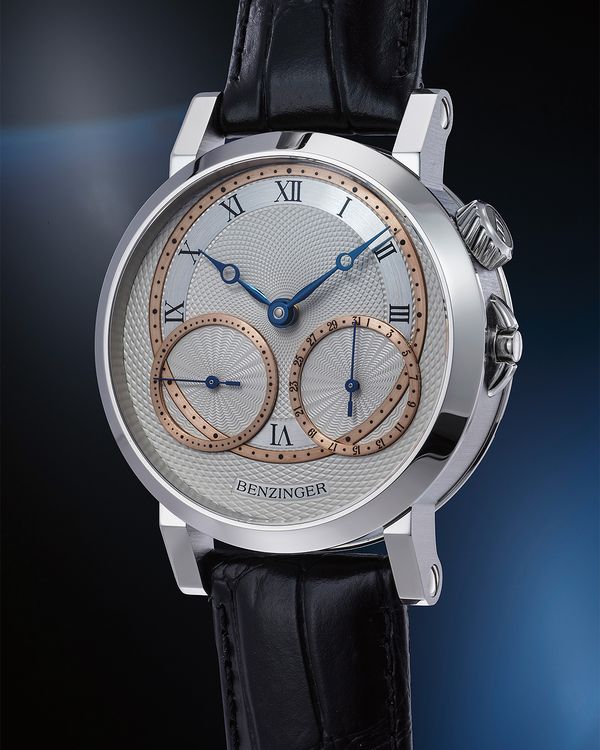
Benzinger
Jochen Benzinger, born in 1961, began his training in 1978 at the Pforzheim Goldsmiths' School in the heart of Germany's historic jewelry- and watchmaking district on the edge of the Black Forest. He fell for the centuries-old craft of guilloché — hand engine-turning — while still a student, completed his master's examination with distinction, and opened his own workshop in 1984. Today he is widely regarded as Germany's foremost specialist in guilloché, hand engraving, and movement skeletonization, and one of the very few people left in the world who still practices these crafts almost entirely by hand on machines that are frequently over a century old, with no stamping, no CNC, and no copies. For more than thirty years the House of Fabergé has called on him for the engraving and guilloché work on its legendary Imperial eggs; he has also cut the guilloché dials for Rolls-Royce's dashboard clocks on select eighth-generation Phantom models, made rotors for Christiaan van der Klaauw, and supplied dials, engraving, and skeletonization work — under NDA, and so rarely credited publicly — for brands including IWC, Chronoswiss, Glashütte Original, and Moritz Grossmann.
Every Benzinger Uhrenunikate ('watch unique pieces') watch is custom-made to order rather than produced as a catalogue run. A client begins with one of the atelier's architectures — the regulator-dial Regulateur models, the openworked Skelett and Vollskelett pieces, the historically inspired Subskription series revived from 19th-century pocket-watch dial layouts, or the in-house GAP 1 and GAP 2, built on a manufacture hand-wound calibre co-developed with the Austrian watchmakers Habring² — and then works with Benzinger to choose dial metal and guilloché pattern (often a 'Breguet frost' grain cut in homage to Abraham-Louis Breguet, whom Benzinger cites as his chief inspiration), case finish, hands, and strap. Dials are typically cut from solid sterling silver on antique rose-engine and straight-line engine-turning lathes, line by line, a process that alone can take many hours per dial; movements are hand-guillochéd, rosé-gilded, and rhodium-plated, with flame-blued screws and crown wheels and Breguet-style blued steel hands throughout. Because no two hand-cut guilloché patterns are ever truly identical, every finished watch is, by definition, one of a kind — the atelier states plainly that a watch ordered today will not be exactly reproducible tomorrow, even to the same specification.
Benzinger now works alongside a small team of two assistants in Pforzheim, primarily on skeletonization work, while keeping local watchmakers busy with assembly and finishing. Commissions typically take six months or more to complete, with the atelier sending progress photos throughout, and span the full range of the collector market, from four-figure engraved components to fully bespoke unique pieces well into six figures. He has also collaborated under his own name with other independent and small-batch makers — supplying hand-guillochéd dials for Towson Watch Company's Benzinger Choptank in the United States, for example — and lent his engraving and finishing expertise to the Jaeger & Benzinger brand he co-founded in Baden-Baden as a more accessible expression of the same craft.