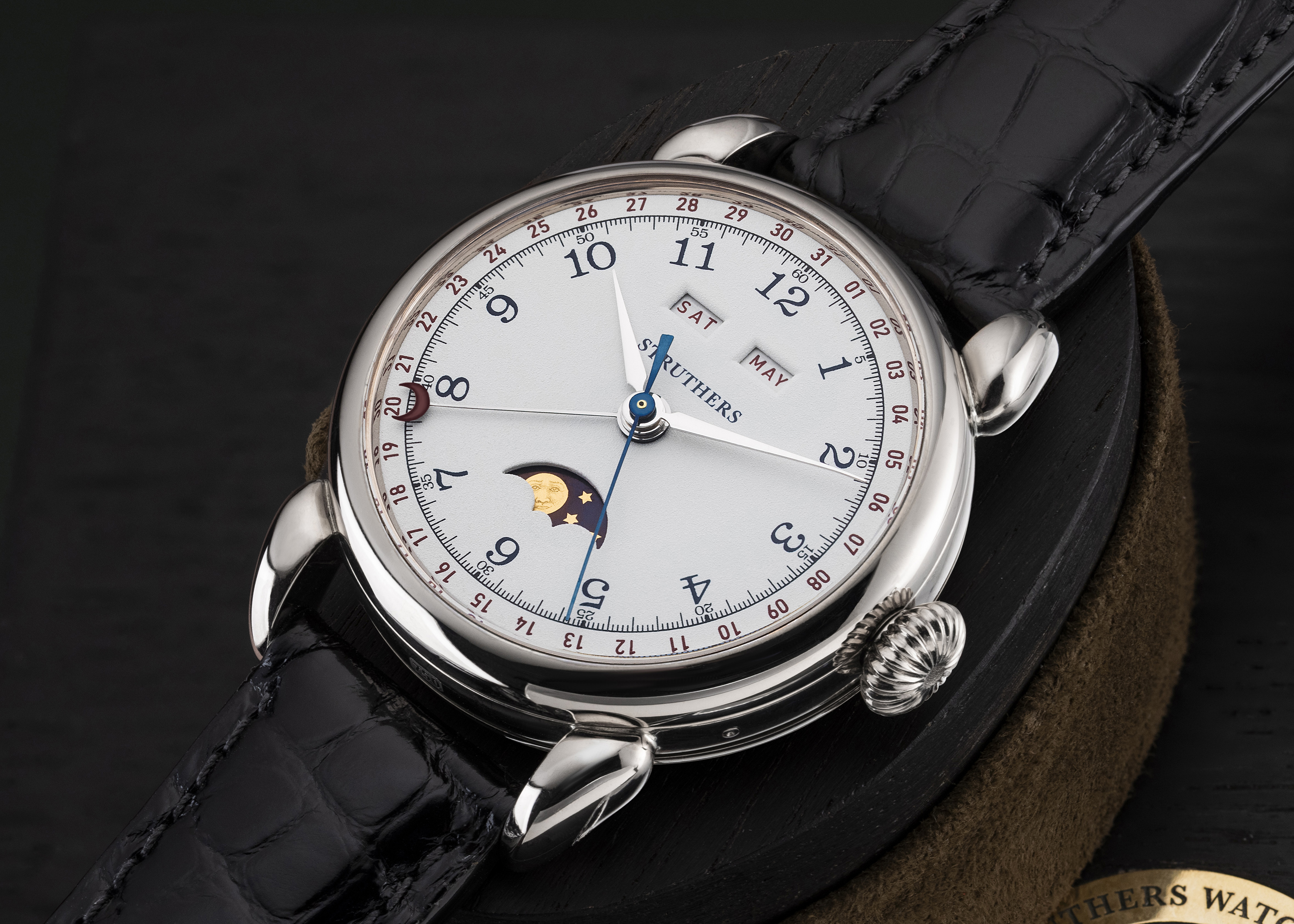
C. & R. Struthers
Struthers Watchmakers was founded in 2012 by husband-and-wife partnership Craig and Rebecca Struthers, who between them combine more than 40 years of experience in vintage and antique watch restoration with formal training across watchmaking, goldsmithing, silversmithing, fine art, gemmology, and design history. Craig discovered watchmaking in 2004 after a lifelong interest in vintage mechanics — classic cars, motorbikes, and scooters — and studied the British Horological Institute course at the Birmingham School of Jewellery, where he built a reputation for patient, complex restoration work on antiquarian pieces. With no spare-parts supply for historic watches, he taught himself to make virtually every component in a mechanical watch by hand, training under some of Britain's finest vintage restorers and apprenticing a retired Mercer chronometer maker; in 2017 the Queen Elizabeth Scholarship Trust, sponsored by Johnnie Walker, awarded him a scholarship to train with one of the last traditional watch case makers left in Britain, a craft now practiced in only a handful of workshops, the Struthers' among them. Rebecca began her own watchmaking journey at 17 after training as a jeweller and silversmith, and in 2017 became the first watchmaker in British history to earn a PhD in the field, researching the development of the European watch industry through the 18th and 19th centuries — scholarship that now directly informs how every Struthers watch is designed and built. She is also an author: her first book, Hands of Time, was a BBC Radio 4 Book of the Week and an instant bestseller, and her 2025 children's book About Time, co-written with Alom Shaha, teaches curriculum science and history through watchmaking.
The Struthers' workshop occupies a restored 19th-century textile factory in the Staffordshire Moorlands, equipped almost entirely with named, decades- and sometimes century-old machines — among them Barney, a 1950s 10mm Pultra lathe used for traditional boxwood-process case making; Helga and Heidi, twin 1970s Andrä & Zwingenberger 8mm watchmaker's lathes (one for wheel-cutting, one Craig's daily workhorse for blanking barrels, arbors, and screws); Charlie, a 1960s English 8mm IME lathe dedicated to turning watch balance staffs, whose pivots measure a fraction of a millimetre; and Maus, a circa-1950 6mm Lorch lathe — Rebecca's favourite — now used for making the winding crowns on their own watches. Beyond their own bench, the Struthers maintain a network of independent UK and international artisans for specialist crafts such as engraving, enamelling and enamel micro-painting, rose-engine turning, and lapidary work. Before building watches under their own name the pair spent over a decade on bespoke and tailor-made commissions and restorations — including the Carter, Kelso, and Kingsley series, among them a run of watches built around vintage Valjoux 90 chronograph movements — accolades from that period now numbering more than a dozen, alongside television, radio, and press features in Britain and abroad.
In 2023, after eight years in development, the Struthers completed Project 248 — their first watch built entirely in-house — named, only half-jokingly, for '2 minds, 4 hands, and an 8mm lathe.' Project 248 deliberately picks up the British watchmaking tradition where it was interrupted in the late 19th century, reviving the commercially extinct English (ratchet-tooth) lever escapement, the truest surviving descendant of Thomas Mudge's original 1754 detached lever design, in which the pallets sit at a right angle to the escape wheel rather than the Swiss club-tooth form that displaced it. Shock protection is a fully functional parachute setting based on Abraham-Louis Breguet's circa-1790 pare-chute mechanism — a name borrowed from the contemporary parachute trials of Louis-Sébastien Lenormand. The First Edition's balance design references the work of George Daniels, with rocking-bar keyless work inspired by Derek Pratt, in a 39.5mm case with every component (other than jewels and the hairspring and mainspring) made in-house on the workshop's heritage machines.
The Second Edition refines the formula further: a slightly slimmer, 38mm case, an improved parachute setting, and the addition of antiquarian wolf's-tooth winding-wheel gearing — a stronger, more elegant tooth form dating to the 1770s, found historically in pieces by Patek Philippe and Louis Audemars and used today by some of the world's finest independent watchmakers — alongside further material and production refinements, and the workshop's first fully in-house-developed calibre. A Third Edition is in development. Every Project 248 watch is made strictly to commission, beginning with a conversation to establish the client's vision and typically taking up to 18 months from first sketch to delivery, with custom dial, engraving, and colourway options, and — over the years — more than a few personal details and secret messages hidden inside.