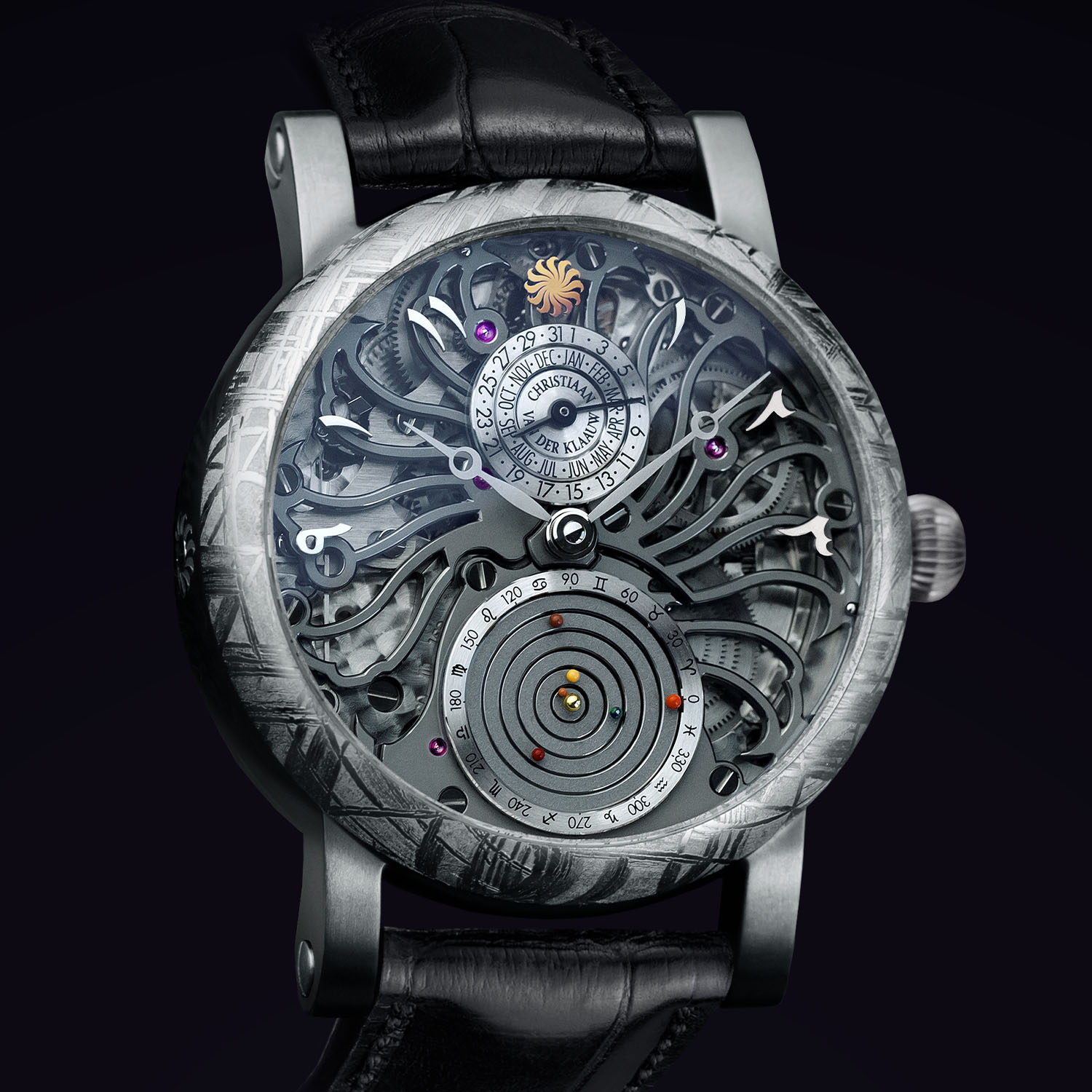
Christiaan van der Klaauw
The only atelier in the world dedicated exclusively to the design and production of hand-made astronomical watches. Founded in 1974 by master watchmaker Christiaan van der Klaauw — born in 1944 in Leiden, the city where Christiaan Huygens began his studies in 1645. Educated at the Leidse Instrumentenmakers School (LiS), he moved to Joure in 1967 to work with a producer of Friesian grandfather clocks before establishing his own atelier. His inspiration: Eise Eisinga (1744–1828), the Friesian wool comber who built the world's oldest working planetarium on the ceiling of his living room in Franeker, Netherlands — a model CVDK has honoured by recreating it as the world's smallest mechanical planetarium on a wristwatch. Awarded honorary AHCI membership in 1989; Basel Innovation Prize 1992 for his Pendule Variable clock.
Key milestones: Real Moon (1980 — first CVDK moon phase, based on the actual lunar surface); Satellite du Monde (1996 — first CVDK wristwatch); CVDK Planetarium (1999 — world's smallest mechanical planetarium on a wristwatch). In 2009 Christiaan handed control to designer Daniël Reintjes; CEO Pim Koeslag (former Patek-trained watchmaker and Technical Director at Frédérique Constant and Ateliers de Monaco) joined 2014. GPHG 2021 Calendar & Astronomy Prize. 2024 marks the 50th anniversary — celebrated with the Grand Planetarium Eccentric Manufacture. Current collections: Real Moon, Real Sky, Grand Planetarium, Joure. Named after their founder's inspiration, Christiaan Huygens — whose pendulum clock of 1656 transformed precision timekeeping.
CVDK's astronomical credentials extend well beyond its own dials: in 2014 the atelier supplied the mechanical astronomical basis for the Van Cleef & Arpels Midnight Planetarium, one of the Parisian maison's most celebrated men's watches — a quiet endorsement of the Dutch workshop's singular expertise. Ten years later came the crowning achievement of the anniversary era: the Grand Planetarium Eccentric, the first wristwatch to display all eight planets of the solar system orbiting the Sun in real time on eccentric (non-circular) orbital tracks, with Mercury completing its circuit in 87.97 days and Neptune requiring 164.8 years; first deliveries began at the end of 2024, with the manufacture version priced around a quarter of a million dollars. The planetarium module sits atop an exclusive CVDK automatic movement built on Andreas Strehler's CKM-01 base, and the model has already spawned extraordinary variants: a 2025 Meteorite edition whose case is machined from a genuine asteroid-core fragment that fell to Earth some 50,000 years ago — capped at three pieces, of which only two could be made from the available material, with an aventurine-glass dial ring set with fragments of a Martian nakhlite meteorite — and a three-piece Sincere Platinum Jubilee edition for the Singapore retailer. Meanwhile the classic Planetarium, still the world's smallest mechanical planetarium at 40 mm with its aventurine star-field dial, continues alongside the more accessible Ariadne and Real Moon lines, and one-off commissions like the fully skeletonised Planetarium 'Julie' of 2025 — built around a client's wish shared with his young daughter — show the atelier at its most poetic: a workshop where the solar system itself is the complication.