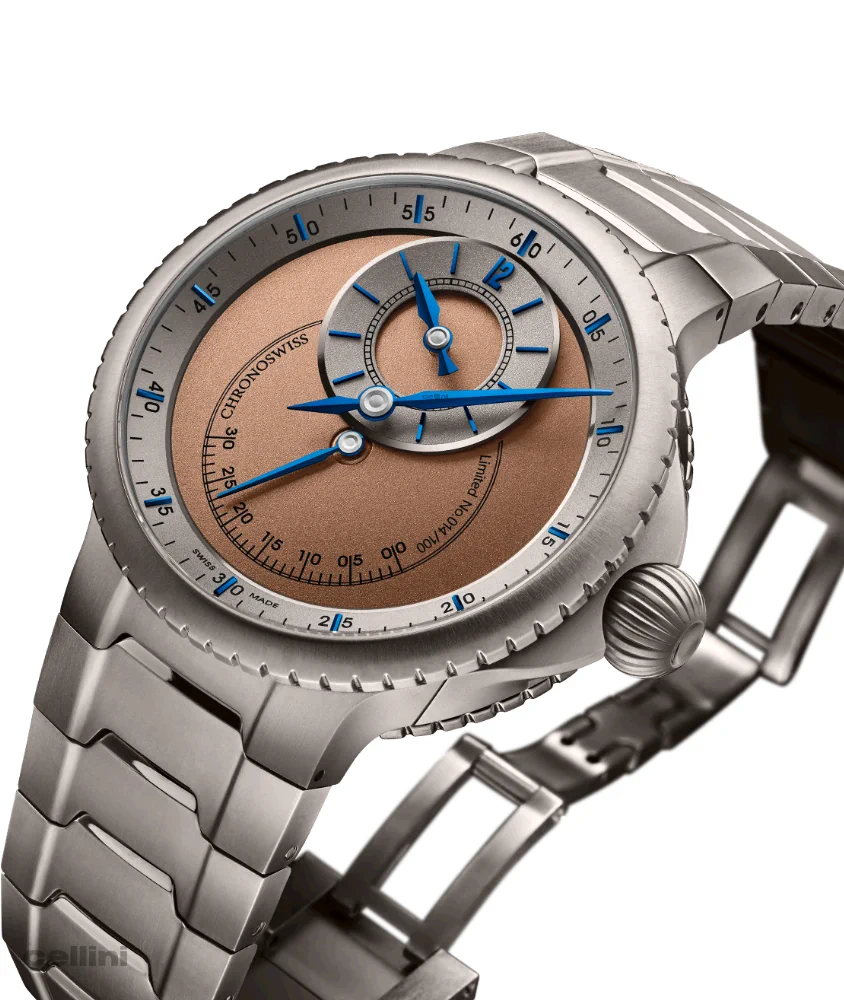
Chronoswiss
Chronoswiss was born not in calm — but in crisis. In 1983, master watchmaker Gerd-Rüdiger Lang, recently made redundant when Heuer closed its German branch (where he had worked since 1964 and witnessed the 1969 co-development of the first automatic chronograph with Breitling), defied the quartz crisis by founding his own brand in Munich with little more than a garage full of mechanical parts. The name: Greek 'chronos' (time) + 'Swiss' (tribute to Swiss watchmaking). His first watch was also the world's first mechanical chronograph with a moon phase indicator and a clear crystal caseback.
Chronoswiss found its signature in 1987 with the Régulateur — the world's first serially produced wristwatch with a regulator-style dial, separating hours, minutes, and seconds onto different sub-dials in the tradition of precision observatory regulators. This was followed by the Kairos Chronograph (1990, first automatic chronograph with decentralized hour and minute display), the Rattrapante, the Opus, and the Delphis jumping hour. In 2012 the brand was sold; it is now based in Lucerne as Atelier Lucerne (name on post-2012 dials). The DNA set by Lang continues: mechanical mastery, three-dimensional dials, innovative materials, architectural design. Current collections include the Open Gear Resec, Sirius, and Delphis. All watches are hand-finished.
The 2012 sale placed the brand with the Ebstein family, and under CEO Oliver Ebstein — with head of design and master guillocheur Maik Panziera, who joined in 2013 — Chronoswiss has reinvented itself as something rarer than its Munich-era self: a Lucerne atelier, open to the public, where nearly every artisanal craft is performed in-house. Hand guilloché is cut on century-old rose engines, and the workshop also practises grand feu and paillonné enamel, skeletonisation, perlage, and full T1-to-T4 assembly, along with quietly offered bespoke commissions. The modern signature is the three-dimensional 'Open Gear' dial — up to 42 components stacked on multiple levels, with skeletonised train-wheel bridges and floating funnel-shaped displays preserving Lang's regulator layout — often finished with a technique unique to the house: handmade guilloché coated by chemical vapour deposition, producing colour-shifting patterns like the palm-leaf moiré of the 50-piece Open Gear ReSec Jungle. The complications have scaled up too: the in-house hand-wound C.303 half-skeletonised flying tourbillon (60-hour reserve) anchors ever-bolder editions from an electric-blue original to the purple-and-Paraiba-green Tourbillon Psycho, while the PULSE GMT pairs a true dual-time movement with either hand-guilloché silver or paillonné enamel dials. Remarkably, entry to this world of genuine hand-guilloché still starts under €10,000 — nearly unheard-of at that price — which has made the reborn Chronoswiss one of the strongest value propositions in artisanal independent watchmaking, and a bridge between Lang's regulator heritage and a distinctly younger, colour-hungry generation of collectors.