CLEGUER Horology
CLEGUER Horology is the independent watchmaking debut of Mathieu Cleguer — a French-born movement construction engineer from Brittany, now based in Geneva, who spent over a decade developing calibres for other brands before launching his own name in 2026. Born approximately in 1991, Cleguer is 35 years old, and his background is that of the new class of independent watchmakers who arrive not from the traditional bench-trained route but from the engineering and movement construction side of the industry. His first formative exposure to the craft came during an internship at De Bethune, under Denis Flageollet — the movement legend who co-founded De Bethune after his years at THA alongside François-Paul Journe and who, by Cleguer's own account, turned him onto the entire craft and the rest was history. He studied micromechanics and watchmaking at HE-ARC in Neuchâtel between 2011 and 2014, then spent the following decade as a movement construction consultant, designing calibres from scratch for independent brands at the highest level — a career that included Akrivia (Rexhep Rexhepi's workshop), Breva, and a role as head of R&D at Emile Chouriet. This industry career was deliberately conducted behind the scenes, almost always constrained by non-disclosure agreements, making Cleguer well known within the professional watchmaking community but essentially invisible to the public.
The founding question of CLEGUER Horology, as stated on the brand's website, is: 'if each movement were built surrounding a key element, how would the watch look?' Each movement, in Cleguer's conception, tells a story — and the Inspiration series is planned to explore a series of different escapement architectures, one per reference, over the course of a lifetime of watchmaking. The brand's three-dot logo, visible on the dial, is a Celtic rune — a nod to his Breton origins; the name Cleguer itself is discreetly engraved on the inner flange, visible only on close inspection.
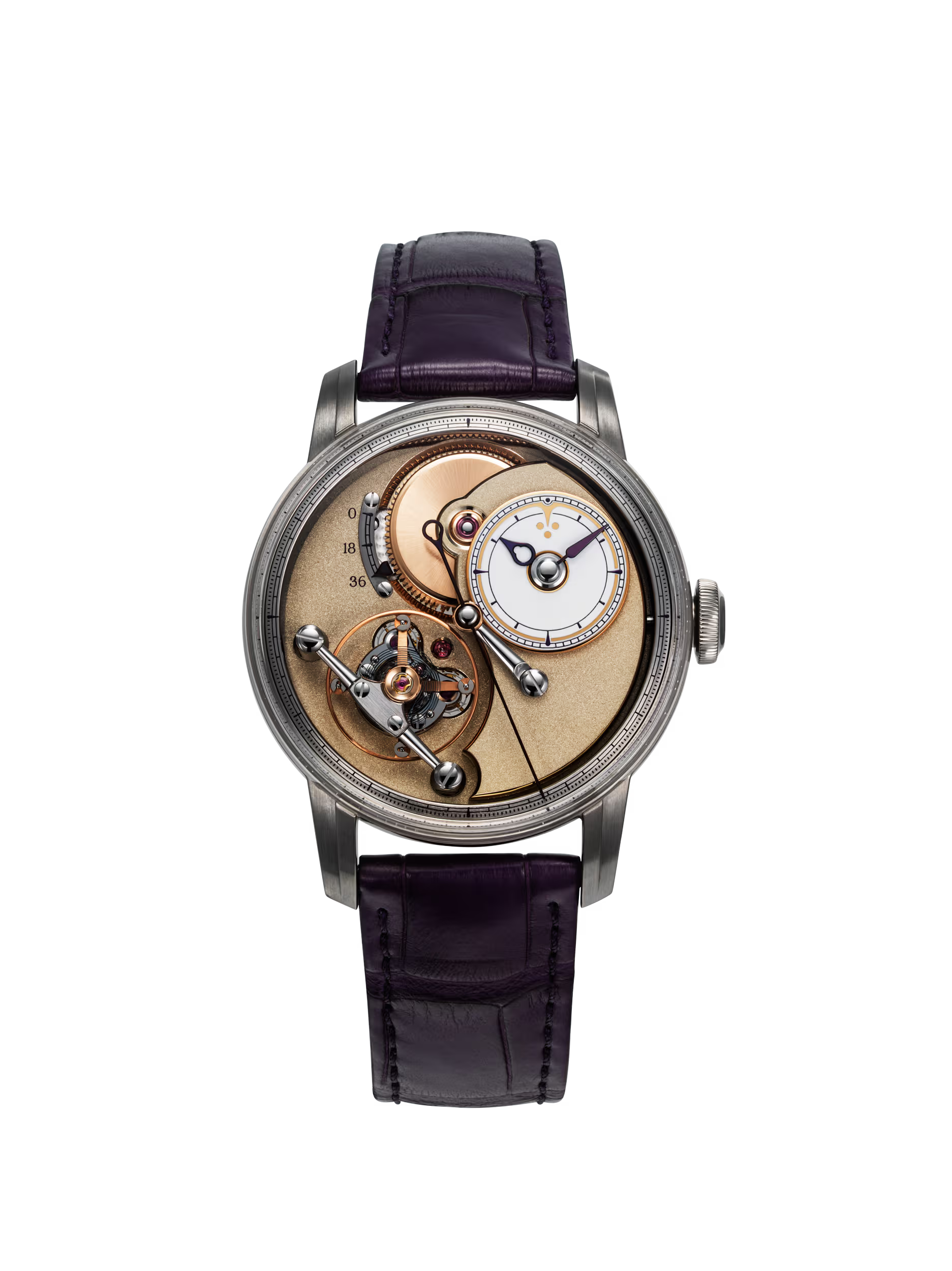
The Inspiration One was presented at Watches & Wonders 2026 and is the first reference in the Inspiration series — the inaugural exploration of the quest for chronometry. The watch's visual identity is defined by radical architectural openness: a layered, multi-plane movement construction whose components are selectively revealed or partially concealed, creating depth and intrigue that Cleguer describes in his own words: 'When you leave something to the imagination, it keeps people engaged — it makes them return to the piece again and again.' The decentred time display occupies a champlevé Grand Feu enamel subdial produced by the Swiss enamel atelier Blandenier — a small, warm disc of artisanal warmth within an otherwise technical landscape. An elongated central seconds hand sweeps above it. A power reserve indicator is positioned on the dial side, mechanically connected to the barrel and integrating its function directly into the visual composition. The 38.5mm × 12mm titanium case (48.2mm lug-to-lug, 19mm strap width) has a sapphire crystal on both front and back; the caseback view focuses on the gear train, ratchet click system, and Maltese cross stopwork, accented by a frosted bridge and Geneva-stripe mainplate.
The mainplate and bridges are German silver finished in alternating champagne and rhodium platings.
Steel components throughout are mirror-polished; bevels are rounded where geometry allows; the click wheel receives special attention — solarisation combined with sharply bevelled and polished ratchet teeth. Two bercé (rocked) steel bridges on the dial side are meticulously polished; the balance bridge is deliberately offset from its axis, allowing the stud holder to be hidden from view. The Souscription was limited to 12 pieces in titanium at CHF 56,000, all pre-sold through a subscription model that funded the development cost; future production in precious metals is priced at CHF 95,300. Total lifetime production of the Inspiration One is capped at 80 pieces — a production scale comparable to Rexhep Rexhepi's annual output. Deliveries of the Souscription are scheduled for the second half of 2026.
The technical core of the Inspiration One is the Innate escapement — Cleguer's proprietary geometry, described as a self-starting indirect natural escapement, synthesising elements from two historical sources. The first is Breguet's natural escapement of the early 19th century: a double-escape-wheel system where two wheels operating alternately deliver impulse as directly as possible to the balance wheel without the lateral friction losses of the conventional lever escapement, and where neither escape wheel requires lubrication. The natural escapement's chronometric advantages are real, but it has two significant drawbacks: additional wheel inertia and lower efficiency than a single-wheel lever, and the lack of self-starting behaviour — a watch fitted with one must be shaken or manually set in motion after it has stopped, making it impractical for everyday wear. The second inspiration is the Fasoldt chronometer escapement, devised by German-American watchmaker Charles Fasoldt in the mid-19th century, which transmits impulse via indirect tangential contact through a multi-functional lever. Cleguer's Innate synthesises both: two mirrored steel escape wheels meshed together on the underside via large gears, offset by a half-tooth spacing so that they deliver impulse alternately; impulse is transmitted through a broad central lever carrying two pairs of pallets — one locking pallet and one impulse pallet per wheel — and passed traditionally to the roller jewel of the balance via the pallet fork, preserving the architecture of the conventional lever while achieving natural escapement efficiency.
Crucially, the locking wheel is also positioned to deliver impulse after unlocking, eliminating any 'flutter' in the dead wheel and ensuring perfectly consistent impulse from both sides. The system is also self-starting — the key deficiency of classical natural escapements, solved here. The geometry of the Innate escapement is kinematically identical to the Rolex Dynapulse launched in 2025 — a correspondence discovered independently, as Cleguer had been working privately on this design for years before Rolex's announcement — but the execution is entirely different: where Rolex's implementation uses silicon components produced by industrial precision manufacturing, Cleguer's is constructed from traditionally finished steel and ruby, hand-built by the watchmaker himself. The 12.9mm balance wheel is fitted with four regulating weights and a hairspring carrying both a Phillips terminal curve and an inner Grossmann curve. The power reserve is intentionally capped at 36 hours — not by the barrel's capacity (which stores 55 hours of energy) but by a Maltese cross stopwork integrated into the barrel ratchet, limiting the spring to its optimal torque range. Cleguer's philosophical stance on this was stated directly: 'I chose 36 hours in a provocative way; I'm annoyed by the idea that we are selling mechanical watches like electric cars.' This philosophy of restricting the usable power reserve to the chronometric portion is shared by Roger W. Smith and Charles Frodsham, both of whom operate on the same principle of daily winding.