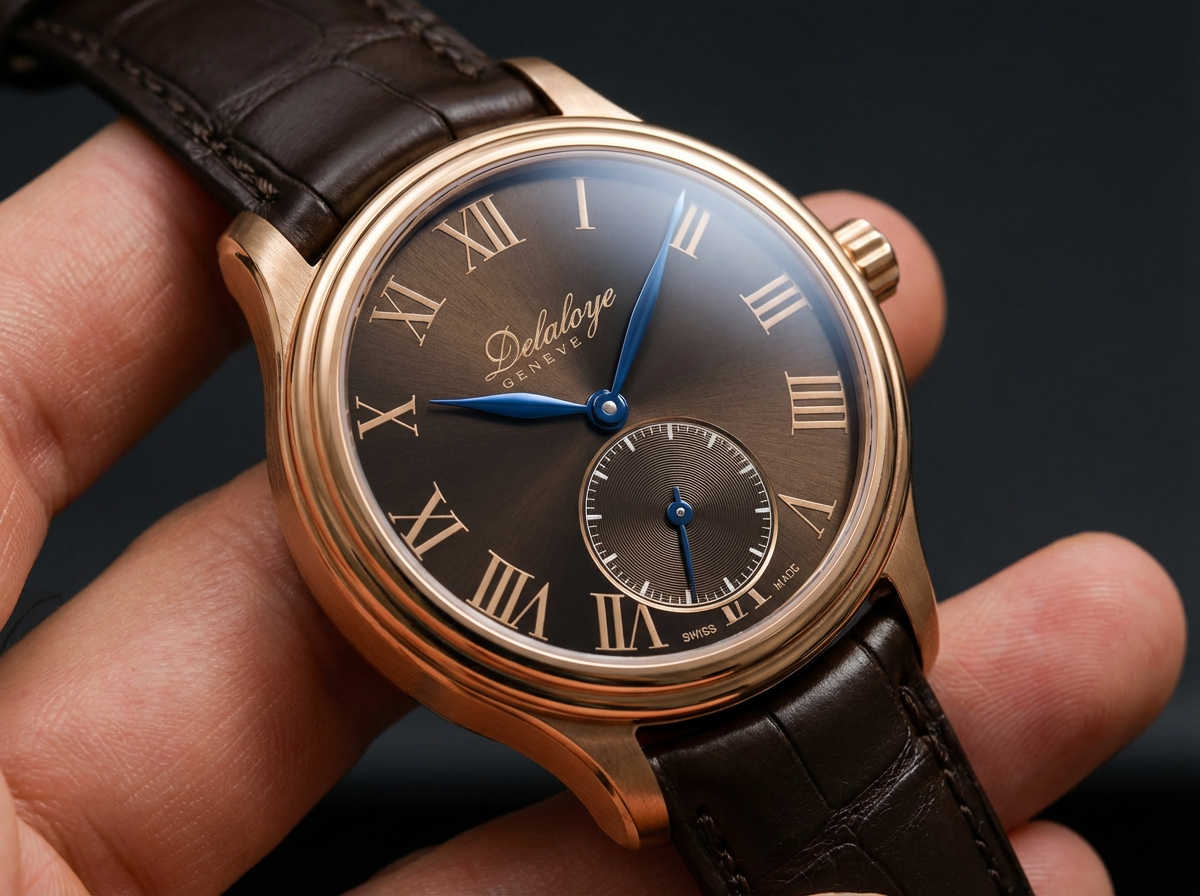
Delaloye Genève
Delaloye Genève is the Geneva atelier of Nicolas Delaloye — born in 1970, an AHCI member, and one of the most quietly accomplished watchmakers working in independent horology today. His biography is almost entirely defined by Geneva: he entered the Geneva Watchmaking School in 1987, graduating in 1991 after completing a curriculum so demanding that students were required to produce, by hand and to precise tolerances, an entire set of pivot diameters confirmed with a micrometer — a discipline that forged the manual precision that characterises every Delaloye piece. Among the distinctive skills he developed was the making of watch hands from raw steel, from scratch — a capability so rare that it can be counted among a handful of watchmakers anywhere in the world.
After graduation he joined Patek Philippe, working in various capacities and absorbing the standards of the most exacting manufacture in Geneva. He also worked for other prestigious brands before his career took a pivotal turn in 2016, when he was invited to join the Patek Philippe Museum to head its restoration department. There, over eight years, he spent his days bringing back to life some of the most important antique movements and complicated pocket watches in the history of watchmaking — an immersion in centuries of craft that left permanent traces on his sensibility, his patience, and his understanding of what makes a watch truly endure. The atelier is located in Carouge, in the Plan-les-Ouates industrial district on the south-western edge of Geneva, where Patek Philippe and Vacheron Constantin also have their primary manufacturing sites. The workshop is modest in its physical footprint — an office, a bench, Schaublin 70 precision lathes, a microscope, and tools accumulated across decades — but extraordinary in what it produces.
The brand's history is structured as four Chapters. Chapter 1 (2000–2023) — the Garde-Temps: Nicolas founded Delaloye Genève in 2000 and introduced his first watch, Le Garde-Temps ('The Time-Keeper'), powered by the original ND01 in-house calibre. The Garde-Temps was presented to the international watch community at collector events and received warmly by connoisseurs; early examples in white gold with guilloché and mother-of-pearl dials entered private collections and were later offered by specialist retailers. A rare 37mm version was also produced. Through this period Nicolas worked largely in isolation, producing a small number of pieces, before the Patek Philippe Museum engagement drew him away from independent production entirely. Chapter 2 (2024–2025) — the Renaissance: after eight years at the museum, the passion to create under his own name reignited. In 2024, on the twenty-fourth anniversary of the brand's founding, he relaunched with the Renaissance — a 39mm time-only watch that takes the Le Garde-Temps as its spiritual ancestor and reimagines it through everything he had learned and refined in the intervening years. The Renaissance is limited to 24 pieces, each made entirely to order. Chapter 3 (2026) — the Renaissance Origine: the current release, an evolution of the Renaissance concept with a new dial expression — Origine — introducing a refined aesthetic treatment that continues the dialogue between classical Genevan watchmaking and Delaloye's personal vision. Chapter 4 (2027) — the Asteria: announced for 2027, named for the Greek goddess of falling stars and nocturnal oracles; details are not yet public, but the name suggests an astronomical or celestial complication.
The ND01.s calibre — the updated version of Nicolas's original in-house movement, now used in the Renaissance — is built on the AS1130 platform, manually wound, beating at 18,000 A/h (2.5Hz), with a 72-hour power reserve and 20 jewels. The slow beat is deliberate: at 2.5Hz, the balance wheel sweeps across the dial with a wide, measured arc that is immediately visible to the naked eye and gives the watch a meditative, hypnotic presence on the wrist — a characteristic Nicolas has always prized. The movement is decorated to classical Genevan standards entirely by hand: rose-gold plated barrel and wheel train bridges with Côtes de Genève (Geneva stripes); rhodium-plated mainplate with perlage; polished steel bevels (anglage); screwed chatons holding each jewel in a gold setting — a finishing detail associated with Patek Philippe and a handful of the most traditional Geneva manufactures; a free-sprung balance with swan-neck spring; a small snail regulator for fine adjustment; and black polishing on the steel regulator and escape wheel cap, referencing the tradition of classical Genevan finish at its most demanding. The movement is visible through a sapphire crystal caseback.
The Renaissance case is machined from 99.5% pure tantalum — one of the rarest and most technically demanding case materials in watchmaking. Tantalum is harder to work than platinum, denser than steel, resistant to corrosion, and possesses a distinctive dark blue-grey tone and cool heft that gives the watch a quiet gravitas unlike any conventional metal. Nicolas machines and finishes the tantalum himself. The 39mm diameter is paired with 11.1mm thickness and a domed sapphire crystal. The crown — tantalum, like the case and pin buckle — is set with either an amethyst or citrine cabochon, adding a flicker of colour against the muted grey. Dials are hand-painted fire enamel in ivory or jet black, with a choice of Roman or Arabic numerals; hands are high-polished, blued, or purpled steel, the latter two achieved through controlled heat treatment. Nicolas makes the hands himself from raw steel stock — one of the few watchmakers anywhere to do so. Straps are fabric and nubuck in black, beige, or light blue with tone-on-tone or contrasting stitching options. Each watch is accompanied by a tantalum pin buckle. The Renaissance has been reviewed by Monochrome, Fratello, and Independent in Time, all of which praised the movement finishing and the coherence of the aesthetic vision.