Petermann Bédat
Petermann Bédat is the independent watchmaking atelier of Gaël Petermann and Florian Bédat — two French-speaking Swiss watchmakers who met in 2007 at the Geneva Watchmaking School and whose career paths ran in parallel for years before converging into a shared enterprise. Gaël spent his formative industry years at A. Lange & Söhne in Glashütte; Florian worked at Harry Winston and then joined Gaël at Lange; both also undertook restoration work at Christie's, spending time with some of the finest antique movements and complicated pocket watches in the auction world's holdings. That combination — deep technical formation at the most demanding of German manufactures, intimate familiarity with the finest historical watches in existence, and the quiet patience of restoration work — established a particular kind of watchmaker: one who thinks in centuries, designs with restraint, and executes with an intensity of finish that belies the workshop's modest scale. The brand was founded in 2017 and is based in Renens, near Lausanne — a location chosen for its deliberate distance from both Geneva's independent watchmaking scene and the Swiss German manufacturing axis, giving them the space to work at their own pace and on their own terms. The workshop is staffed by four watchmakers and two finishing specialists alongside the founders, all working on secondhand machines accumulated over years of careful acquisition. They were guided in developing their first movement by a mentor named Dominique, under whose direction they chose as their debut complication one of the most mechanically interesting yet commercially underexplored: the deadbeat (or jumping) seconds.
The Reference 1967 — named with a knowing wit for the year of the first quartz watch movement, a cheeky reference for a watch whose mechanical jumping seconds 'ticks' rather than sweeps, mimicking quartz's discrete beat with purely mechanical means — was launched in 2020 and won the GPHG Horological Revelation Prize the same year: the award given to the most promising debut from a new independent. The watch was made in a total of 45 pieces across its run, with the initial two limited editions (10 pieces in rose gold, 10 pieces in white gold) selling out immediately following the GPHG recognition. The Reference 1967 established the Petermann Bédat visual and technical DNA: an in-house calibre with German-inspired movement architecture, a semi-open sectored sapphire dial that reveals the movement in a restrained and controlled way, a design philosophy grounded in precision and proportion, and hand finishing throughout in which every surface is attended to individually.
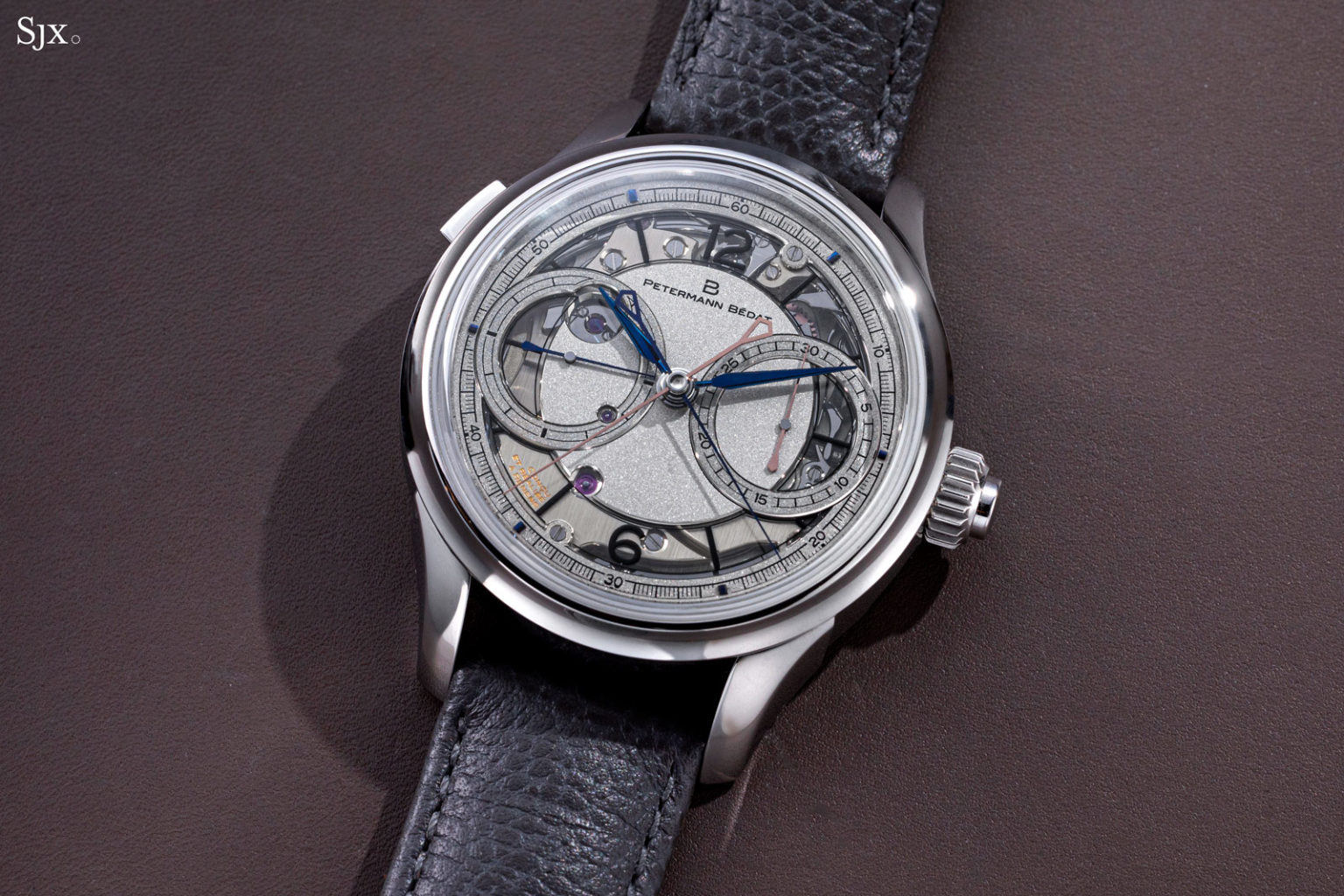
The Reference 2941 followed in 2023 — the second watch, and one of the most technically ambitious debuts ever made by a two-man independent: a monopusher split-seconds (rattrapante) chronograph, limited to just 10 pieces, with 339 components, that won the GPHG Chronograph Prize in 2023. The competition for the Chronograph category included models from Audemars Piguet and TAG Heuer among others, making the victory all the more pointed. The 2941's movement architecture carries a distinctive feature: the column wheel — conventionally placed on the caseback side — is mounted on the dial side at 12 o'clock, where it is visible through the semi-open dial construction. The split-seconds function allows two intervals of time to be measured in parallel from the same start point, and a jumping minute counter advances instantaneously rather than creeping — a construction particularly difficult to engineer and adjust. The name 2941 carries a deliberately obscure internal reference, the answer to which Gaël has offered to reward with a bottle of whisky.
The Reference 1825 (2025) is the third watch and the most restrained: a three-hand time-only watch in the brand's purest expression, powered by the new Calibre 233. Its dial is the first Petermann Bédat enamel dial — translucent green fired over a solid gold base that has been laser-engraved to create a grained underlay, producing a subtle two-tone depth. The movement features a bell-shaped bridge for the centre wheel and an escape wheel cock of uncommon elegance — SJX noted it as one of the more original and difficult bridge forms in the current independent landscape, avoiding the tubular/rounded bridge forms that have become overused. The 1825 will be available continuously, limited only by production capacity, as Petermann Bédat's most accessible permanent reference.
For the 10th edition of Only Watch — the biennial charity auction benefiting the Monaco Association Against Muscular Dystrophy — Petermann Bédat collaborated with Théo Auffret to produce the Chronomètre d'Observatoire, a unique piece that blended the two ateliers' signatures in a single watch. The movement architecture and the swan-neck regulator characteristic of Petermann Bédat's calibre style were married with the click system and the charbonnage bridge finishing technique personal to Auffret — a charcoal-based frosting process that creates a soft, warm, hazy surface beloved by both watchmakers and by the Paris-based independent tradition that Auffret embodies. The piece toured the world in September 2023 and was eventually sold at the delayed 2024 auction for CHF 240,000. The collaboration was not merely an auction piece but a genuine meeting of two complementary minds, as A Collected Man observed: 'charbonnage, a finishing technique where charcoal is employed to create a soft, hazy finish, is one that has been the hallmark of makers such as Viot and Auffret. The latter employed it even to the watch he created jointly with Petermann Bédat for Only Watch 2023/24.' The reference series numerals carry hidden meaning throughout: 1967, 2941, 1825 — all dates of specific horological significance, chosen with the kind of connoisseurship that characterises everything Petermann Bédat does. A chronograph derived from the 2941 but less complicated is planned for 2027. Two GPHG prizes in three watches — Horological Revelation 2020 and Chronograph Prize 2023 — confirm Petermann Bédat as among the most consequential young workshops in contemporary independent watchmaking.