Winnerl
Winnerl is a one-man independent watchmaking atelier in L'Orient, in the heart of the Vallée de Joux, built by Austrian master watchmaker Bernhard Zwinz around the revived name and legacy of Joseph Thaddäus Winnerl (1799–1886) — a 19th-century Austrian horological master whose historical importance rivals Breguet's, yet who remains almost entirely unknown today. Born in a small town near the Austrian-Slovenian border, the elder Winnerl left home young to apprentice under Georg Schmidt Fidel in Graz, Kessels in Altona, Urban Jürgensen in Copenhagen, and finally Breguet himself in Paris beginning in 1829. By 1832 he had founded his own business in Paris producing marine chronometers, precision pocketwatches, and clocks; by 1835 his renown was such that a young Ferdinand Adolph Lange expressly learned French in order to apprentice under him for five years — an apprenticeship during which Lange absorbed Winnerl's preference for the 3/4 movement plate, diamond endstones, and screwed chatons, elements that remain foundational to German watchmaking to this day.
Winnerl's own inventions were extraordinary and largely uncredited by history: the first pocketwatch with an independently stoppable seconds hand (1831); the pointer mechanism with two superimposed seconds hands (1838), the direct precursor of the split-seconds chronograph; and around 1840, the first triple split-seconds chronograph pocketwatch ever created. He was appointed clockmaker to the Paris Observatory in 1850 and Expert Clockmaker to the French Navy in 1873; his marine chronometers were so exceptionally accurate that, with nothing more than routine oiling and cleaning, they remained in active naval service into the 1970s — after atomic timekeeping had already been established. He was present for Foucault's 1862 determination of the speed of light at the Paris Observatory, providing the precise timing measurements the experiment depended on, and was closely involved with the Arithmaurel, one of the first mechanical calculators. His renown faded from horological history for two reasons: he left no heir, and unlike his famous contemporaries he never courted rich, fashionable, aristocratic clientele — his focus remained purely on accuracy, in service of ships at sea.
Bernhard Zwinz's own path mirrors Winnerl's with an almost uncanny symmetry that Zwinz has spoken about directly: both men are Austrian, both left their homeland to pursue horological excellence 'where the action was.' After graduating cum laude from the Technical School for watchmaking in Karlstein, Austria, Zwinz moved through Germany and Switzerland, working with Vacheron Constantin and Roger Dubuis before a period at Chronoswiss in Munich. On the recommendation of his friend Andreas Strehler, Zwinz became the first watchmaker to work personally for Philippe Dufour, crafting many of Dufour's celebrated Simplicity watches over three and a half years — an unmatched pedigree for absorbing the discipline of restraint and precision that defines the finest independent watchmaking.
In 2004 he founded his own workshop, L'Atelier de Joux, working behind the scenes for some of the industry's most respected names: Greubel Forsey, La Joux-Perret, Girard-Perregaux, MB&F, Urban Jürgensen, and H. Moser & Cie. Conversations with watch enthusiasts eventually prompted him to revive the Winnerl name in 2018 — a project he approached with the same unhurried, research-first rigour that defined the original Winnerl's chronometers. He began by researching Winnerl's history and patents, cataloguing surviving timepieces, and only then designing an entirely new movement — one he wanted 'Winnerl would be proud of were he alive today.' The parts were made mostly by his friend Andreas Strehler, to Zwinz's own specifications and calculations. The result is, in Zwinz's own words, 'a ship's chronometer for the wrist, inside and out' — the first wristwatch movement of its kind to incorporate the distinctive balance wheel design taken directly from Winnerl's historical Chronometer No. 80, a piece more than 175 years old that, with simple cleaning and oiling, keeps better time than a quartz watch.
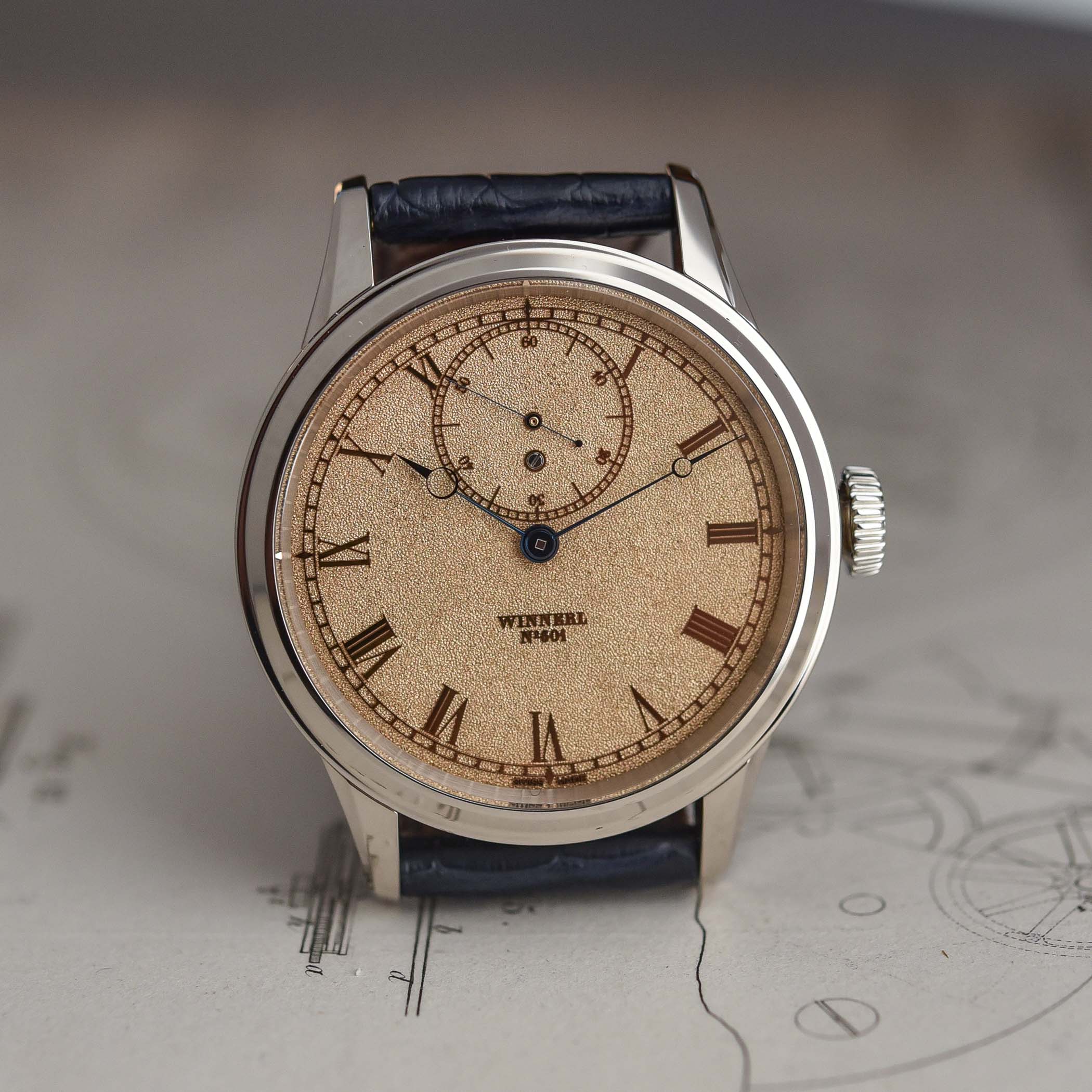
The Founder's Series is the debut collection: hand-wound marine chronometer wristwatches housed in a 39.9mm × 10.3mm case, water-resistant to 100 metres with a screw-down bezel and caseback — a genuinely everyday-wearable dress watch despite its serious horological intent. The movement carries 21 jewels and 93 components, a Beryllium copper balance wheel sloped at 45 degrees (allowing fine adjustment of its inertia without removing it from the movement, via inward-facing screws — an unusual and historically direct Winnerl feature), a Breguet overcoil hairspring, directly driven small seconds at 12 o'clock, and a 3/4 plate architecture (closer to a 4/5 plate, occupying nearly the entire movement diameter save for the balance and its open-worked cock). The prototype, reference N°595, was followed by the Founder's Series proper — three pieces commissioned by a single collector: N°596 in white gold with a blue-gold grené dial (its distinctive colour achieved through pressure and thermal treatment, finished in Silver Grainage) and polished steel hands; N°597 in red gold with a white enamel dial, Geneva Stripes finishing, and blued steel hands; and N°598 in platinum with a black enamel dial, hand-engraved movement finishing, and polished steel hands.
The Tremblage Series that followed is limited to just 6 pieces (N°601–606) in 18k white gold case with an 18k pink gold dial, executed using the tremblage technique — hand-hammering the dial surface with a small burin in a process demanding unbroken concentration, since any inconsistency in the tempo or pressure of the hammering causes light to reflect unevenly across the finished surface. On the Tremblage watches, the dial furniture — black polished Roman numerals and the chemin de fer minute track — is carved from a single contiguous piece of 18kt gold rather than applied separately, eliminating any risk of markers loosening or detaching from shock. Every Winnerl watch is made entirely by Zwinz's own hand, using a set of traditional machines and techniques that most contemporary watchmakers have long abandoned — true one-man, one-watch-at-a-time production, in the same spirit of uncompromising, unfashionable accuracy that defined the original Winnerl 175 years ago.