Cavasino
Founded by Didier Cavasino — an engineer with roots in competitive mechanics who unites performance with a passion for micro-mechanics, and 17 years in Swiss watchmaking with some of its most prestigious maisons — from his atelier in Le Brassus, at the heart of the Vallée de Joux. More than an engineer, he embodies precision, creativity, and a relentless pursuit of excellence. Surrounded by master artisans he describes as friends, he built a deeply human-centred project where each timepiece reflects technical mastery, emotion, and the transmission of savoir-faire.
Every detail is shaped by a contemporary vision that honours watchmaking heritage — classic codes reinterpreted with a fresh and dynamic spirit. Rooted in noble traditions, the finishes embrace modern contrasts and bold proportions. The past isn't fixed; it evolves through dialogue with the present to create timepieces that are both timeless and modern. Each component is hand-finished according to the strict codes of Swiss Haute Horlogerie — bevelling, circular graining, and Côtes de Genève. These precise gestures, passed down through generations, are performed with care in the heart of the watchmaking valleys. The true value of a movement lies in both the artisan's mastery and the excellence of its finishing. Innovation is deeply rooted in tradition: cutting-edge technology is integrated at every step of production, with each component crafted within ±2 microns using advanced machining and optical control, ensuring outstanding reliability, stability, and chronometric performance. Every timepiece is the expression of the craftsmen's passion and pursuit of excellence. Masters of rare and precious skills, they breathe life into each creation, endowing it with a soul that speaks of heritage and authenticity. Far beyond a tool for measuring time, each watch becomes a living, enduring work of art.
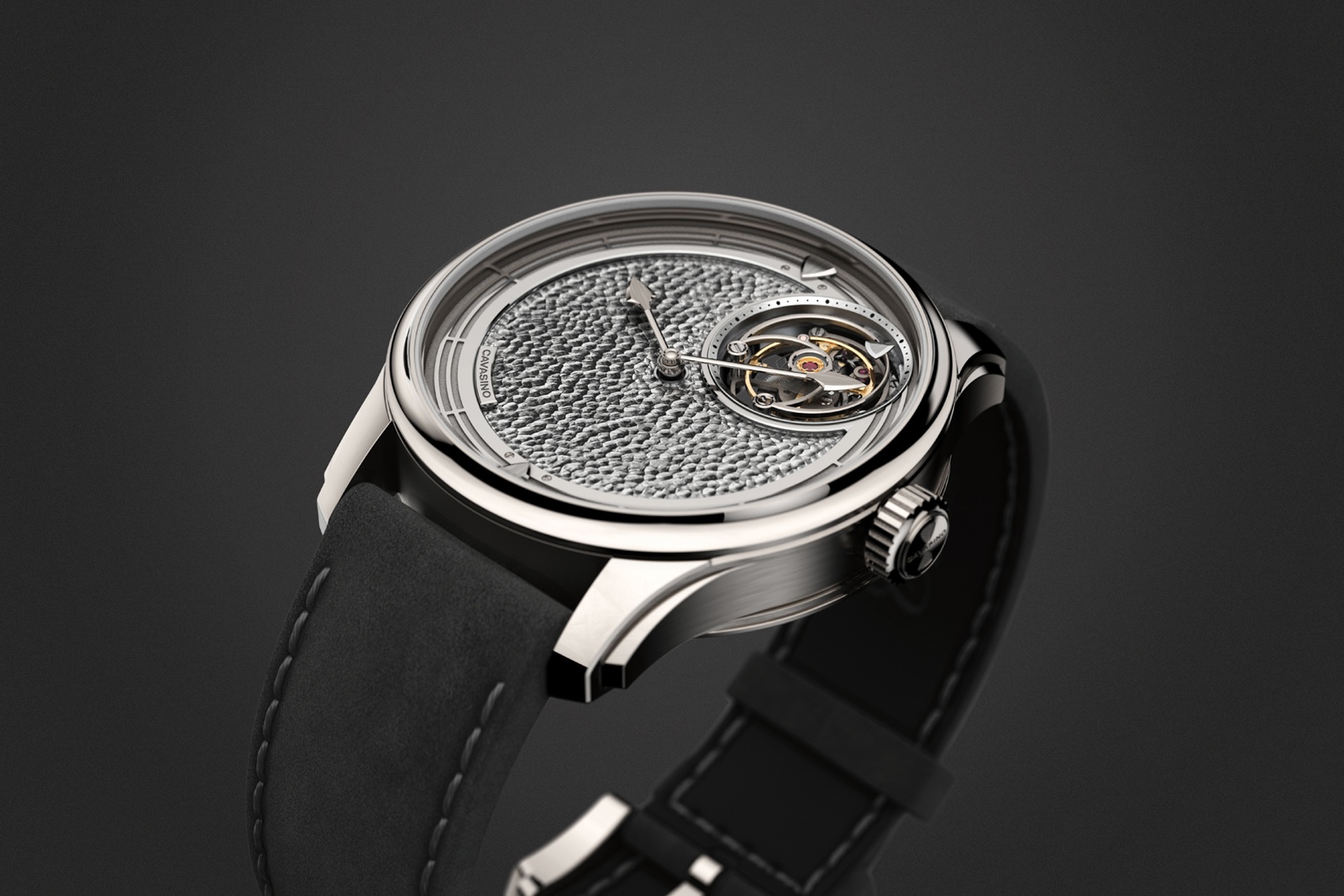
The debut creation features the in-house DCR-01 calibre (also designated FT60-S): an automatic tourbillon of perfectly symmetrical architecture, anchored by a central chaton around which four elements form a harmonious composition — a flying tourbillon, a white gold micro-rotor, and twin barrels. The 0.41g titanium tourbillon cage beats at 28,800vph (4Hz) with a 60-second rotation; the 10 inward angles of its cage are hand-bevelled. The white gold micro-rotor is hand-chiselled (tremblage) on the side and hand-hammered on top, covered with a specially developed translucent cherry-purple enamel. Twin barrels with 820g springs deliver 65 hours of power reserve. The steel bridges feature hand black-polish, wide Côtes de Genève, satin finish, hand bevelling, perlage, and engraving — with each wheel featuring 20 hand-prepared inward angles and circular satin finish. Even the undersides of bridges are finished with circular grain. 196 components, 32 jewels, Ø32.8mm x 6.28mm. Each piece carries a hand-engraved subscription number.
Didier Cavasino's own story traces to 1990s Marseille, where he grew up mechanics-obsessed, later graduating from the École des Arts et Métiers before his fascination with tourbillons crystallised at a Paris collectors' dinner in 2001 — a moment that eventually led to seventeen years inside some of Switzerland's most prestigious maisons before he struck out alone. For his debut he called on friends made across that career: the case is produced by Voutilainen & Cattin, and the straps come from Akrivia's own bracelet atelier — a fitting collaborator, given that Akrivia has itself been an influential force in the kind of symmetrical movement architecture the DCR-01 pursues, a design lineage traceable to Girard-Perregaux's 1867 three-bridge tourbillon. Cavasino himself has described the DCR-01 not as a production movement but as a manifesto — a deliberate founding statement rather than the first of an ongoing series. The entire Inaugural collection was capped at exactly 50 movements: a 20-piece titanium subscription series sold out at CHF 77,000, followed by 30 further pieces in stainless steel (CHF 88,500) and platinum or 18k rose gold (CHF 95,000, the rose gold limited to just 8), each requiring more than 500 hours of work, the majority devoted to hand-finishing. With all 50 now spoken for, the founding chapter is complete, and whatever Cavasino builds next — slated for 2027 — will be built on an entirely new foundation.