Moritz Grossmann
Moritz Grossmann was founded on 11 November 2008 by Christine Hutter — a trained watchmaker and the only woman to found and lead a German watch manufacture. Hutter had worked at Wempe, Maurice Lacroix, Glashütte Original, and A. Lange & Söhne before discovering the extraordinary legacy of Karl Moritz Grossmann and securing the trademark rights with her family. Born in Dresden in 1826 — making 2026 the bicentennial of his birth — the historical Grossmann trained across London, Hamburg, Paris, Stockholm, and Copenhagen, settled in Glashütte in 1854 to produce pocket watches of exceptional quality, and in 1878 co-founded the German School of Watchmaking in Glashütte, the institution that still sustains the entire Saxon watchmaking industry today. Hutter restarted the brand from her kitchen during the 2008 financial crisis, moved to a former hardware store, and in 2010 opened a dedicated, purpose-built manufacture on Uferstrasse overlooking the Grossmann brook — today employing around 46 people and producing roughly 250 watches a year, with the singular distinction, among all Glashütte manufactures, of making even its own hands in-house.
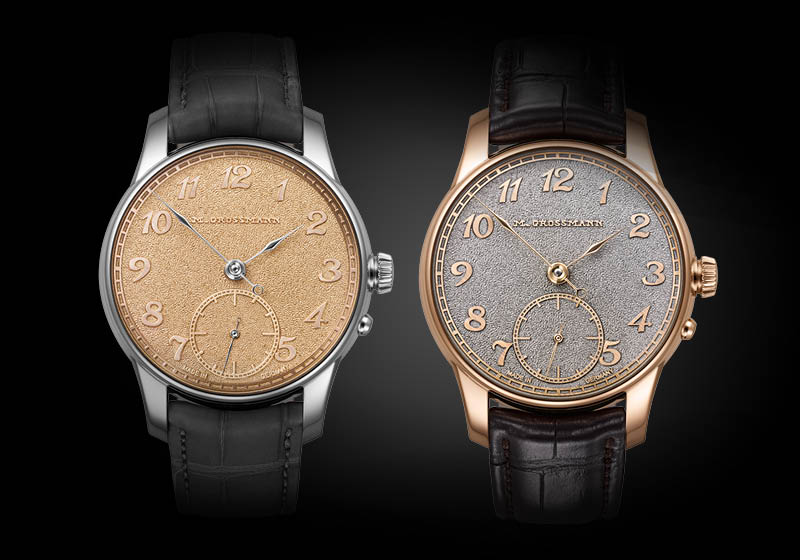
The modern catalogue is organized around two model lines. Benu — the flagship, and the watch that started it all in 2010 with Caliber 100.0 — carries the house's full Saxon vocabulary: a two-thirds plate, hand-polished bevelled bridges, blued screws, diamond-polished steel, and the brand's signature stop-seconds lever, famously tipped with human hair, that acts directly on the balance to guarantee precise time-setting. Its Heritage side reaches deepest into complication and craft: the Power Reserve, the Tourbillon (offered in rose gold, white gold, or titanium), the rectangular Corner Stone, the Hamatic with its novel automatic hammer-winding system, the vintage-inflected 37 Arabic, and the Tremblage — introduced for Glashütte's own bicentennial, its every bridge and plate covered in a finely irregular hand-textured surface that few workshops anywhere attempt — alongside enamel-dial Arabic and Roman vintage references. Benu's Contemporary side reinterprets the same DNA for modern complications and everyday wear: the Universalzeit world timer, the openly-worked Backpage (and Backpage Tremblage), the Date, a new Perpetual Calendar, the GMT (and hand-guilloché GMT Guilloché), the colorful Primavera, and a run of Art Edition pieces created with German painter Max Frintrop.
The second line, Tefnut, named for the Egyptian goddess of moisture and softer forms, is the house's more compact, overtly elegant collection. Tefnut Classic keeps the focus on pure watchmaking — the core Tefnut model in rose gold or steel, a silver-plated-by-friction dial variant, the diamond-bezel Tefnut Lady, and the Tefnut Twist — while Tefnut Jewellery pushes further into gem-set artistry with the Arabian Nights and Sleeping Beauty references, each also offered on a Milanaise mesh bracelet. Across both lines, Grossmann's manufacture philosophy stays constant: the vast majority of every component — 85% or more — is designed, decorated, and finished within the Glashütte workshop itself, a level of vertical integration that places this comparatively young manufacture on genuinely equal technical footing with Saxony's oldest and most storied names.