DRT
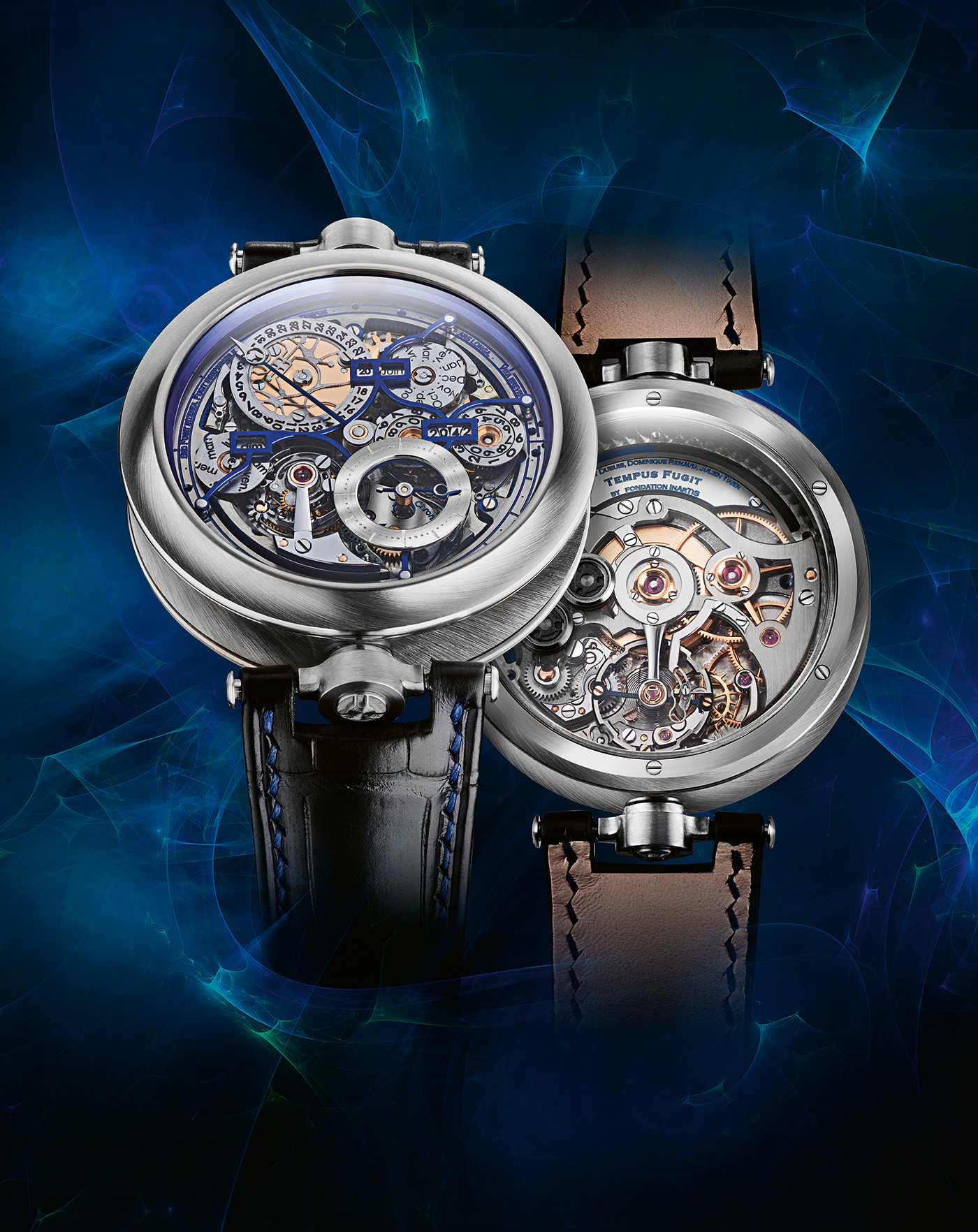
DRT is the signature on the Tempus Fugit (Latin for 'time flies'), a one-off watch conceived by Dr. Benoît Dubuis, designed by the independent watch designer Dominique Renaud and built by the young watchmaker Julien Tixier, with the project funded through Dubuis's Fondation Inartis. The sources spell the foundation 'Inartis'; it is sometimes written 'inArtis'. DRT stands for the initials of the three men, and like the MIH Watch it is a single-watch project rather than a conventional brand, with no dedicated website. The Tempus Fugit was launched in September 2022 as reference IN-X DRT-001, and it was made in the Vallée de Joux.
The idea came from Dubuis, president of the Swiss Academy of Engineering Sciences (one source also calls him the head of the Geneva Biotech Campus). He had geneticists, statisticians and genomics specialists, with researchers at EPFL, build an algorithm that estimates an individual's life expectancy from environmental, lifestyle and genetic risk factors, and proposed a watch with a countdown based on it. He took the idea to Renaud, formerly of Renaud & Papi, who was uneasy about a death countdown and accepted it only when it was reframed as a 'life reserve', a form of power reserve measured in the wearer's remaining life and tied to a perpetual calendar. The brief became a motivational object: awareness of time passing as a spur to pursue goals, not a cause for despair. The idea took shape during the COVID-19 lockdown, and development took about two and a half years.
Julien Tixier, a watchmaker under thirty when he began, designed the watch virtually and then made almost every component himself in a workshop of under 50 square metres in the Vallée de Joux, including a detent escapement of his own, with only one part made by a neighbour because of time constraints. Renaud, who co-founded Renaud & Papi, sold his share to Audemars Piguet in 2000 and later set up the research laboratory Dominique Renaud SA, has said that the younger man gave him more than he gave. Tixier and Renaud later formed Renaud Tixier, whose first watch, the Monday, launched in 2024.
The watch's core is a secular perpetual calendar, which handles the leap-year corrections every 4, 100 and 400 years and is designed to run accurately to the year 9999 (Europa Star says it is set to stop on 31 December 9999). The calendar module is 8.3 mm in diameter and 1.85 mm high and has 51 components in most sources, which Time+Tide puts at 25; it is billed as the most compact secular calendar to date and is built as a reversed version of the usual feeler-spindle design. It sits in a suspended mobile, and removing one layer would turn it into an ordinary perpetual calendar to 2100. The watch shows hours, minutes, day, date, month and year.
The life reserve is shown on the back as a coloured ring around the edge of the movement, programmed for 100 years and advancing one notch a year; it shows no exact date, only a zone of fading colour spanning a few years, calculated from the owner's data. A small replaceable chip holding the owner's genome is built into the movement, so that on a change of ownership it can be swapped and the gauge reprogrammed. A secret message chosen by the owner is engraved on a hidden plate and appears at the edge of the movement on a set future date, which Time+Tide describes as a time capsule with a mechanism inspired by vaults. The watch is meant to be handed down for generations and was designed to stay simple to repair and maintain.
The hand-wound skeleton movement is 31.5 mm across and 7.6 mm thick and beats at 18,000 vibrations per hour, with an 80-hour power reserve and a detent escapement. It sits in a 39 mm brushed titanium monobloc case 10.6 mm thick, with a sapphire crystal, 30 m of water resistance and a safe-style lock that only an accredited watchmaker can open; there is no visible crown or corrector, and adjustment is made through the rear crystal with a small key hidden in the pin of the removable bracelet. It comes on a black leather strap with a pin buckle. The Tempus Fugit was a finalist at the 2022 Grand Prix d'Horlogerie de Genève in the Calendar & Astronomy category, where it was runner-up to the Krayon Anywhere. It is a unique piece priced at CHF 376,730, a figure Europa Star derives from the impedance of the vacuum (Z0 = 376.730 Ω); the GPHG lists CHF 376,000 including VAT.