Dubois et Fils
Founded in Le Locle in 1785, when Philippe DuBois took his two sons on as partners, DuBois et fils traces its watchmaking lineage further still to 1743, when Moïse DuBois began trading pocket watches, and to 1751, when he opened the family's first watchmaking workshop at 22 Grande-Rue — making the house, by its own reckoning, the oldest watch factory in Switzerland. In its first 55 years the company sold more than 110,000 pocket watches and built a genuinely international network, with offices in Amsterdam and Frankfurt and distribution reaching the United States by 1804; in 1931 it launched the 'Autorist,' an early self-winding wristwatch wound by the motion of its own lugs, before shifting deliberately toward limited production at mid-century. The brand's continuity was broken when it was sold to owners in Hamburg in the 1980s, severing its Swiss roots for a generation, until Basel entrepreneur and watch enthusiast Thomas Steinemann bought Philippe DuBois & Fils SA in 2010 and brought it home. The house now marks 275 years since Moïse DuBois's first workshop, still family-connected to the historic DuBois building on Le Locle's Grand Rue, and still built, in its own words, around the passion of preserving and passing on a nearly three-century-old Swiss tradition.
Steinemann's revival has been as unconventional as the brand's history is long. In 2012 DuBois et fils became the first luxury watch brand anywhere to launch an equity-based crowdfunding campaign through its own website; within five months of a 2013 follow-on raise, 587 investors from 21 countries had subscribed CHF 1.5 million, and the company continued selling shares directly to collectors for years afterward, holding annual general meetings that read more like enthusiast gatherings than institutional investor days — the 2019 AGM at Basel's Natural History Museum welcomed the firm's 1,000th shareholder. In 2021, working with SwissValueChain, DuBois et fils tokenised 330 historic movements on the blockchain, linking each new watch to a digital 'chronicle' that owners can expand with their own photos, videos, and stories — a system that has since attracted footballers Ivan Rakitić and João Cancelo to record blockchain-linked personal 'diaries' tied to DuBois timepieces. Former Swiss national-team record goalscorer and Aarau coach Alex Frei joined the board as partner and shareholder in 2023 to help expand the business, and watchmaker Thomas Gronenthal took over running the atelier in 2024; that same year DuBois et fils lent its restoration expertise to Gübelin's own Ipsomatic project, underscoring how central the house's movement knowledge has become within the wider Swiss industry.
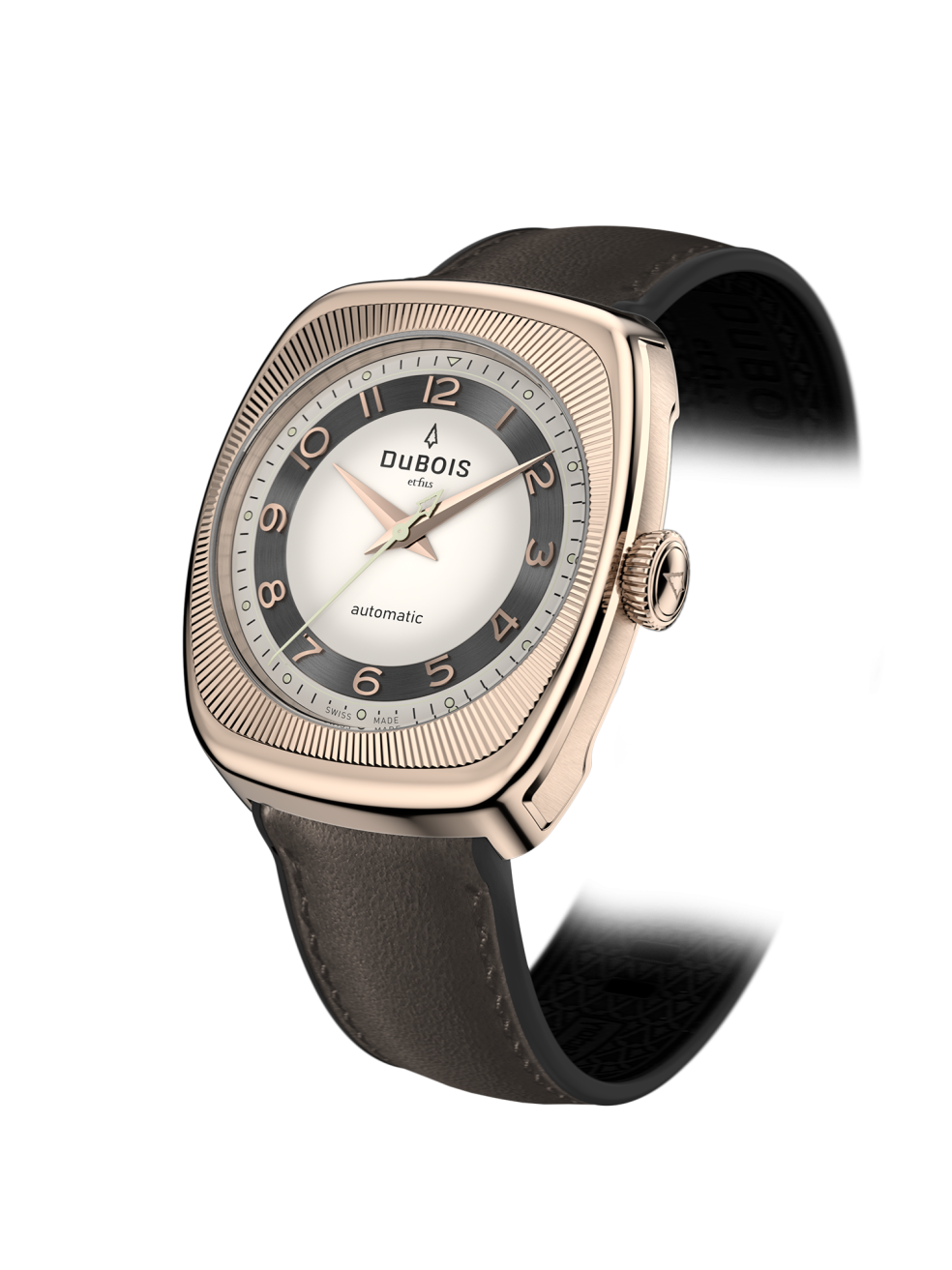
That knowledge rests on an almost unmatched physical archive: DuBois et fils holds more than 200,000 original Swiss movements from the 1930s to the 1970s, sourced from a single major western-Switzerland find, plus a further 18,000 movements and millions of spare parts acquired in 2024 from Edgar Sutter, owner of the last remaining alarm-clock factory in Switzerland — sixteen cabinets weighing up to 600 kilograms each, trucked from Bettlach to a dedicated restoration atelier in Muttenz. Every current model is built around one of these New-Old-Stock calibres rather than a modern ébauche. The DBF007 diver runs a 1960s A. Schild AS-1895 in a milled, satin-and-polished case with a one-way ceramic bezel and an optional hand-tanned deer, chamois, or roebuck leather travel case; the DBF008 houses an AS-1985 beneath a domed box-sapphire crystal, its lug 'horns' polished and then soldered on using a technique revived from historic pocket-watch hinge-making; the DBF009 'Sky Striker' pilot's watch, cased in titanium, is wound and set via a propeller that physically springs out from the crown, powered by a 1948 Felsa 692 Bidynator — the world's first double-sided automatic winding rotor, one of engineer Friedrich Meyer's several patented Felsa inventions; the 1970s-inspired DBF010 runs a Geneva-made Record 1959-2 calibre from Record Watch Co.; and the 2026-exclusive DBF011, released for the 275th anniversary and limited to 33 pieces per colourway, is powered by Meyer's own 1962 Felsa 4017 hand-wound movement, visible through an open caseback. Nearly every model was designed by Basel product designer Stephan Messmer, and each remains a strictly numbered limited edition — a working museum of twentieth-century Swiss movement-making, sold one blockchain-verified watch at a time.