Hajime Asaoka
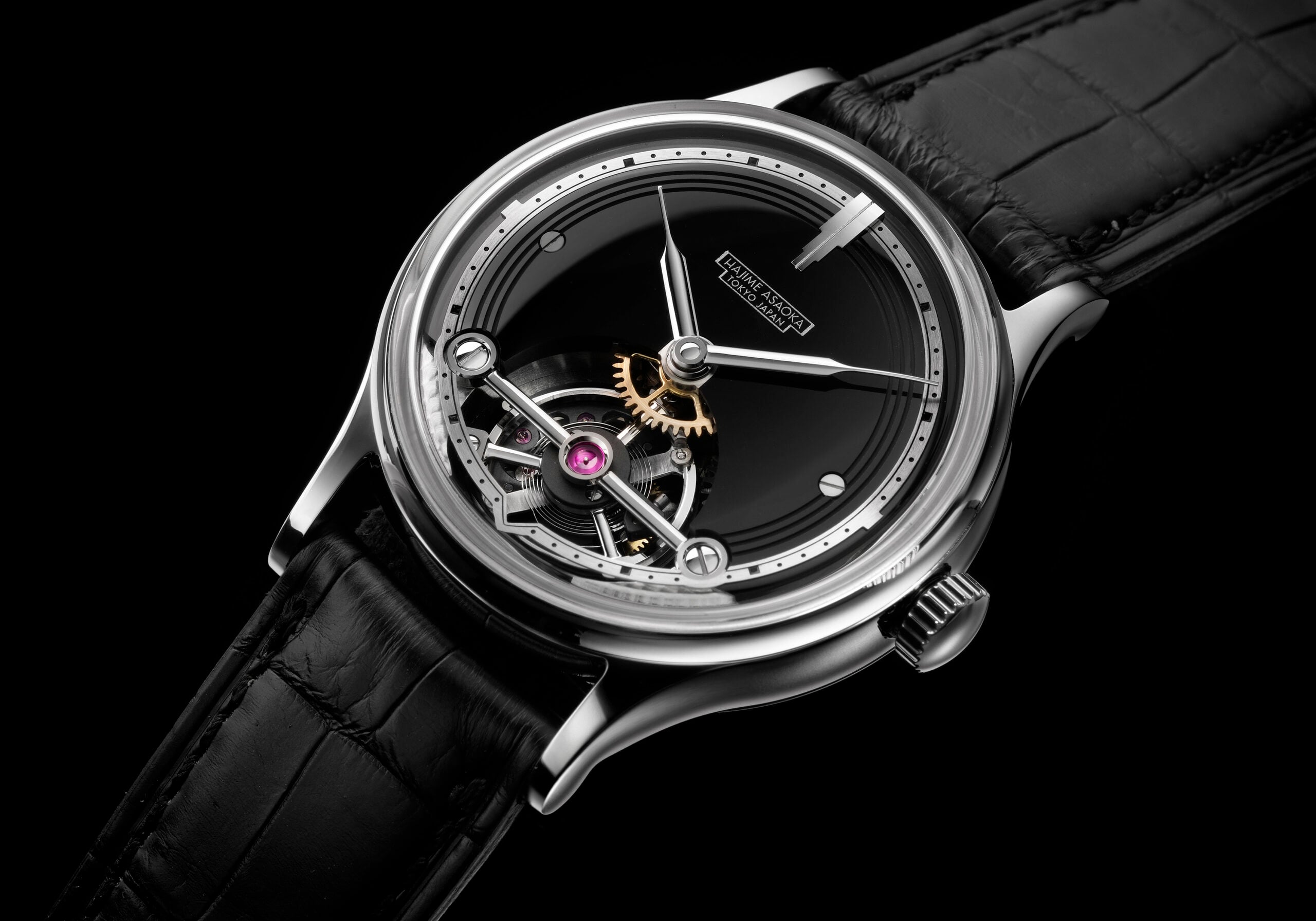
Hajime Asaoka is the self-taught engine of Japan's modern independent watchmaking scene — the man who built the country's first-ever in-house tourbillon wristwatch with no formal training whatsoever. Born in 1965 in Kanagawa Prefecture, he graduated in design, not horology, from the Tokyo University of the Arts in 1990, and spent over a decade running his own product design office before watchmaking took hold. His entire education came from a copy of George Daniels' Watchmaking, YouTube tutorials, and machine tools bought on eBay; he began building watches in 2005 and, just four years later, unveiled the Tourbillon #1 prototype in 2009 — Japan's first tourbillon wristwatch, built entirely from scratch by a man who had never worked inside a watch manufacture. The achievement brought AHCI membership in 2015, making him one of only two Japanese members alongside Masahiro Kikuno, and friendships with Swiss masters including Philippe Dufour and Antoine Preziuso, who have helped him source the handful of components — mainly base parts adapted from historic Unitas movements — he doesn't make himself. In 2016 he founded Precision Watch Tokyo Co., Ltd. as CEO to strengthen Japanese watchmaking more broadly, and in 2019 launched the far more accessible Kurono Tokyo label alongside his own collector-grade work — all guided by a philosophy borrowed from shogi, Japanese chess: 'place pawns in unexpected positions to surprise and defeat opponents.'
His own-name collection is built around four watches, each requiring roughly six months to construct and together numbering only around 19 pieces ever made. The Tsunami, his debut and still considered one of the most elegant independent watches of the modern era, houses an oversized 15mm free-sprung balance and barrel visible through the caseback inside a compact 37mm stainless steel case (18,000vph, 40-hour reserve) — every part positioned with no wasted space to maximize timing accuracy. The Project-T Tourbillon (2014), developed with aerospace manufacturer Yuki Precision and master tool-maker OSG, carries 13 ball bearings throughout its construction, including what is claimed to be the smallest tourbillon-carriage bearing in the world, split across two independent modules — a power pack and a separate regulation module — for superior maintainability and axis positioning, finished with a DLC black dial in a 43mm case. The Tourbillon Pura (2016) pursues architectural purity instead: a single-plate movement holding every component in one optimized layout, its tourbillon carriage machined from A7075 duralumin — an aerospace and precision-rifle alloy chosen for its strength-to-weight ratio, which lets the balance swing at maximum amplitude without overtaxing the mainspring's torque. A fully scratch-built, skeletonized Chronograph followed in 2017.
Asaoka's watches sell almost entirely through word of mouth and multi-year waitlists, production remaining in the single digits per year despite prices running from roughly $25,000 for the Tsunami to $400,000 for the rarest Project-T configurations. Working alone in Tokyo on machines he taught himself to operate, Asaoka has become something like Japan's answer to the Vallée de Joux — proof, alongside Kikuno and the artisans of Credor's Micro Artist Studio, that the country's independent watchmaking tradition, though tiny, now belongs in the same conversation as Switzerland's oldest houses.