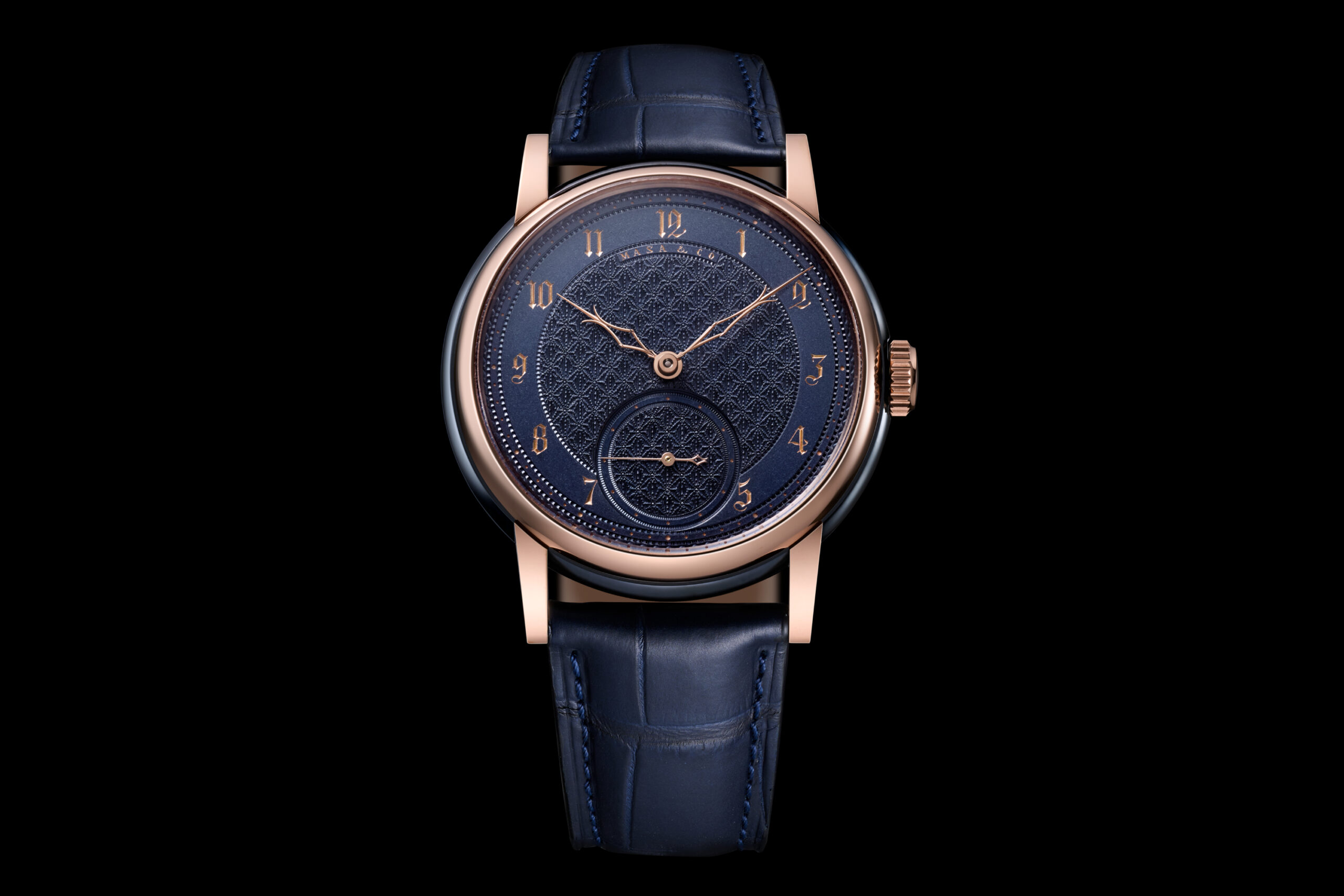
Masa's Pastime
In the spring of 1990, Masa Nakajima — a former professional scuba diver who had spent his twenties in the Philippines, Indonesia, and the US West Coast — opened a small antique watch shop called Masa's Junkyard in a Tokyo suburb, importing American antique watches. When the local watchmakers he relied on began retiring one by one, he was forced to teach himself watchmaking from books and tools, night and day. By 1995 he could restore his own stock; in 1998 the shop moved to Kichijoji, Tokyo's famous antique district, and was renamed Masa's Pastime. As the team grew, they began creating custom wristwatches in 2004 — housing antique pocket watch movements (over 100 years old) in modern waterproof cases with sapphire crystals, a concept that has run ever since. Skilled engraver Kei Tujimoto joined in 2007, adding hand-engraved dials, cases, and movement decoration. Through decades of component fabrication for century-old antique repairs, the team naturally accumulated every skill, machine, and discipline of watchmaking in-house.
In 2023, Masa & Co. was formally established as their original watch brand. The original watches: the Nayuta Model (2023, designed and produced by team member Nayuta Shinohara, sold at Phillips TOKI auction, estimate HKD $150,000–300,000); and the MP Series — NAGI, SHIKE, and SOHKOKU models — powered by the in-house MP1 movement, developed with a singular obsession: longevity. 'How can we make something that won't deteriorate after a few decades? What design ensures it remains unfazed after a century?' Custom creations include shakudo dials — an alloy of copper and pure gold dyed black by traditional Japanese boiling techniques used since the Heian period. Theme: timepieces passed down as cherished heirlooms from generation to generation.
The MP1 took a full decade to reach reality: work began in 2012, and between securing rare materials, acquiring specialised machinery, and simply working through the accumulated problems of building a calibre from nothing, the movement wasn't completed until 2022, finally reaching watches on wrists with the MP Series' 2024 debut. Nayuta Shinohara, who joined the team five years ago, brought his own distinction to the workshop — the first Japanese watchmaker to win gold at the A. Lange & Söhne Watchmaking Contest — and Nakajima gave him near-total creative freedom, telling him simply to do whatever he wanted and reporting back only on cost; Shinohara's models start from heavily modified ETA/Unitas bases but rebuild the mainplates, backplates, and wheels by hand. The two lineups — the MP Series that Nakajima personally oversees and the Nayuta models Shinohara designs with the team — share no components and are allocated through annual order lotteries of startling scarcity: just ten Nagi and ten Sohkoku pieces per cycle, selling for roughly $60,000 to $80,000 depending on case metal, with the Sohkoku's blackened shakudo case hand-engraved by Kei Tsujimoto in a traditional hemp-leaf motif. A tourbillon is quietly in development — reusing as many MP1 components as possible within the same case dimensions, with an unannounced prototype reportedly around 70% complete — though Nakajima insists the workshop's ambitions stay modest: perhaps thirty watches a year within a decade, no more, because scaling further would mean sacrificing the very quality the antique-repair decades were spent learning to protect.