Haldimann Horology
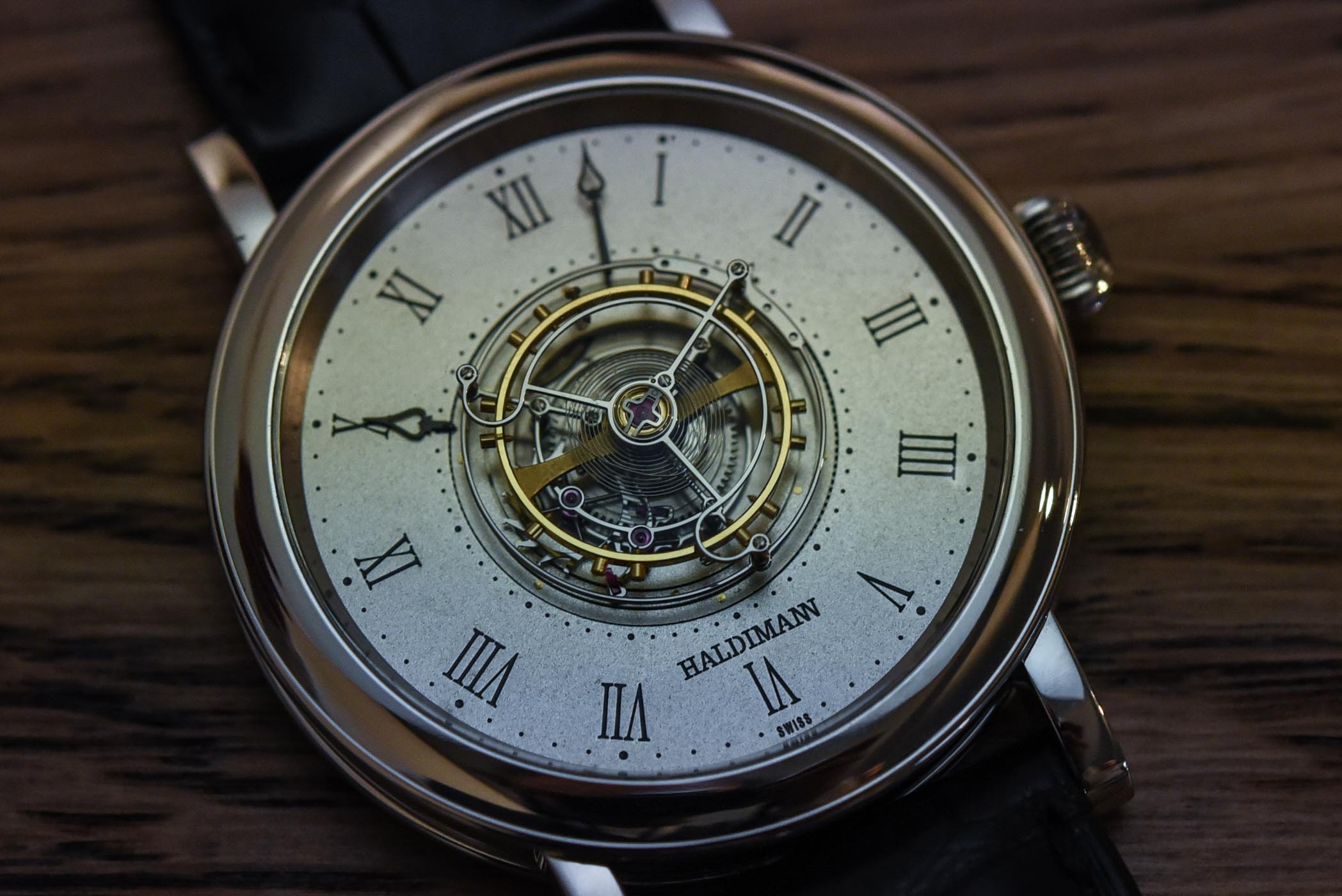
Beat Haldimann's family has practised watchmaking since 1642 — when his ancestors Ulrich and Hans Haldimann established the tradition. He qualified as a watchmaker-restorer ('horloger-rhabilleur') and, in 1993, as a master watchmaker, before carrying out R&D for various brands. He holds a patent for the Haldimann detached spring-impulse escapement, accurate to 1/10th of a second, incorporated into his H101 resonance clock (2000) — twin pendulums oscillating in resonance. In 2002 he arrived at Baselworld with a world-first: the H1 Flying Lyra — a flying central tourbillon, located directly on the dial side in a lyre-shaped cage 17.8mm in diameter, inspired by Alfred Helwig (inventor of the flying tourbillon) and the design philosophy of Carl Moritz Grossmann (ambitious mechanics within elegant constraints). The tourbillon also serves as the central seconds hand and 'hums' or 'sings' against the ear — the resonance between the slow-beat escapement and the tourbillon carriage produces an audible, pocket-watch-like sound. Three mainspring barrels power the H1; the fragile lyre cage can only be hand-finished by the most experienced watchmakers, as the slightest pressure would distort its shape.
The H2 Flying Resonance (2005) unites both of Haldimann's obsessions: two flying tourbillons revolving about the centre of the watch, resonating with each other, combined with a remontoir d'égalité. Other models: H8 Flying Sculpture (the H1 tourbillon with no hands at all — pure sculpture); H9 Reduction (the H1 tourbillon concealed beneath a black dial); H11 and H12 (centrally positioned balance wheels). Awarded the Prix Gaïa in the Craftsmanship-Creation category. Works entirely without CNC machines — the most modern tool in the workshop is an optical microscope from the 1960s. Operating from Villa Nussbühl, a meditative home-workshop overlooking the river Aare in Thun — a place George Daniels himself visited and considered the ideal setting to work. Haldimann personally services and restores every watch bearing his name, free of charge, for life. 20–30 watches per year.
The H11 and H12, launched in 2013, marked the conceptualist's return to a classical register — hours and minutes only (plus offset small seconds on the H12) — yet even here Haldimann achieved something unprecedented: a centrally positioned balance wheel on a watch with centrally mounted hands, paired with his patented lever escapement and proprietary anti-shock system. In 2017 they became his first steel watches, wearing dials that require enormous labour — a frosted midnight blue created specifically for the steel case, and a silver grené surface built up from silver powder with engraved, lacquer-filled indices — while the H12's hands take their form from an eighteenth-century Haldimann Frères pocket watch, closing a family circle nearly four centuries wide. Haldimann has explained that he makes at least ninety percent of every watch himself, down to cases and clasps, precisely so that he depends on no one, and that his clients are people who care about content rather than brands; he sees no need for limited editions when the limits are set by his own two hands. The collector market has caught up with that logic: a platinum H12 realised CHF 144,900 at Phillips Geneva in 2022, and his early tourbillons are now chased by the same bidders pursuing Dufour and Daniels. Between the singing central tourbillon of the H1, the handless H8, the deliberately hidden H9, and the pared-to-nothing H11, Haldimann's catalogue reads less like a product line than a philosophical argument conducted over twenty years — that a watch's deepest purpose is not to show time but to embody it — argued from a riverside villa in Thun with tools no newer than a 1960s microscope.