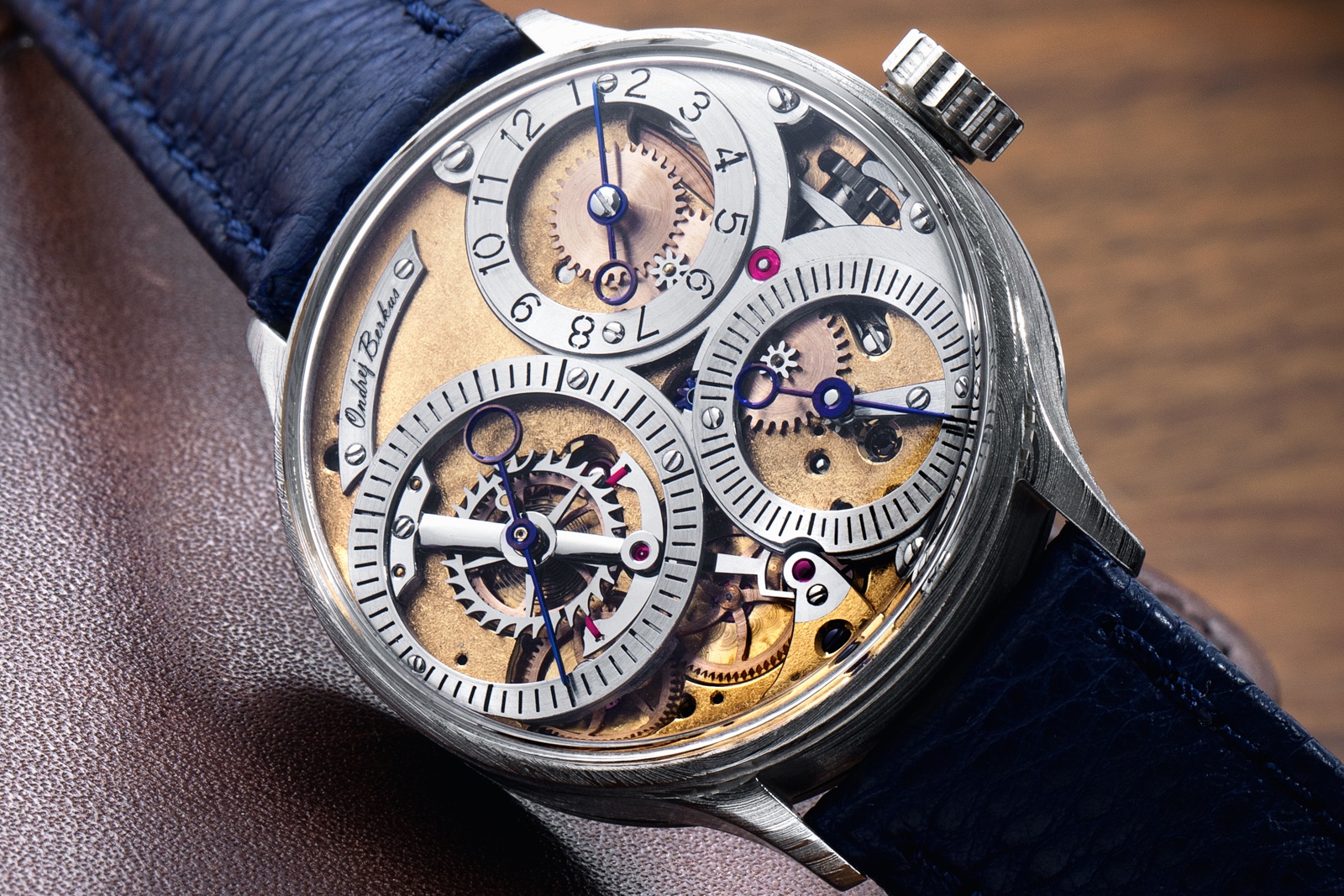
Hodinky Berkus
Ondřej Berkus is a self-taught Czech watchmaker who came to horology sideways, through roughly six years spent making knives before, by his own account, a few drinks and his father's offhand challenge — 'why don't you make a watch? How hard can it be?' — set him on an entirely different path. It turned out to be very hard: he began with cases, then dials, then hands, teaching himself everything with no formal training and no local watchmaking community to lean on in the Czech Republic. An early misstep selling watches before he could reliably make them taught him a hard lesson about credibility, which he addressed head-on by setting himself a harder goal: building a tourbillon and a perpetual calendar entirely by hand to prove his ability. The perpetual calendar, in particular, started as a bet — a visiting client spotted a doodle on his desk, wagered he couldn't actually build it, and agreed to pay for it if he did. He won the bet, and both watches are considered the first tourbillon and perpetual calendar ever made in the Czech Republic. He operates with no formal website, taking commissions and sharing his process directly through Instagram, and has by his own admission a waiting list stretching past 2035.
Berkus's earlier background making knives directly shaped his watchmaking: where a knife blade and handle offer limited room for material expression, a watch case does not, and he carried his knife-making material vocabulary — Damascus steel, tantalum, meteorite, mammoth ivory, and Mokume-gane (a Japanese metal-lamination technique that produces a wood-grain pattern) — directly into his cases and dials, including pieces with heat-blued meteorite dials and cases combining silver and copper Mokume-gane. He is fiercely particular about what counts as genuine independence in watchmaking, arguing that designing a watch and outsourcing its CAD, machining, and finishing to others doesn't constitute making it yourself; in his own work, he machines, finishes, and assembles essentially everything by hand, ordering in only items like sapphire crystals, Incabloc shock absorbers, jewels, gaskets, and rough-machined case blanks that he then substantially reworks on his own lathes. In 2025 he spent time training in traditional haute horlogerie finishing with decoration specialist Philippe Narbel, a turning point reflected in his more recent work, including selectively polished steel cocks and cleaner inner angles — applied deliberately rather than uniformly, since Berkus treats his own rougher, tool-marked surfaces as a stylistic signature rather than an oversight.
Every Hodinky Berkus watch is unique, designed in direct dialogue with the client rather than offered as a catalogue model; a typical commission starts from a 1:1 sketch held against his own wrist, with client and watchmaker working through every surface, material, and even individual screw color together as the piece comes together. Complications across his body of work include tourbillons (including an alien-inspired central tourbillon set in a meteorite-and-Mokume-gane case, its dial styled after the event horizon of a black hole), a sonnerie au passage, a remontoir d'égalité, retrograde date displays, chronographs, and power-reserve indications, alongside simpler time-only pieces — cases have ranged from a standard round profile to Daniel Roth-style curved cases to 1970s-influenced cushion shapes, generally sub-40mm with a minimalist bezel. His Deadbeat Seconds models showcase a Reuleaux-triangle-cammed jumping seconds display at 9 o'clock, with the DS 2.0 (2025) housed in a 36mm, 10mm-thick Damascus steel case and featuring a wolf's-tooth gear train of his own making — a profile invented by Lepine in the 18th century and prized today for its visual character rather than any functional advantage, here deployed unusually in the going train rather than the winding wheels alone. Berkus, who relocated from the Czech Republic to Italy in 2025, also makes knives, rings, and fountain pens (the latter now continued by his cousin under a separate name) on a zero-scrap-material basis, repurposing the same precious offcuts left over from his watch cases.