John Mikael Flaux
John-Mikaël Flaux discovered watchmaking as a child in a museum in Fougères, Brittany — no one in his family had ever been a watchmaker, but he had always been drawn to understanding how mechanical objects worked, happily taking apart anything from a broken camera to see what made it tick. That fascination with autonomous, electricity-free mechanisms led him to the Lycée d'Horlogerie in Rennes and then to the renowned watchmaking school in Morteau, and in 2008 he won the gold medal at the French national competition Un des Meilleurs Apprentis de France, opening his own atelier the same year. In 2012 Ulysse Nardin recruited him to Switzerland as the house's own horloger-créateur, where in 2013 he built his first automaton, La Guêpe (the wasp), and in 2016 realised the Super-Catamaran, a unique table clock inspired by racing boats. He left in 2018 to become independent, settling in Besançon and consciously returning to what he calls his first vocation — mechanical art rather than conventional watchmaking — and became a member of the AHCI, the Académie Horlogère des Créateurs Indépendants, in 2021.
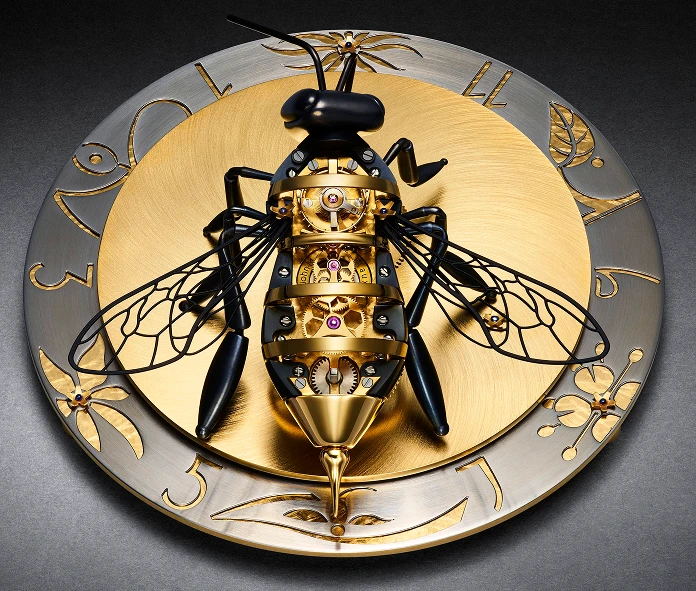
Flaux has been explicit that he has no interest in running a company or committing to catalogue production, however commercially sensible that might be; he describes his atelier instead as a laboratory of ideas, design, and artisanal work producing series of three to a maximum of ten pieces, with roughly 80% of every piece made by his own hand and the remainder entrusted to fellow Franc-Comtois artisans and local workshops he deliberately keeps close by. His work plays constantly with the border between watchmaking's mechanical vocabulary and forms entirely outside it: 2018's Car Clock and Time Fury P18 — two ten-piece automaton series inspired by 1930s Bugatti racing cars, in which a working clockwork movement takes the place of an engine beneath the bonnet — sold out quickly, followed by non-time-telling automatons including Le Duel, which he kept for himself, and a pair of rearing horses, Le Cabré and Le Cabré II, created in collaboration with the atelier Ben & Bros. He delights in turning purely decorative details into functional ones: the sting on his L'Abeille Mécanique automaton bee is, in fact, its hour hand, rotating on its base to point out the time, while the exhaust pipe on the Time Fury P18 doubles as its winding mechanism. L'Abeille Mécanique carries an explicitly engaged message about humanity's relationship with the natural world and the threats currently facing bee populations, and the piece carried Flaux to the top five of more than 1,000 entries worldwide as a finalist for the inaugural Louis Vuitton Watch Prize for Independent Creatives in 2023–2024.
That same instinct for turning historical erudition into wearable mechanical art produced Homage to al-Jazari, Flaux's second collaboration with Ben & Bros after 2021's Le Cabré. The piece reproduces, in miniature and on the wrist, the Elephant Clock devised by the 12th-century Mesopotamian polymath al-Jazari, documented in his Book of Knowledge of Ingenious Mechanical Devices — the first time this particular automaton had ever been translated into a wristwatch.
A small sub-dial at 12 o'clock carries the entire conventional time display, its blued minute hand paired with a 24-hour disc glimpsed through a window and hand-painted in miniature with a reproduction of the historic Elephant Clock; the rest of the dial belongs to the automaton itself, where an arc of perforated hour-symbols slowly flips from white to black across the day to track the passage from sunrise to sunset, and two hand-painted silver dragons animate every half hour, tilting back like a lever before springing to their original position. The 42mm by 13.3mm steel case houses a modified hand-wound Unitas base beating at 18,000vph (2.5Hz) with 40 hours of reserve, its bridge lacquered, its edges hand-engraved with inward-angled anglage, and its main plate signed in the tradition of old watchmaking masters; the caseback is hand-painted with the original al-Jazari illustration as it survives in one of the rare 13th-century manuscript copies of his work. Limited to ten pieces at CHF 49,000 and finished with silver dragons, cloisonné lacquer, and miniature painting contributed by fellow métiers d'art specialists, Homage to al-Jazari distils Flaux's whole project into a single object: horology treated not as a closed tradition to be repeated, but as a living, borrowable language for telling entirely different stories.