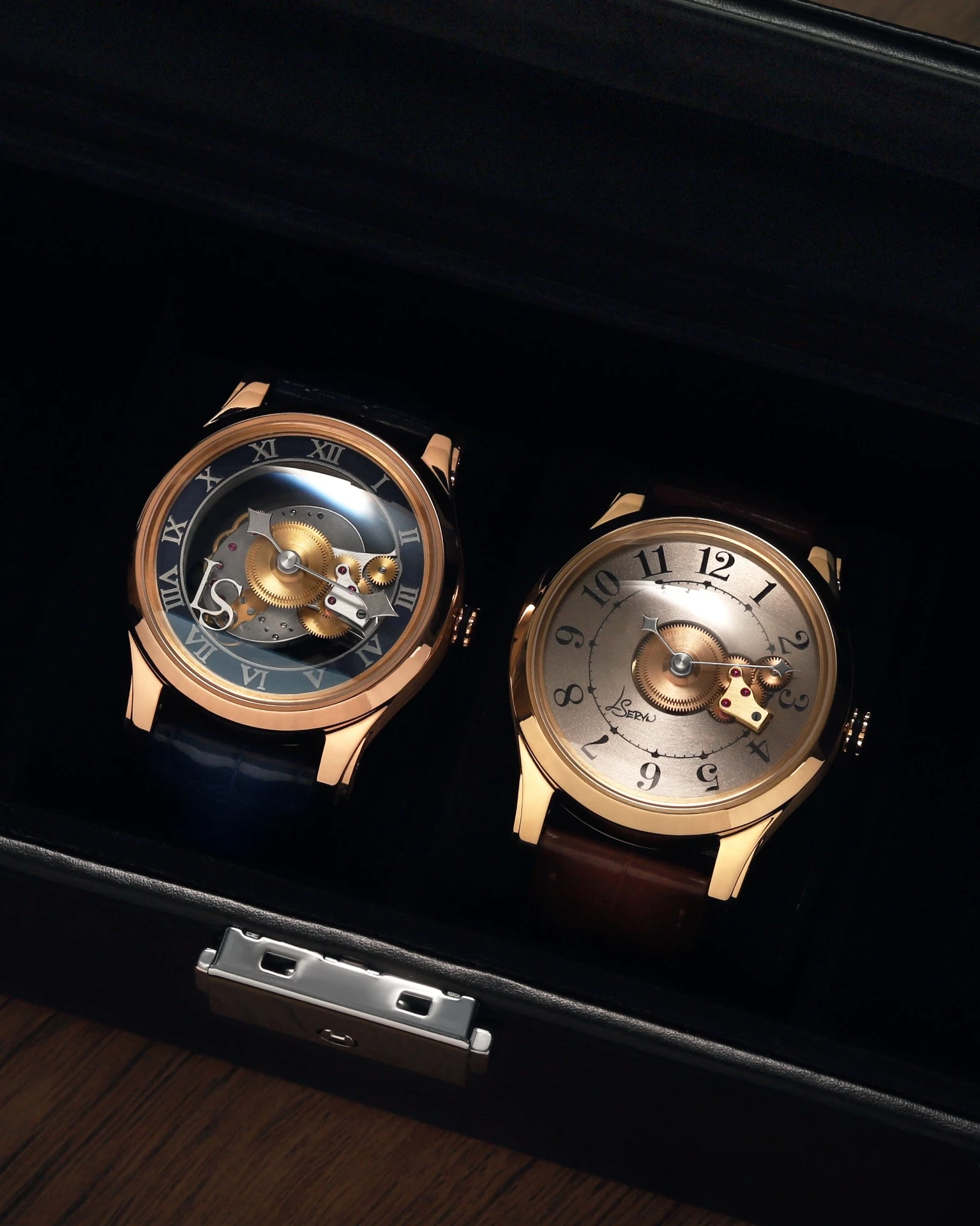
Luděk Seryn
Luděk Seryn trained as a watchmaker from 1993 to 1996 and then as a goldsmith from 1996 to 1999, before establishing his own private atelier in 2002 in his native Czech Republic, initially focused on watchmaking, goldsmithing, watch servicing, and jewellery production. In 2006 he began experimenting with the construction of his own in-house watch cases, and by 2009 he presented the first Atelier LS watches — the Rectangular and Round Classic models, in gold cases fitted with Swiss movements — at his first public presentation in Prague. The atelier's real turning point came in 2013, with the creation of the Imperator model and the introduction of its first in-house calibre, the LS2012, first used in the Carabus model; further LS2012-based watches followed in 2014 and 2015, including the Skeleton Round, Tonneau, and Skeleton Lady.
In 2016 Seryn began developing the Karel Rotation, a watch built around an entirely rotating movement architecture, presenting it on the global stage in 2019. Its debut led to an invitation among the candidates of the Académie Horlogère des Créateurs Indépendants (AHCI), and Seryn became a full member in 2021; since 2019 he has also served on the jury of the Grand Prix d'Horlogerie de Genève (GPHG). The rotational concept continued through the Jitka Rotation (2020), the RO-18 (2022), and the Adam Rotation, developed between 2023 and 2025 and limited to just three numbered pieces.
The atelier itself has moved five times, each move marking a distinct phase of the work. It began in 1995 on a simple workbench at Seryn's parents' house, repairing watches for friends and neighbours; from 2002 to 2011 it operated out of former pram-storage rooms on Nádražní Street in Mohelnice, where the first Atelier LS watches — the Rectangular, Classic Round, and Nolanus — were built. A custom-designed workshop in Mohelnice's Kovárna building followed from 2011 to 2015, producing the Carabus, Imperator, Skeleton Round, and Tonneau; from 2015 to 2023 the atelier operated from a duplex apartment at Náměstí Míru in Prague, where the Skeleton Lady, Karel Rotation, Jitka Rotation, and RO-18 were all created. Since 2023 the atelier has been based in Motol, Prague, now supported by a small team of collaborators — though the Mechanica line continues to be personally assembled by Seryn himself, with only the simpler Simplex line assembled alongside a collaborating watchmaker.
Mechanica represents the highest level of construction in the atelier, completed at a rate of only around two watches a year — in some years, just one. The line began with the Karel Rotation (completed 2018): a rotating base carrying two independent movements working in synchrony, completing a full rotation every eight hours on two barrels with roughly 40 hours of reserve, its concealed platinum rotor mounted on a sapphire track and its time set via a manual key built into the case. The 18ct gold, 45mm case houses 54 jewels running at 18,000vph. The Jitka Rotation (completed 2019) is a more delicate reading of the same idea: a dial-less 37mm case in platinum and gold, indices set beneath the crystal so the hand-assembled Calibre RO-18 movement is fully visible, with a side aperture at nine o'clock and, on this piece, 80 diamonds totalling 0.54 carats.
The RO-18 (completed 2021) reworks the rotating architecture into a new, patented, manually wound generation, available either fully skeletonised or with a calmer full dial, in a 43mm case with 42 hours of reserve. The Adam Rotation, or 'ADR' (completed 2025), pushes furthest: a thinner, bridge-less 44mm case built around a proprietary peripheral rotor with a cycloidal gear system — a first for the atelier — carrying two independent movements linked by a differential and completing one rotation every eight hours, with 45 hours of reserve and up to 288 components depending on version. Limited to three numbered pieces, each is customisable down to the colour of its mechanics and the design of its gold case.
Simplex is the atelier's simpler, Art Deco-inflected line, capped at no more than 40 pieces a year; its first steel model, Art Deco (introduced 2025), rebuilds the mechanical foundation of the earlier Carabus around the in-house LS2012 calibre in a 43mm case. Every Mechanica piece is logged by hand in the atelier's Almanach of Production, maintained since 2012, recording a photograph, completion date, technical details, and the name of the first owner in Seryn's own writing; on collection, the owner's certificate and the Almanach entry are signed with the same fountain pen, a small ritual that marks their entry into what the atelier calls the Circle — an informal, unstructured community of collectors and owners connected by their relationship to the watches and the work behind them.