Minase
Minase is a small Japanese manufacture founded in 2005 in the village of Minase, in the mountains of Akita Prefecture in northern Honshu — a place so deep in the countryside, as the company's own craftsmen like to point out, that no one would ever suspect industrial production of any kind happens there, let alone some of the most obsessively finished watch cases in Japan. The brand grew out of its parent company Kyowa, a precision drill maker, and honors that heritage in its logo: a stylized drill head that appears on the polyhedric crown and on the movement rotor of every watch. When Minase launched, it hired people from the surrounding region and trained them in-house following the principle of Monozukuri — learning by doing — building a workforce of local artisans that today produces fewer than 500 timepieces a year. Every watch carries the brand's registered HiZ label, a conjunction of the Japanese words 'Hizu' (exceptional) and 'Hi Izuru Kuni' (land of the rising sun), which certifies the three pillars of a Minase watch: Sallaz finishing, the patented Case-in-Case construction, and the MORE concept.
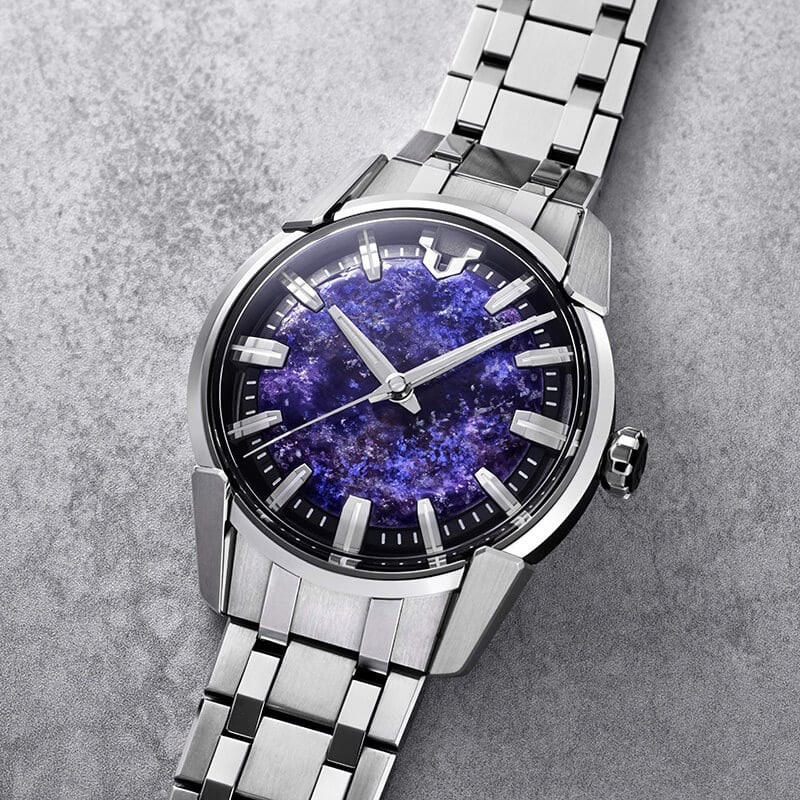
Those three pillars define the brand's technical identity. Sallaz polishing — better known internationally as zaratsu — takes its name from the Swiss-German polishing-machine maker Sallaz, which supplied equipment to the Japanese case maker Hayashi Seiki Seizo, the pioneer of the technique in Japan; steel components are held by hand against a rotating wheel charged with diamond powder until they achieve a perfectly flat, distortion-free mirror surface. Polishing a single Divido on its steel bracelet involves up to 479 separate processes and more than 15 hours of work, and a Windows case takes over 20 hours. The Case-in-Case structure, inspired by Japanese three-dimensional puzzles, does away with a conventional dial entirely: the movement is enclosed between a plate and a top container fixed by four tiny corner screws, so the whole inner box appears to float inside the outer case beneath a box-type sapphire crystal, with light flooding in from all sides. The MORE concept (Minase Original Rebuild Equation) is a patented construction allowing every exterior component — case, bracelet, all of it — to be disassembled and reassembled as many times as needed, so the watch can be serviced and treasured for more than a century. Bracelets hide all their screws on the underside of the links, leaving no visible pins when worn.
Movements are Swiss, based on ETA 2892 (and 2671 for the smaller models) ébauches customized to top-grade specification for Minase: perlage, blued screws, diamond-polished bevels on the bridges, black gold plates, MPS lubrication-free bearings, and the ETACHRON regulating system, running at 28,800 vph with 50 hours of power reserve. Four collections carry the catalogue: the round Divido, whose stamped-copper lacquered dials are inspired by Suiboku-ga ink-and-water painting and whose date window shows the preceding and following dates with an arrow marking the current day; the Uruga, a softer round family in 42 mm and 31 mm designed by Hirokuni Yamamoto; the architectural Horizon (original production now ended, continuing in midsize form); and the extraordinary Windows, whose seven-sided case is set with seven sapphire crystals offering a 360-degree view through the watch, offered in a five-crystal 40 × 32 mm midsize alongside the regular 38 × 51 mm model.
The Windows also serves as the base for Minase's Masterpieces — bespoke métiers d'art commissions that read like a roll call of living Japanese craft. Urushi lacquer dials are painted by Junichi Hakose, one of the most internationally acclaimed lacquer artists in Japan, for whom the Minase dials were his first horological work; his shibo urushi technique mixes lacquer with paint and egg white into a viscous medium that lets him sculpt puddle-like pools of color, while classic urushi dials are built up in repeated heated layers before micro hand-painting with metal powders and flat hirame gold flakes. Maki-e ('sprinkled picture') dials are made in Kyoto by urushi master Megumi Shimamoto, who dusts silver powder through bamboo tubes onto wet lacquer before sealing, polishing, and sun-curing each dial. Cases and dials can be hand-engraved by master engraver Kenji Kanagawa, and Minase also revives Akita silver filigree — twisting pure silver wires just 0.2 mm in diameter into openwork dials, a craft descended from the prefecture's centuries as Japan's most productive gold- and silver-mining region; filigree clients receive the artisan's original drawing along with the finished watch.
The newest chapter is the Yusai series by Tokyo-born artist Towa Takaya, whose dials are painted entirely with natural pigments she prepares herself from soil, plants, and other materials gathered on her travels, in compositions named Pluralistic Garden, Falling Stars & Mirage, and Otherwise than Being. Enamel champlevé, diamond setting, 18k rose or yellow gold cases, and personal text engraved on the movement holder round out the options. Prices run from roughly CHF 3,500 for a Horizon Midsize on rubber through CHF 8,700 for a Shibo Urushi Divido and CHF 15,850 for a Hakose Windows, to CHF 22,900 and beyond for gold Masterpieces, with fully bespoke commissions quoted individually; a European office in Bienne, Switzerland handles international distribution. The result is one of the most distinctive propositions in Japanese independent watchmaking: Swiss mechanics wrapped in uncompromisingly Japanese cases, dials, and philosophy.