Kikuchi Nakagawa
An unlikely partnership that has become one of the most quietly admired names in independent watchmaking — often compared to Philippe Dufour for its restraint and obsessive finishing. Yusuke Kikuchi graduated in architecture from the prestigious University of Tokyo and worked at a domestic software vendor before the pull of mechanical objects proved stronger than lines of code; he retrained as a watchmaker. Tomonari Nakagawa trained originally as a swordsmith — a discipline central to Japanese culture — before pursuing watchmaking. The two met in Paris and, sharing a love of 1930s–40s wristwatch design and an obsessive purity of line, founded Kikuchi Nakagawa together in 2018 (Yusuke had previously made watches solo under his own name).
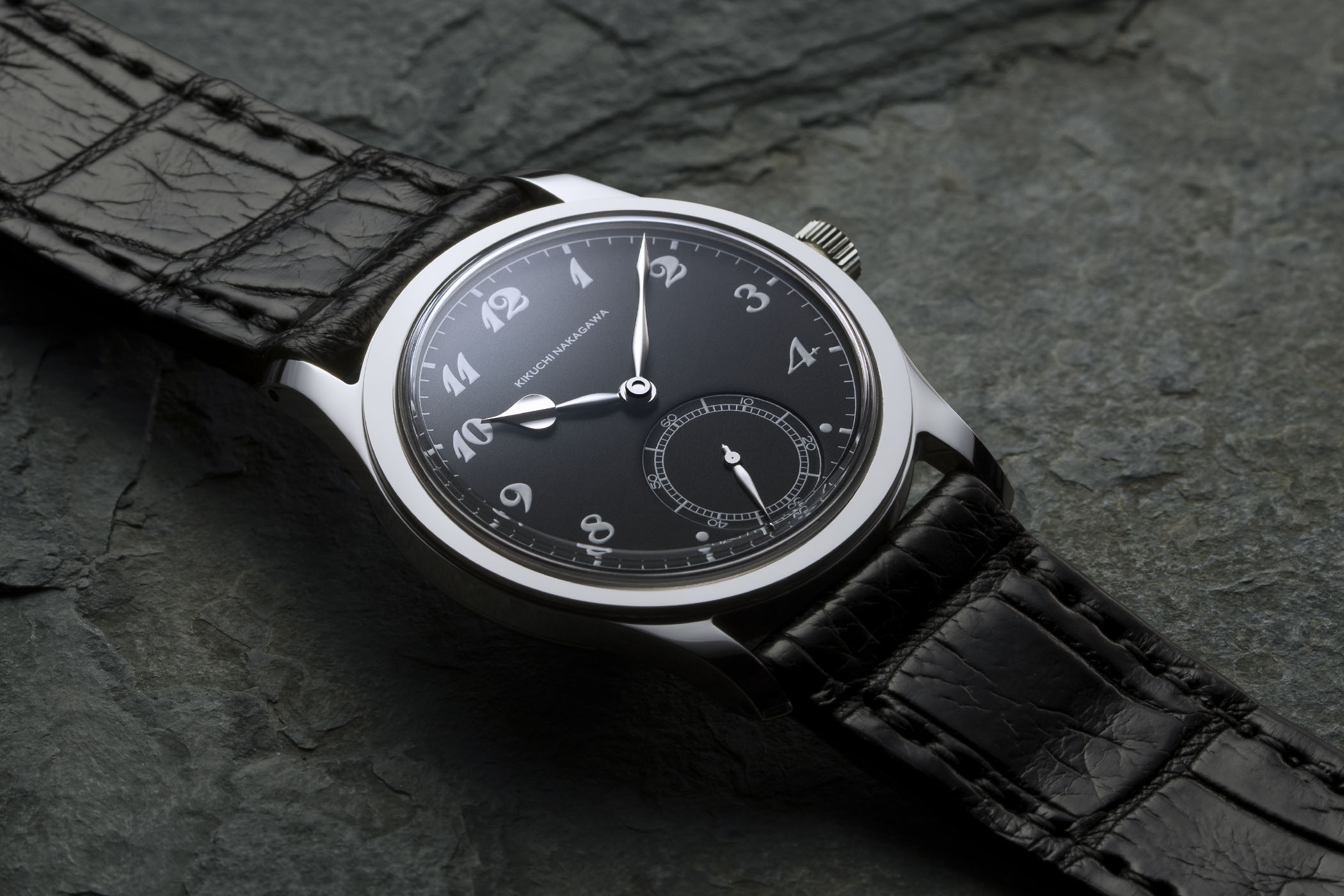
The house style is best described as the most ambitious possible interpretation of early-to-mid-century Swiss design codes — particularly the Patek Philippe ref. 96 Calatrava — but pushed to a level of finishing that Calatrava never received. Central to this is black polishing (poli noir), an extremely time-consuming hand technique traditionally reserved for tiny components, which Kikuchi Nakagawa applies to large primary movement components — something most Swiss watchmakers would consider unfeasible at scale. The Murakumo (debut) and Ichimonji models feature sculpted spade hour hands that catch and reflect light dramatically against pitch-black polished surfaces, finely grained matte black or white dials, printed Breguet numerals, a large recessed sub-dial for seconds, and a sharp minute track at the periphery — all signature elements. Collectors favourites include the Divido and Five Windows. Tomonari Nakagawa's swordsmith-trained hands lead much of the assembly and metal finishing, while Yusuke Kikuchi, the architecture graduate, drives design. A fascinating, understated atelier representative of the new wave of Japanese independent horology.
Before founding the brand together, Kikuchi had already tested his own instincts: back in Japan after his Paris apprenticeship, he ran a small solo maison called Chronomètre, building original watches and writing technical articles on constant-force mechanisms for Chronos Japan — theoretical grounding that fed directly into the restraint of what followed. The Murakumo takes its name from the Japanese for 'gathering clouds,' and the dial earns it: rather than a conventional sunburst or guilloché, the surface is treated to a soft, almost organic texture that shifts with the light, evoking a misty sky rather than a manufactured pattern. Both the Murakumo and Ichimonji are powered by a Vaucher 5401 micro-rotor movement — a deliberate choice for its slim profile, which lets the case stay faithful to Calatrava-era proportions, even though the maker's own philosophy of visible craft means the movement itself sits hidden behind a solid caseback, a tension the brand accepts without apology. A third model, the Genmon, has since joined the line, continuing the same restrained vocabulary. Demand tipped into the extraordinary after the brand was mentioned favourably in a Hodinkee video by musicians Ed Sheeran and John Mayer, prompting Kikuchi Nakagawa to close new inquiries altogether; the atelier's Instagram now states plainly that it is focused entirely on production and regretfully cannot respond to new requests, and waiting times for existing orders are reported to run as long as a decade. For a house producing perhaps a handful of watches a year, that combination of scarcity and obsessive finishing has made Kikuchi Nakagawa one of the most quietly coveted names to emerge from Japan this decade.