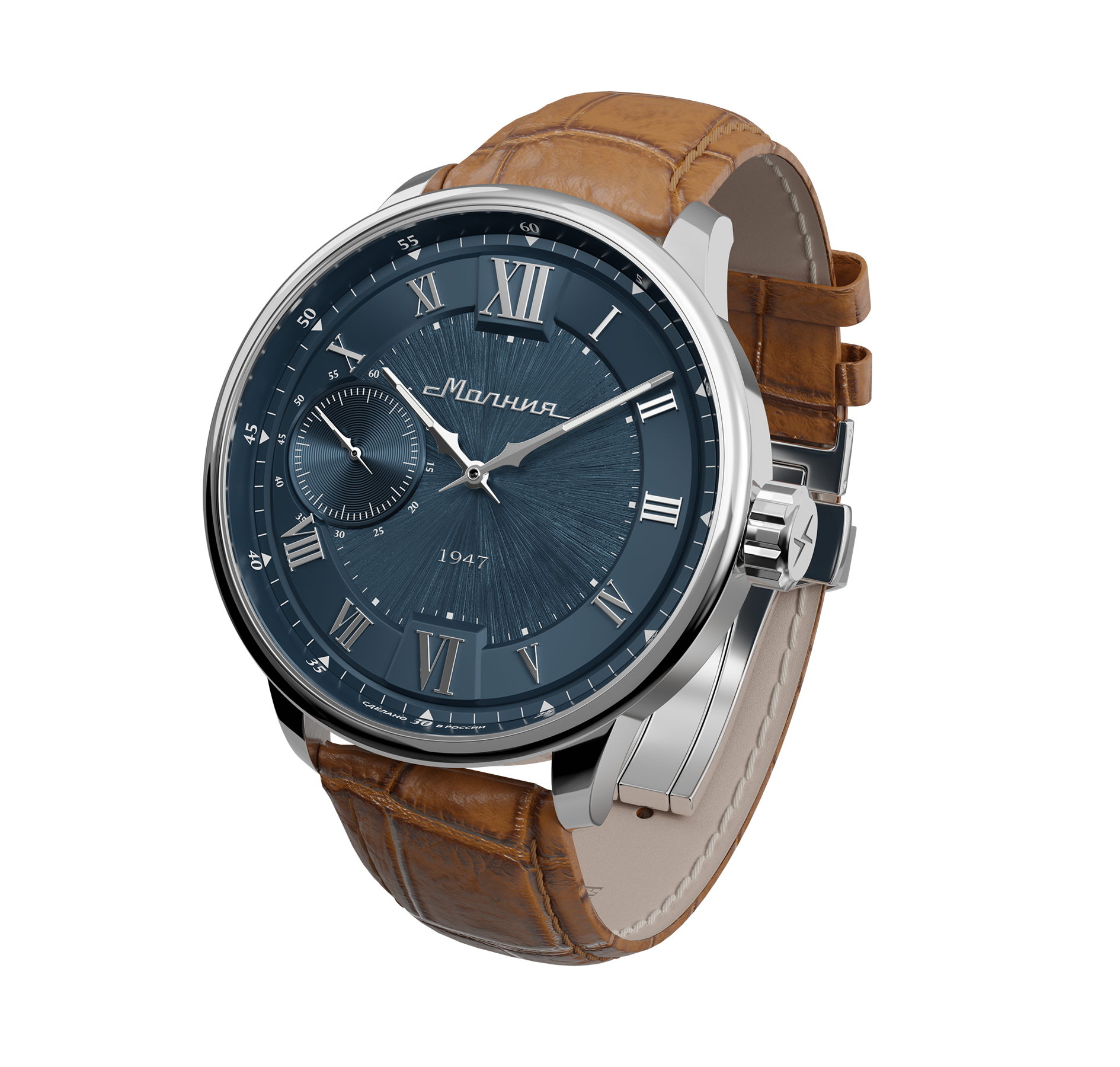
Molnija
Molnija — Russian for 'lightning' — is the storied watch factory of Chelyabinsk in the Southern Urals, and one of the very few enterprises in Russia (alongside Raketa and Vostok) still manufacturing complete mechanical movements in-house. Its origin story is one of watchmaking's strangest: in 1929 the Soviet trade mission in America, Amtorg, bought two bankrupt U.S. factories — the Dueber-Hampden Watch Company of Canton, Ohio and the Ansonia Clock Company of New York — and shipped their machinery home to seed the First and Second State Watch Factories in Moscow. When the First Moscow Watch Factory was evacuated east during World War II, its Ural offshoot took root, and in 1947 the Chelyabinsk Watch Factory was established, building high-precision instruments for military aircraft, tanks, and naval ships — clocks engineered to shrug off extreme cold, heat, and shock, which served Soviet and Russian aviation for decades (the AVR-M cockpit clock entered production in 1951). Pocket watch production began in 1949, and the ChK-6 movement — descended from the Swiss Cortebert 620 — evolved into the immortal calibers 3602 and shock-protected 3603. At its Soviet peak the factory turned out more than a million pocket watches and 30,000 specialized instruments annually, exported to over 30 countries, and collected international honors from Austria, Mexico (the Golden Arch), Spain (Diamond Star), France (Golden Eagle), and Switzerland (a technology prize); its metallurgists even developed a new invar alloy for quartz tuning-fork watches accurate to 30 seconds per year. Molnija pocket watches were awarded, gifted, and passed down through Soviet generations — special editions served railway workers, miners, and the blind (with Braille dials).
The post-Soviet decades nearly killed the factory, but privatization in 2010 began a slow revival: by 2016 the original machinery and tooling were back in service, and in 2018 the reborn manufacture did something it had never done in the Soviet era — put its legendary caliber into wristwatches. The hand-wound 3603, mass-produced from 1984 and revived unchanged in its essentials, uses a spring-suspension shock system whose thin support rods let the balance survive a one-meter drop onto a solid surface. True to its military DNA, Molnija subjects civilian watches to combat-grade acceptance testing: climatic chambers with maximum temperature gradients, a unique vibration-and-shock test bench, hydrostatic pressure testing, humidity desiccators, and a dust chamber simulating blowing and static dust. Signature touches include heat-blued hands colored by heating in a special solution, decorated movements visible through transparent casebacks (the 'TCB' models), and hand-engraved pocket watch lids that constitute 80 percent of the work on its classic line.
Today the catalogue spans aviation-themed collections like the Berkut with the in-house 3603, the Tank line, the Tribute 1984 honoring the caliber's launch year, the Etude and Green Ray, plus marine, military, sport, and classic families, skeleton table clocks, and — since 2019 — a first women's collection, developed with leading Russian and international watch design studios. Pricing remains defiantly accessible for a true manufacture, with in-house-caliber models selling for a few hundred dollars, direct from the factory's official shop with worldwide DHL delivery. For collectors, Molnija offers something almost extinct: an unbroken mechanical lineage from 1940s Ohio tooling through Soviet aviation history to a living Russian manufacture — lightning, still striking after 75 years.