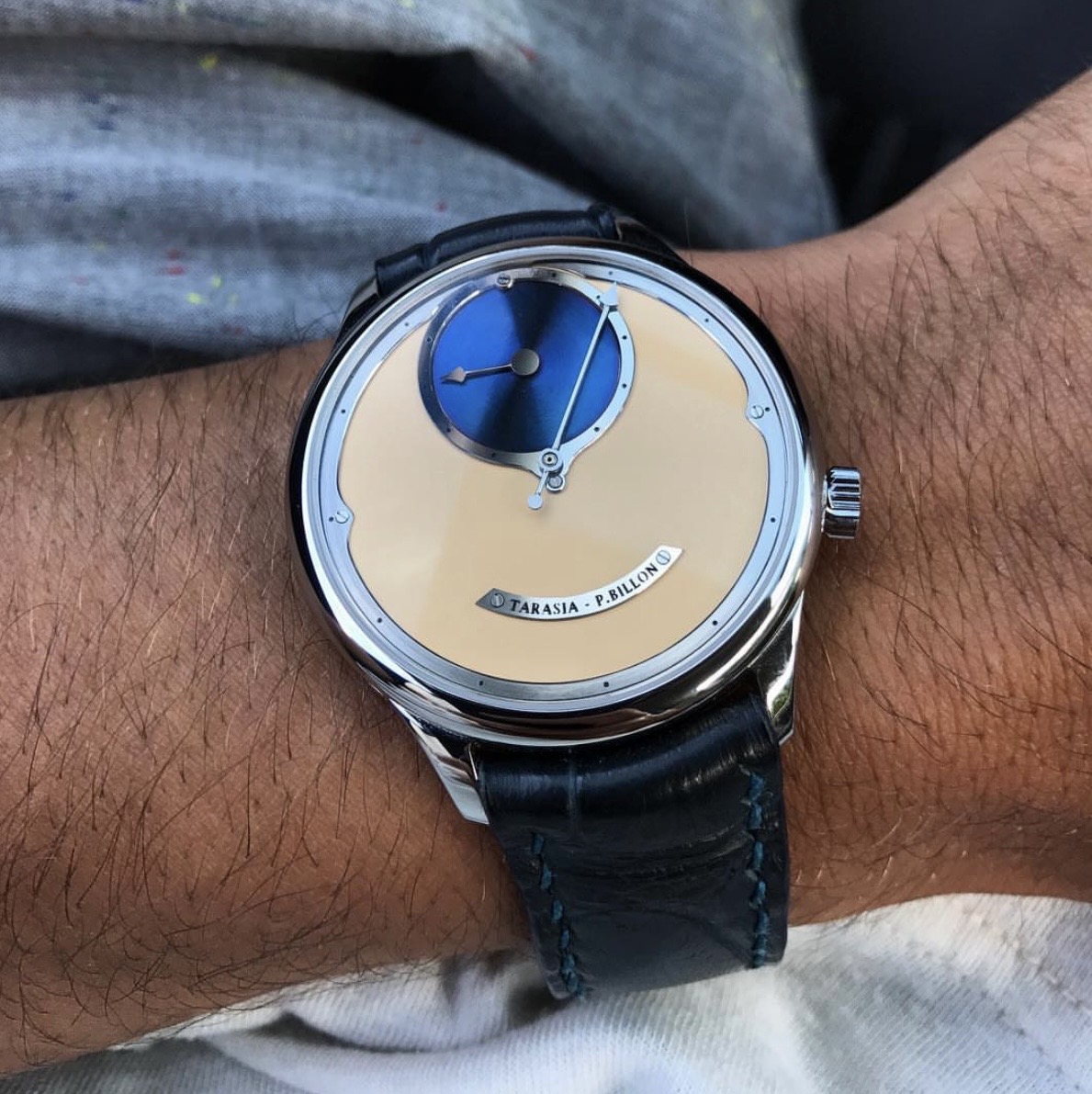
Pierre Billon
Pierre Billon is a French watchmaker whose formal training was completed at the Lycée Edgar Faure in Morteau, where he earned the Diplôme des Métiers d'Art in horology — the same demanding French qualification and, notably, the same institution that has produced other names now emerging in independent watchmaking. Morteau sits at the heart of the French Jura, a region with deep historical ties to watch and clock manufacturing across the border from the Vallée de Joux, and the Lycée Edgar Faure is one of the most respected training grounds in France for the traditional hand-finishing disciplines that define the finest end of the craft. Billon's work, as documented on his own account, centres specifically on those traditional techniques: hand-beveled edges, flame-blued components, and the patient, loupe-based finishing methods that separate genuinely hand-worked components from machine-finished ones — the kind of unglamorous, hour-consuming discipline that rarely photographs as dramatically as a finished dial, but which forms the technical foundation every serious independent watchmaker is built on.
His notable graduation piece, Tarasia, created in 2017 during his time at Morteau, stands as the clearest public demonstration of that training. The watch is built around a modified, hand-finished movement, and its most visually striking details are its flame-blued elements — components coloured through traditional heat-bluing, a technique requiring precise control of temperature and timing to achieve a consistent, jewel-toned finish across steel components — paired with intricate manual anglage throughout: the hand-beveling of internal angles on bridges and plates, one of the most demanding and time-intensive finishing techniques in all of watchmaking, executed entirely by eye and hand under a loupe rather than by machine. As a school watch, Tarasia represents the traditional culmination of a French watchmaking education: a single, fully realised piece intended to demonstrate mastery of hand-finishing at the highest level demanded by the Diplôme des Métiers d'Art programme, built the same way generations of Morteau-trained watchmakers have proven their skills before going on to careers at maisons across the Jura Arc and Switzerland, or, as an increasing number of talented graduates are now choosing, toward independent careers of their own.
The Lycée Edgar Faure's programme that shaped Billon is itself worth understanding, because it explains why Morteau has become such a reliable feeder of independent talent. Students progress through three years toward the DMA, with the final year devoted entirely to designing and building an original watch from scratch, each class's graduation project assigned a real watchmaking sponsor and theme — chiming complications under the movement-maker La Joux-Perret in one recent year, automatism under young independent Olivier Mory in another — with the finished piece judged against the highest standards of excellence horlogère rather than merely passed or failed. It is this crucible, repeated year after year with a new cohort and a new sponsoring theme, that has quietly produced an outsized share of France's emerging independent watchmakers, Billon's Tarasia among them. Public detail on Billon's activity since his 2017 graduation piece remains sparse compared to some of his better-documented Morteau classmates, a reminder that not every graduate of this remarkable school pursues the same public-facing path toward an eponymous brand; some continue restoration work, others move into maisons across the Jura Arc, and others still work quietly on independent commissions without courting the press coverage that has followed contemporaries like Théo Auffret. Whatever form his subsequent career has taken, Billon's inclusion on this list stands as recognition of Morteau's training itself — proof that the discipline instilled by the Diplôme des Métiers d'Art produces watchmakers capable of world-class hand-finishing before they ever set up their own workshop.