Hazemann & Monnin
Hazemann & Monnin is the independent watchmaking atelier of Alexandre Hazemann and Victor Monnin — two young French watchmakers whose friendship, creative partnership, and shared ambition have already made them the most decorated independent duo of their generation. They met on the benches of the Lycée Edgar Faure in Morteau — the same school in the Franche-Comté that produced Théo Auffret (F.P. Journe YTC 2018), Rémy Cools (F.P. Journe YTC 2023), Florent Lecomte, Cyril Brivet-Naudot, and a remarkable number of the most respected young independents in French watchmaking. From their very first year Hazemann and Monnin recognised in each other the same ambition and uncompromising work ethic: a determination to see every project through to the end, even if it meant long nights and weekends at the bench. Victor Monnin is a fourth-generation watchmaker — horology is not a passion he discovered but a heritage he was born into. Alexandre Hazemann was drawn by the need to express his creativity: 'At a certain point, you become an entrepreneur because it is the only way to follow your dreams.' Their mentors at Lycée Edgar Faure included Simon Brette, Sylvain Pinaud, and Emmanuel Bouchet, best known for his complications work at Harry Winston. Their skills are deeply complementary: Alexandre leads engineering, watchmaking calculations, construction, and prototyping; Victor leads project management, organisation, CNC machining of components, and aesthetics.
The School Watch — Montre École — began as their seventh-year graduation project at Lycée Edgar Faure, carried out between October 2021 and June 2022: sketches from October to November; computer design and watchmaking calculations from December to January; prototyping and production from February to June. The challenge they set themselves was one that few watchmakers at any career stage would have attempted: a watch combining two complications that rarely coexist — an instantaneous jumping hour and a sonnerie au passage (an hour-strike that chimes autonomously at the top of each hour without any intervention from the wearer). Both complications are driven by a central snail cam whose rotation advances the mechanism at precisely the right moment. One of the most demanding aspects of the sonnerie au passage was tuning the gong: Hazemann and Monnin adjusted the pitch, resonance, and clarity of the chime by carefully removing material with a file while listening to the sound, using their ear alone as the instrument of measurement — the same approach Abraham-Louis Breguet and his contemporaries would have used. Hazemann's version of the school watch — the AH.02 Signature, with blue pinstripe accents on a skeletonised dial — won the F.P. Journe Young Talent Competition in 2023, bringing the pair to the attention of the international watch press and collector community. The CHF 50,000 prize and the global platform it provides were instrumental in giving them the confidence to establish their own atelier.
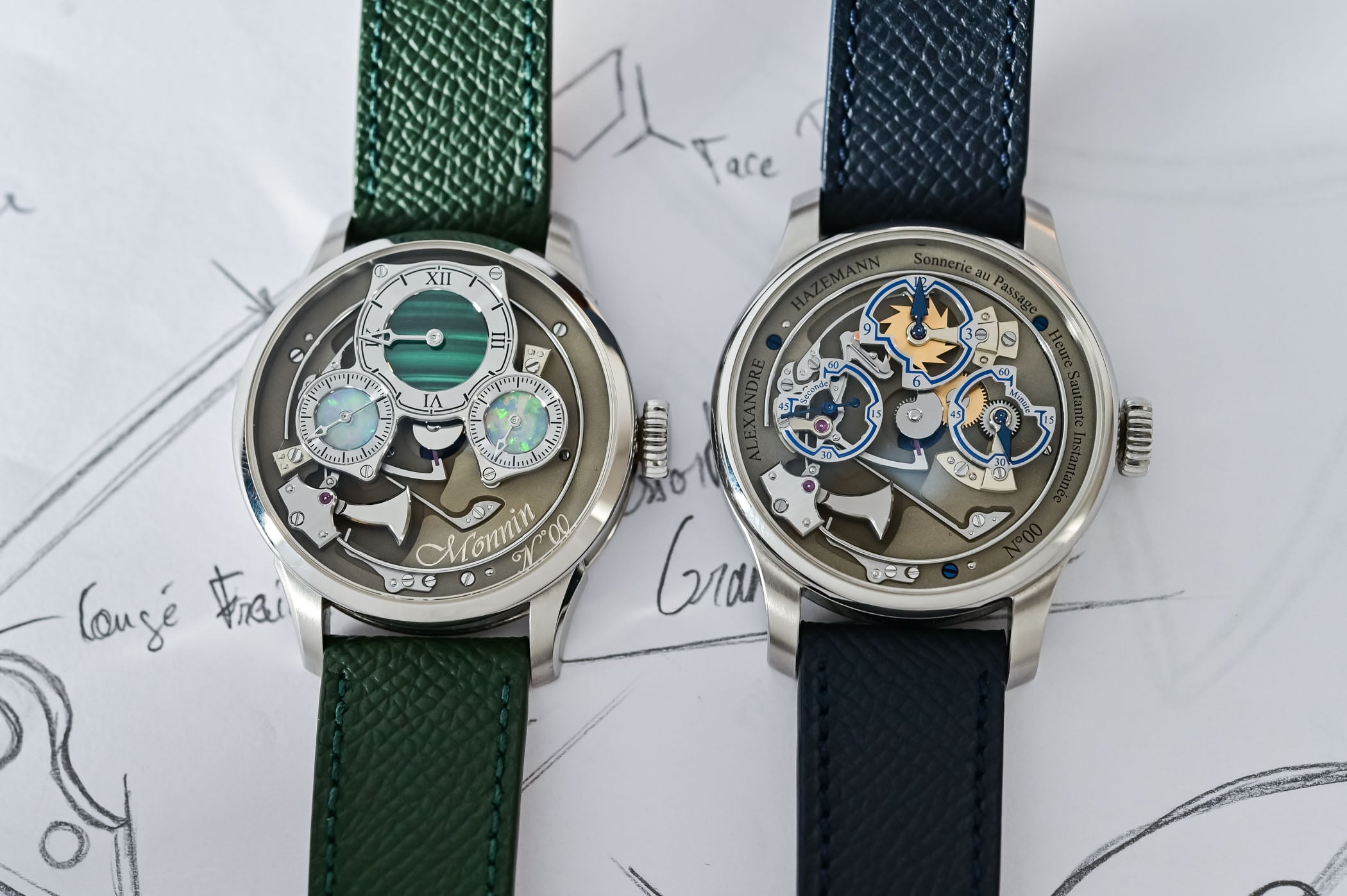
In 2024 they founded their workshop in Saint-Aubin-Sauges, on the shore of the Lake of Neuchâtel in Switzerland — beginning without investors, reusing tools and workbenches from their training years. The commercialised Montre École Souscription — inspired by the school project but substantially re-engineered — is now their debut production watch. The calibre HM01 is designed entirely in-house: where the school project was built on a La Joux-Perret 6900 base, everything has been reengineered from scratch. The elegant movement architecture aligns the barrel, centre wheel, and balance along a single vertical axis across distinct layered planes. The HM01 beats at 18,000 A/h (2.5Hz) — a deliberately slow beat that makes the balance's oscillation visible and meditative — with a 50-hour power reserve and 19 jewels. The jumping hour and sonnerie au passage mechanism is fully visible dial-side on the skeletonised version, creating what Monochrome described as 'a captivating orchestration of sound and movement.' The 39.5mm × 10.9mm steel case houses a regulator-like dissociated display of hours, minutes, and seconds; a transparent caseback reveals the movement's other face. The Souscription edition consists of 20 pieces in two distinct interpretations — a production innovation that allows each watchmaker's signature to survive into the commercial watch. Hazemann's version features a skeletonised dial with blue pinstripes, making the mechanism completely transparent; Monnin's version features a natural stone dial in malachite and opal, where nature's patterns provide the visual interest rather than mechanical architecture. Both versions carry the sonnerie au passage; both are individually regulated; both carry the names of both makers on the dial.
On 25 March 2026, at a ceremony at the Fondation Louis Vuitton in Paris, Hazemann & Monnin were awarded the Louis Vuitton Watch Prize for Independent Creatives — the second edition of the prize launched by Jean Arnault in 2023 to support promising independent watchmakers. They were chosen from more than 1,000 applications whittled to 20 semifinalists and then five finalists, by a jury that included Carole Forestier-Kasapi and Kari Voutilainen. The award carries a €150,000 grant — the largest monetary prize in independent watchmaking — and a year-long personalised mentorship at La Fabrique du Temps Louis Vuitton covering not only watchmaking but also marketing, industrial strategy, and brand development. Raúl Pagès, who had won the inaugural prize in 2024 for his RP1 Régulateur à Détente, handed the silver spiral-shaped trophy to the duo. The recognition confirmed what collectors had already noticed: two watchmakers, only two years into their independent career, already holding two major international prizes — and with a new complication in a new case announced for 2027. The atelier now employs approximately fifteen people across watchmaking, design, engineering, decoration, and operations. 'Craftsmanship is not dead.'