Raketa
Raketa's roots run deeper than almost any watchmaker in this catalogue: the factory was founded in 1721 by Peter the Great as the Imperial Peterhof Factory, producing hardstone and lapidary works for the Russian court near St. Petersburg; a centre table it made for Emperor Nicholas I's 1844 gift to Queen Victoria still stands in Buckingham Palace today. After the Soviet revolution the factory turned to producing the Kremlin stars and Lenin's Tomb, then in 1938 began making the precision ruby stones used in watch movements — every Raketa watch since has carried 24 of them.
In April 1945, by order of the Kremlin, the factory created the watch brand Pobeda, whose timepiece became the first watch ever sent into space, aboard the Vostok 3KA No.1 capsule carrying the dog Chernushka; when Yuri Gagarin made the first human spaceflight in 1961, the Soviet Union renamed the brand Raketa, Russian for 'rocket,' in his honour. The factory went on to invent a 24-hour movement for the 16th Soviet Antarctic Expedition's Polar watch, engineered to function through six-month polar day-night cycles in temperatures as low as -89°C, and later produced the official timepiece of the 1980 Moscow Olympics.
After a difficult post-Soviet period, a 2011 modernisation programme made Raketa one of the very few watch factories anywhere producing every part of its own mechanical movement in-house, including the hairspring, among the most difficult components to make from scratch. Each movement's 242 parts pass through stamping accurate to 5 microns, Swiss automatic lathes positioning to within a single micron, gear milling to a 0.1mm tooth module, diamond-paste journal polishing inspected under electron microscopes for defects under 0.05 microns, and hand-applied decoration, before 103 specialists assemble the finished movement by hand in an ISO 7 cleanroom and subject it to 21 days of testing across four positions.
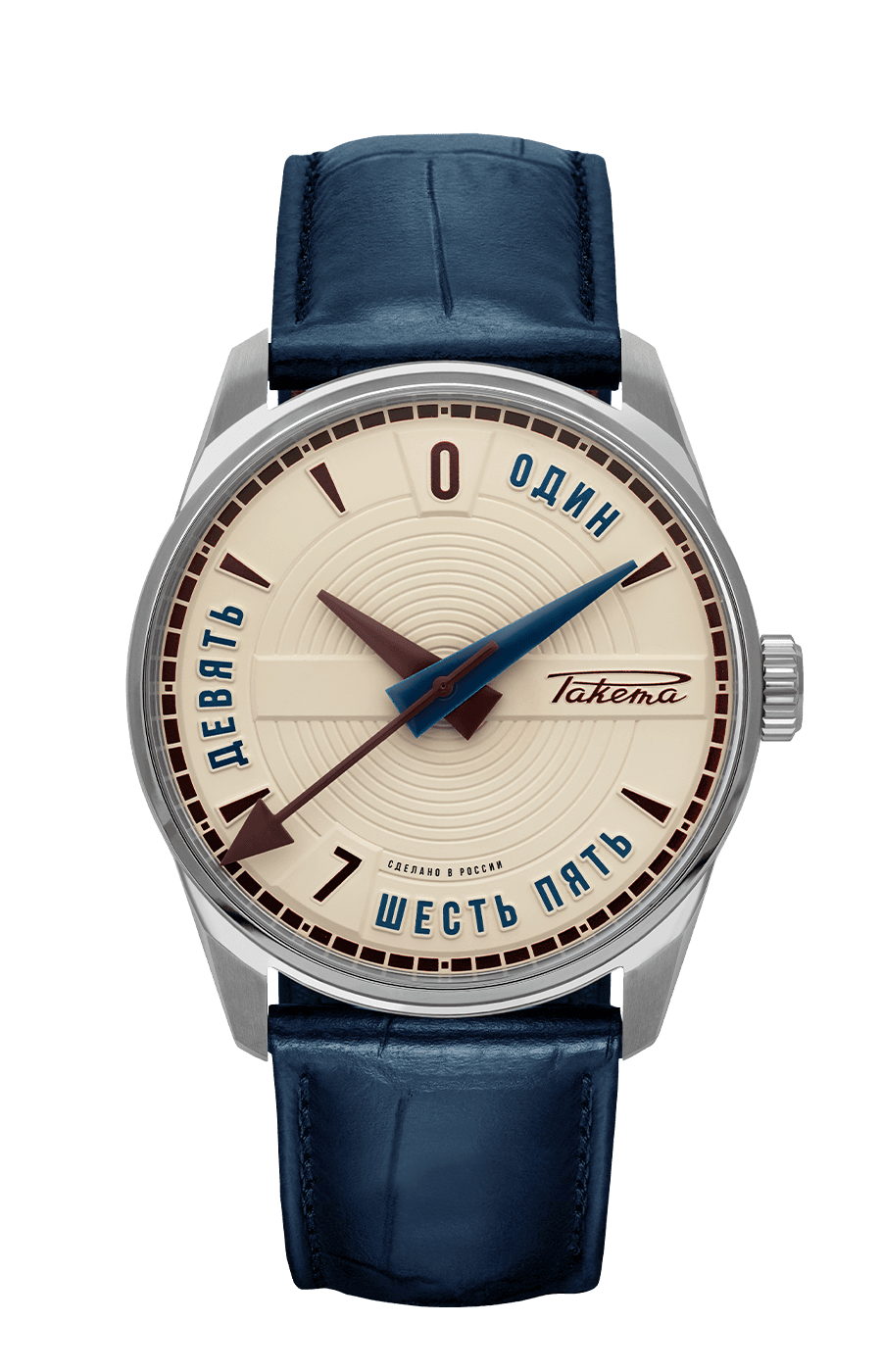
Among the factory's most distinctive pieces, the Russian Code runs its hands counterclockwise, mirroring the actual orbital direction of the planets around the Sun; achieving this meant building Calibre 2615CR, a self-winding movement with a deliberately reversed gear train, a modification the brand notes is only possible at a true manufacture. It carries 24 jewels and runs 40 hours of reserve at 18,000 vibrations per hour (2.5Hz), tested across four positions.
The Big Zero Lebedev, made with the celebrated Russian designer Artemy Lebedev to mark his studio's 30th anniversary, was limited to 300 pieces and introduced Raketa's first rubber strap with adjustable length. The Malevich series was developed with the Russian Museum in St. Petersburg, home to Kazimir Malevich's complete geometric cycle including the original Black Square; its dials are cut from genuine semi-precious stone selected to visually echo the paintings, and the name behind Raketa's broader Big Zero line traces directly to Malevich's own concept of reducing art to a 'zero of forms,' at once an ending and a new beginning.