RJ Watches
Romain Jerome was founded in Geneva in 2004 by Alain Bajulaz, a horology enthusiast and keen golfer who named the brand after his two sons, Romain and Jérôme. Its debut, the Golf Master Time, was comparatively conventional by what would follow: a 42.9mm chronograph in pink gold, white gold, or platinum, its sub-counters tracking holes played and strokes per hole rather than elapsed time, built on a modified ETA 2892-A2 and rated to withstand 5,000G — enough to survive an actual golf swing, even if its bulk made it impractical to wear while playing. Limited to 250 pieces per metal from around €28,000, with tourbillon versions in pink or white gold limited to 50 pieces each above €60,000, it found only modest commercial success.
In 2006 the brand brought in Yvan Arpa, formerly managing director of Hublot and credited with the Big Bang, who concluded that a house founded in 2004 had no heritage of its own to draw on — so he borrowed someone else's. The result, launched in 2007, was the Titanic-DNA: a case alloy incorporating a genuine fragment of the Titanic's hull, recovered two miles down in the Atlantic, combined with steel from the Harland & Wolff shipyard where the liner was built, its dial lacquered with coal dust from the wreck's debris field and its bezel deliberately aged and oxidised. Arpa described the intent as offering 'a message of hope, of life stronger than death, of rebirth.' The line expanded into ceramic and gem-set variants, with prices at its Baselworld launch ranging from 7,800 USD to over 173,000 USD. On July 6, 2009, Arpa and four members of his management team were abruptly dismissed; a three-year legal battle followed, which Arpa won, and he marked the victory with a one-off watch called Rust & Dust, its bezel formed from staples removed, over two weeks, from the mountain of legal paperwork the case had generated, and its dial containing ashes from a ceremonial burning of those same documents.
Majority shareholder Alliance Investment Group, headed by Saudi Prince Faisal bin Fahd bin Abdullah Al Saud, installed Manuel Emch, formerly head of Jaquet Droz, as the new CEO. Under Emch the brand pushed further into 'borrowed DNA': the Moon-DNA collection, limited to 1,969 pieces per the year of the first moon landing, embedded genuine carbon fibre from the Apollo 11 spacecraft and actual lunar sand; the 2010 Eyjafjallajökull-DNA incorporated ash and rock from the Icelandic volcanic eruption of that year beneath a molten-lava dial effect; and the Liberty-DNA, made with the Statue of Liberty-Ellis Island Foundation, set oxidised copper particles taken from Lady Liberty herself beneath a twelve-pointed bezel echoing her crown. From 2012 the brand turned to pop culture, licensing Space Invaders, Tetris, and Donkey Kong before 2015's Super Mario Bros. — a 46mm black-titanium watch with a hand-painted, pixel-textured dial marking the game's 30th anniversary, limited to 85 pieces at 18,950 USD — and further collaborations built around Batman, the Joker, Two-Face, Spider-Man, Pikachu, and Hello Kitty.
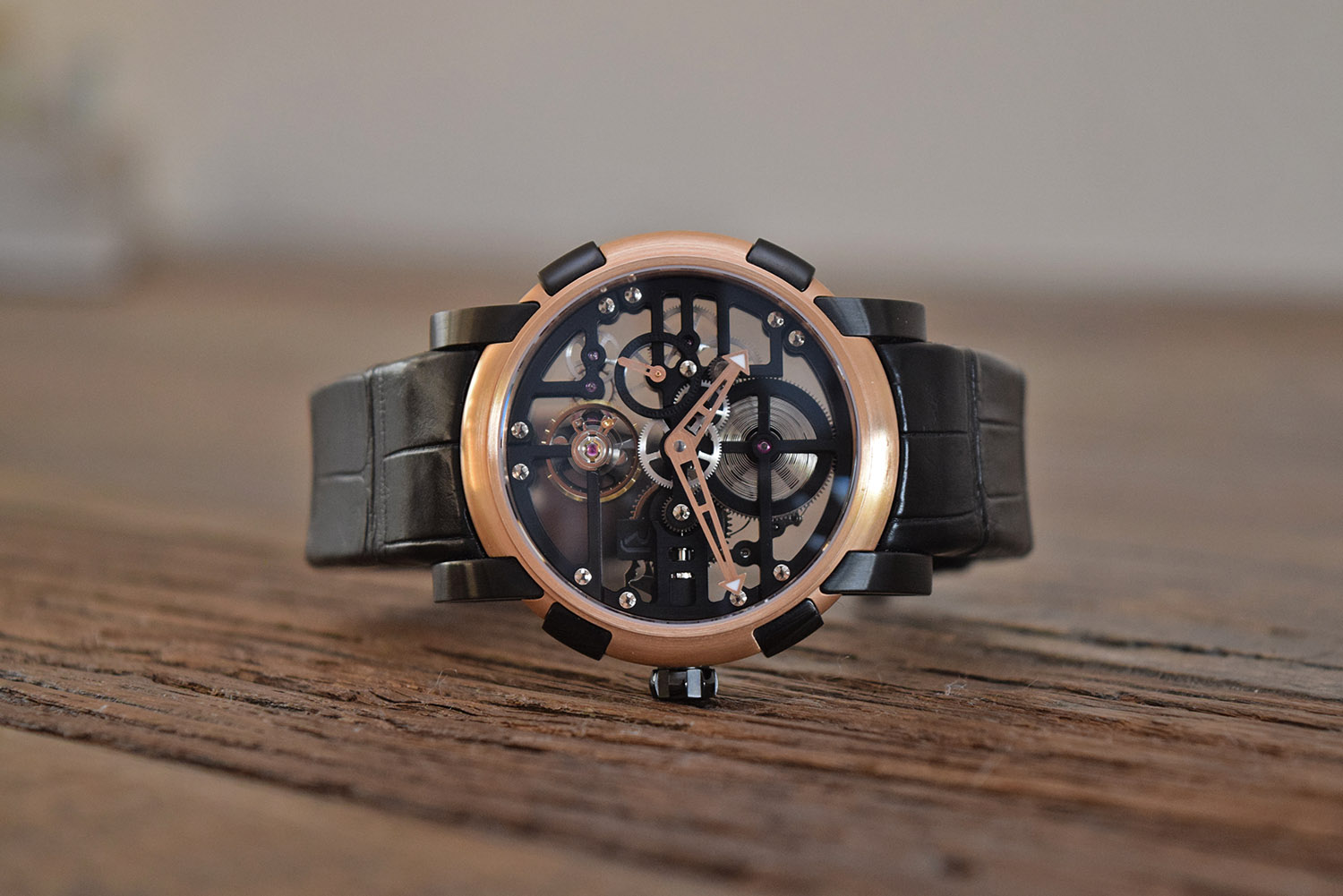
Debuting in December 2013, the Skylab collection marked the 40th anniversary of NASA's Skylab launch and, true to form, incorporated material from the Apollo 11 spacecraft into its case. Built around a reworked Concepto Calibre Squelette 3027 — a hand-wound, fully skeletonised movement with rectangular bridges, 21 jewels, and 48 hours of reserve — the Skylab paired a black-PVD steel case with the brand's signature bezel-securing 'claws' against red-gold hands and accents, with individual references limited to 99 pieces and prices from roughly 16,950 to 19,950 USD.
A further leadership change in 2017 brought in Marco Tedeschi, a second Hublot alumnus, who simplified the unwieldy 'RJ-Romain Jerome' name to simply RJ and, drawing on Hublot's modular Big Bang case system, created the brand's first true core collection, the ARRAW — a chronograph platform mixed and matched across more than twenty variants in different materials and finishes. Its Arraw Space 6919, limited to 100 pieces per version across a titanium and two ceramic references, paired a composite bezel containing genuine material from the Apollo 11 lunar module — its grid pattern inspired by the module's own windows — with a 360-degree orbiting moonphase display, driven by the proprietary calibre RJ-2180 and a rotor styled after the engines of the Saturn V rocket, priced between 26,000 and 28,500 USD.
The pandemic ended that chapter: with much of RJ's customer base concentrated in Asia, Alliance Investment Group cut off funding in February 2020, and the company filed for bankruptcy on February 27, with the loss of 33 jobs. Tedeschi went on to found his own venture, Kross Studio, while the RJ name itself was reorganised as RJ Watches, continuing today around four collection families revived from the archive — Titanic-DNA, ARRAW, Moon Dust-DNA, and Steampunk — priced from roughly 10,400 to 28,500 USD.