Rolf Lang
Rolf Lang was born in 1948 in Gera, Thuringia, in what became the German Democratic Republic, the son of independent watchmaker and bank economist Heinz Lang; growing up alongside three siblings, he observed three generations of watchmaking tradition from early childhood. Under East German policy, however, being the son of a 'hereditary watchmaker' initially barred him from continuing the family trade. He nonetheless trained in his father's workshop for three years after finishing school in 1964, later earning his matriculation certificate through evening courses at the People's University in Gera in 1970. During these years he worked as a precision mechanics specialist at VEB Carl Zeiss Jena, served in the National People's Army, married Margitta Lang, and had two children — daughter Christiane in 1968 and son Marco in 1971, who would go on to continue the family tradition as a fifth-generation watchmaker. Rolf Lang eventually earned the title of Master-watchmaker.
From 1971 he spent five years as a watchmaker for a state repair enterprise, becoming a master of manufacturing training in Jena, before moving to Dresden to run a state watch-repair workshop until 1979. In parallel, he studied at the High School of Economics and Finance and completed a restorer's course at the German Museum in Berlin between 1981 and 1985, which led to a decade, from 1979 to 1989, spent as a part-time restorer for the Mathematisch-Physikalischer Salon, Dresden's state museum of watches and scientific instruments — work that gave him direct access to one of the largest such collections in the world and hands-on experience restoring historical watches, marine chronometers, and other precision timepieces. In 1981 he founded the 'Watch Restorers' group in Dresden; by 1987 he was the Salon's Principal Restorer, and in 1988 he became an active member of the German Society of Watch Chronometry. In 1989, he opened his own restoration workshop in Dresden, combining historical conservation with the design of new high-quality watches.
German reunification opened a new chapter: in 1990 Lang opened a company branch in Glashütte, and in 1994 he was among the founders of the joint venture that relaunched A. Lange & Söhne, serving as a model designer and, from 1999, as the house's professional trainer. Between 2003 and 2007 he was Chief Model Designer at H. Moser & Cie. in Schaffhausen, and in 2004 he founded the Circle of Interests of Saxon Watchmaking Art and Craft. He then returned to Tutima in Glashütte as Chief of its Design Department, where in 2012 he developed the Minute Repetition Homage, the first minute-repeater wristwatch made in Germany. Throughout this period, Lang also mentored his son: Marco Lang, observing his father's work from early childhood, co-founded Lang & Heyne in Dresden in 2001 before leaving in 2019 to found his own eponymous workshop.
Lang founded his own trademark, Rolf Lang Dresden, in 2012, and unveiled his first collection, Canaletto, at Baselworld in 2014. The workshop, now based in Bad Gottleuba near Dresden — with Uhrenwelt Rolf Lang Dresden established there in 2021 — is a genuine rarity in that every watch is manufactured entirely in-house by Lang and a small team, rather than built around externally sourced movements. His stated benchmark is a manufacturing tolerance of 2 to 3 microns, roughly a hundred times thinner than a human hair. The team includes Irina and Anna Lang on finishing, engineer Marcus Werner, designer-engineer Sebastian Wolfram, and assembler Andre Rammer, with the workshop's distinctive free-form cases developed in partnership with Wolfram Design and Engineering in Dresden. Lang has said he is particularly committed to passing his knowledge on to the next generation of independent watchmakers.
Alongside wristwatches, Lang produces spectacular one-off table clocks. The 2018 Golden H marine chronometer, made in tribute to John Harrison's H4, is built from roughly 6kg of 18k rose gold in collaboration with German jeweller Veridor: an 8cm egg of five gold-leafed, dark-blue Murano glass panels that, at the press of a button, unfurls nearly 800 degrees on a powered mechanism as the chronometer rises from within on an 18k gold gimbal. The hand-engraved, key-wound movement has a double barrel, a 72-hour reserve, a diamond end-stone, and a bimetallic screwed balance on a blued-steel Breguet overcoil beating at 18,000 vibrations per hour; the 53mm solid-gold dial shows time, date, power reserve, and a 24-hour indication. The entire sculpture stands 35cm tall, comprises 985 hand-made and hand-assembled components, and is limited to five pieces at €1.2 million each.
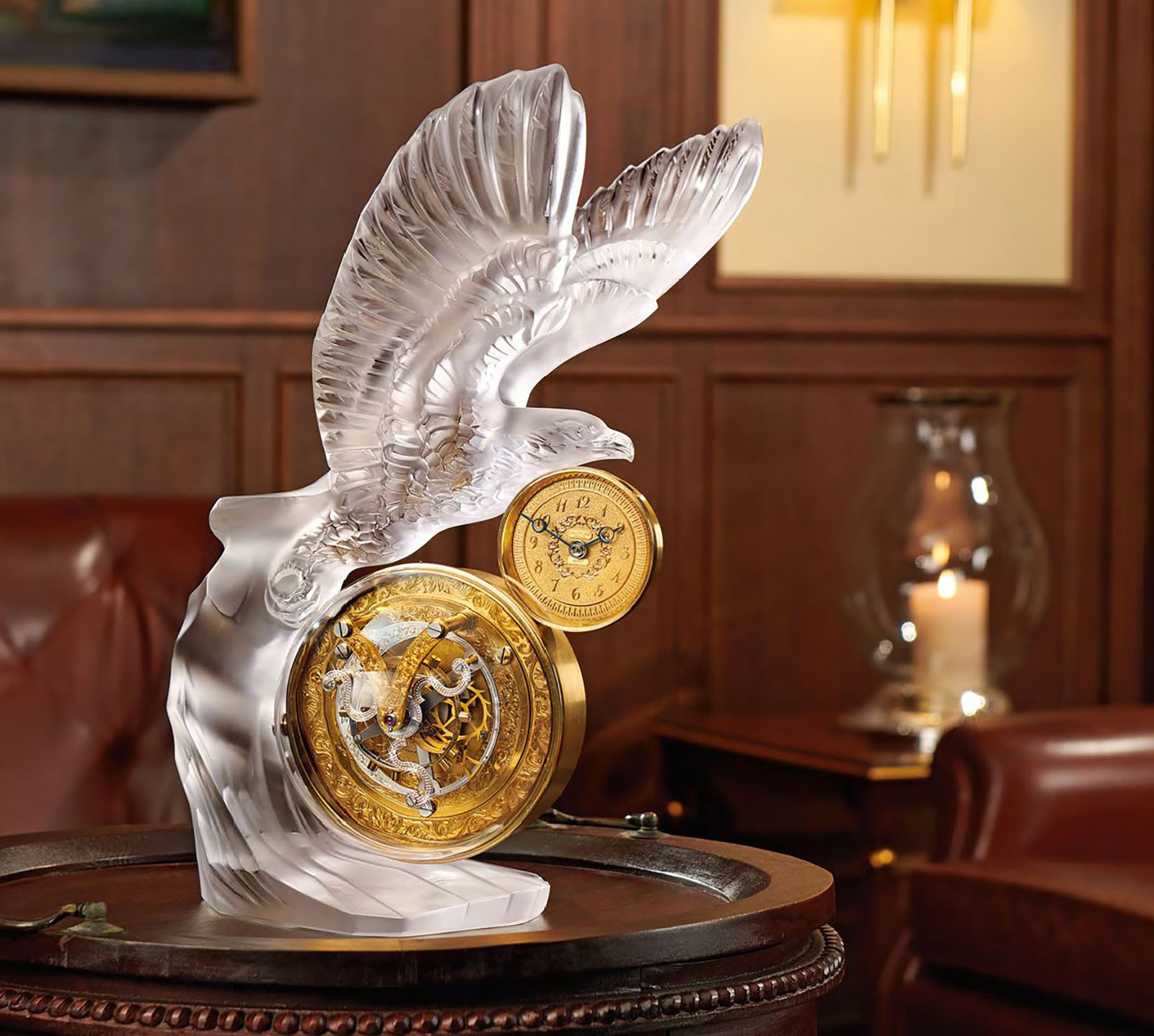
The 2022 Phoenix Clock paired Lang with French glassmaker Lalique, whose century-old atelier produced a crystal eagle, wings spread, cradling an oversized tourbillon beneath its own domed crystal. Deliberately rooted in 19th-century decorative watchmaking, the piece is entirely hand-engraved, gilded, and set with brilliant-cut diamonds on the tourbillon cage; the tourbillon bridge itself carries an engraved view of Dresden, Lang's hometown, while the winding key is inscribed 'Invenit et Fecit' — Latin for 'invented and made,' also F.P. Journe's own motto. The 30cm clock, mounted on a Lalique crystal stand and manually wound with a four-day power reserve, is likewise limited to five pieces, priced on request.