Roysdon Watch Co.
Dr. Paul F. Roysdon, Ph.D., came to watchmaking with no family workshop and no lineage to continue — a career spanning aerospace engineering, aerobatic flying, control systems and navigation, cybersecurity, machine learning, and national security leadership, having built and sold two aerospace and deep-tech companies along the way. He restored hundreds of vintage and modern watches, Breguet, Hamilton, Elgin, and Waltham among the historic pieces, Seiko, Patek Philippe, Rolex, Audemars Piguet, IWC, Longines, and ETA/Unitas among the modern ones, before deciding that taking a watch apart to understand it was no longer enough; he wanted to build one entirely himself.
That decision meant becoming a beginner again and again: movement design led to machining, machining to metrology, cases to metallurgy and casting, dials to guilloché, guilloché to rose and straight-line engines, dial lettering to pad printing — and since no pad printer existed that could do what he needed, he designed and built one himself. Every Roysdon watch today passes through the same single workshop and the same hands, from the first calculation to the final regulation: movements are roughly 95% made in-house, down to hand-cut screws with 0.3 to 1.2mm thread diameters that take one to two hours each, wheels and pinions machined and polished over several days apiece, and jewels press-fit to a 0.05mm tolerance.
Cases are cast in a proprietary 18-karat alloy the house calls Texas Gold, using lost-wax investment casting, a roughly 6,500-year-old technique, with the gold heated to about 1,150°C and vacuum-cast from 3D-printed resin masters before being machined and hand-polished to final dimensions. Dials carry true cut guilloché from rose and straight-line engines rather than printed patterns, alongside enamel, pad-printed lettering, and individually hand-made 18-karat gold indices; hands are shaped and sculpted by hand from 18-karat gold; finishing includes anglage, mirror and black polishing, pearlage, straight graining, and 24-karat gold and rhodium plating, with a single set of bridges taking roughly eight hours to finish after only one hour to machine.
Model One, the debut, took 21 prototypes and 1,440 cumulative hours to arrive at a 220-hour production build; its in-house movement is inspired by the Hamilton 945, cased in 316L steel at 43.5mm, limited to four pieces at $80,000. Model Two, a monopusher chronograph with a movement inspired by the Hamilton Model 23, houses that movement in an exoskeleton case and bracelet machined from aerospace-grade 6061-T6 aluminum, bead-blasted and hand-polished facet by facet; 375 hours per watch, limited to four at $115,000.
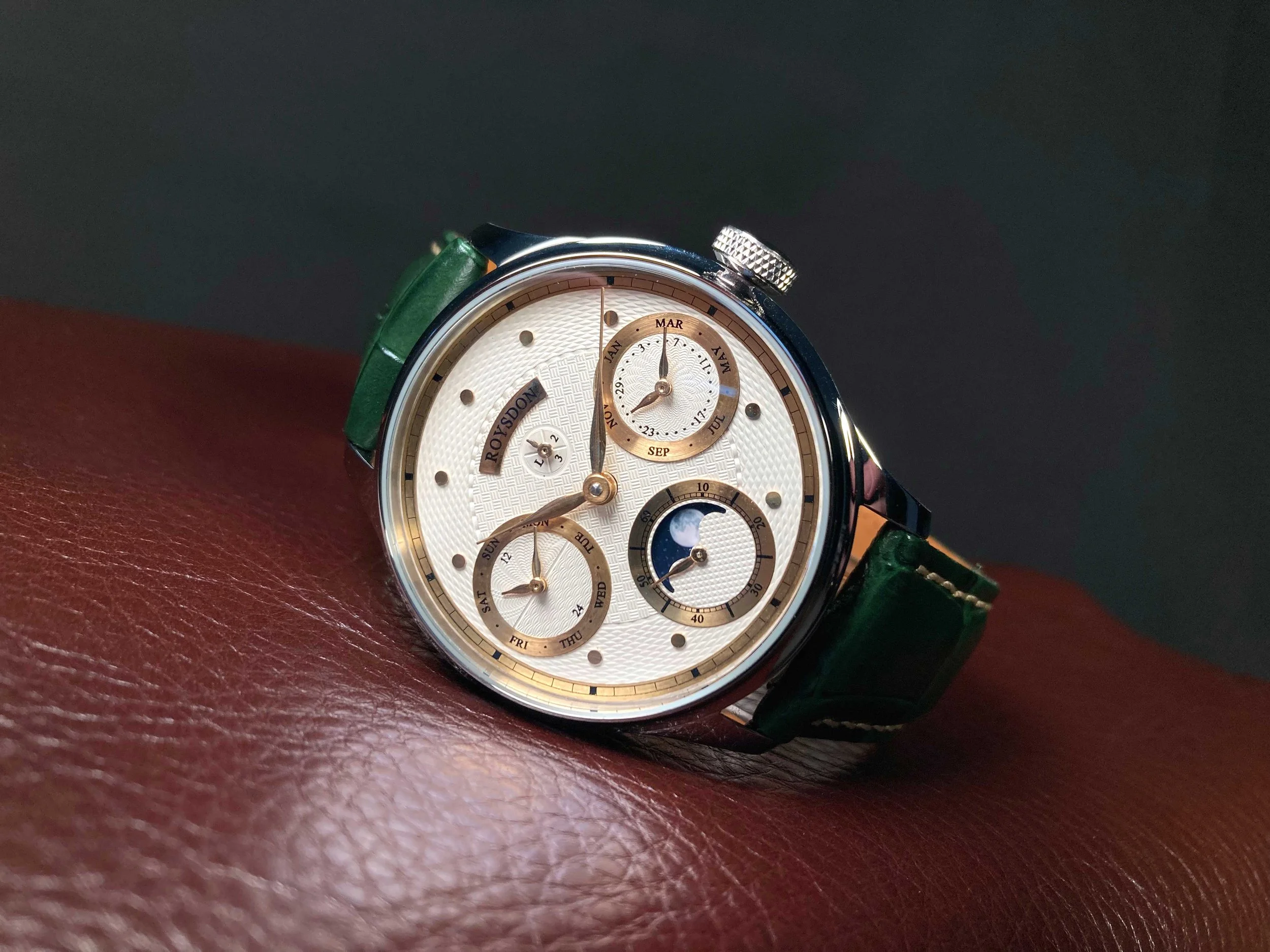
Model Three, a perpetual calendar with a movement inspired by Dubois Depraz architecture, arranges its calendar across five subdials, including a month-and-date display built specifically around prime numbers; 430 hours per watch, limited to two at $130,000. Model Four, a minute repeater whose movement draws on an 1880s Déposé repeater design, requires roughly 880 hours, about 110 eight-hour days, for a single watch, limited to two at $230,000.
Model Five, the Aviator, carries a movement inspired by the ETA 2824 and was genuinely flight-tested by Roysdon himself, an aerobatic pilot, in his own Pitts S2 biplane under loads of +6 to -2 G and rotations of 360 degrees per second; 220 hours per watch, limited to four at $80,000. Model Six, the Jubilee, introduces the house's first in-house automatic movement, inspired by the Hamilton 663 and 827, in a solid 18-karat gold case with a guilloché-and-enamel dial; still in active development as of this writing, it is planned as a limited edition of four at $80,000.