VicenTerra
Vicenterra is the work of Vincent Plomb, a trained micro-mechanical designer who entered watchmaking through the 2D and 3D design of external watch components — case and dial architecture — before the company he worked for went bankrupt. He responded by sharpening his expertise across a string of contracts with different watch brands, and on December 1, 2003 founded Realis, the parent company that would eventually become Vicenterra. Around eighteen months later, now self-employed, a chance encounter gave him the push to design his first module combining three complications; it took three years to turn that idea into working prototypes. A promising production partnership collapsed amid the 2008 financial crisis, stalling the project until June 2009, when the concept that would become the GMT-3 first took shape in Plomb's mind, inheriting the architecture of those earlier prototypes. By February 2010 the design was finalized and the Vicenterra trademark officially registered; unveiled to enthusiastic press coverage, the GMT-3 drew roughly twenty pre-orders within weeks based on renderings and a 3D animation alone, and pre-orders kept arriving from Chicago to Beijing, Sydney to Geneva, until the brand's minimum viability threshold of 70 orders was reached that October — at which point Vicenterra SA was formally incorporated and the watches went into production.
The Earth holds a central, recurring place across every Vicenterra reference — Plomb has described the brand's mission as offering models that let the wearer 'escape' at a glance, behind an apparent simplicity that conceals genuinely intricate mechanical systems. Rather than adapt a single shared complication module across the range, Vicenterra develops a dedicated movement module for each model specifically to preserve the graphic clarity Plomb wants on the dial, fitting these modules to robust Swiss automatic base movements (commonly a premium-grade ETA 2892) rather than building movements entirely from scratch. The brand is designed in Boncourt and made and assembled between La Chaux-de-Fonds and Porrentruy in the Swiss Jura, with more than 95% of each watch manufactured by craftsmen and specialist companies across that same regional network — a transparency about its production chain that Plomb treats as part of the brand's identity, not an afterthought.
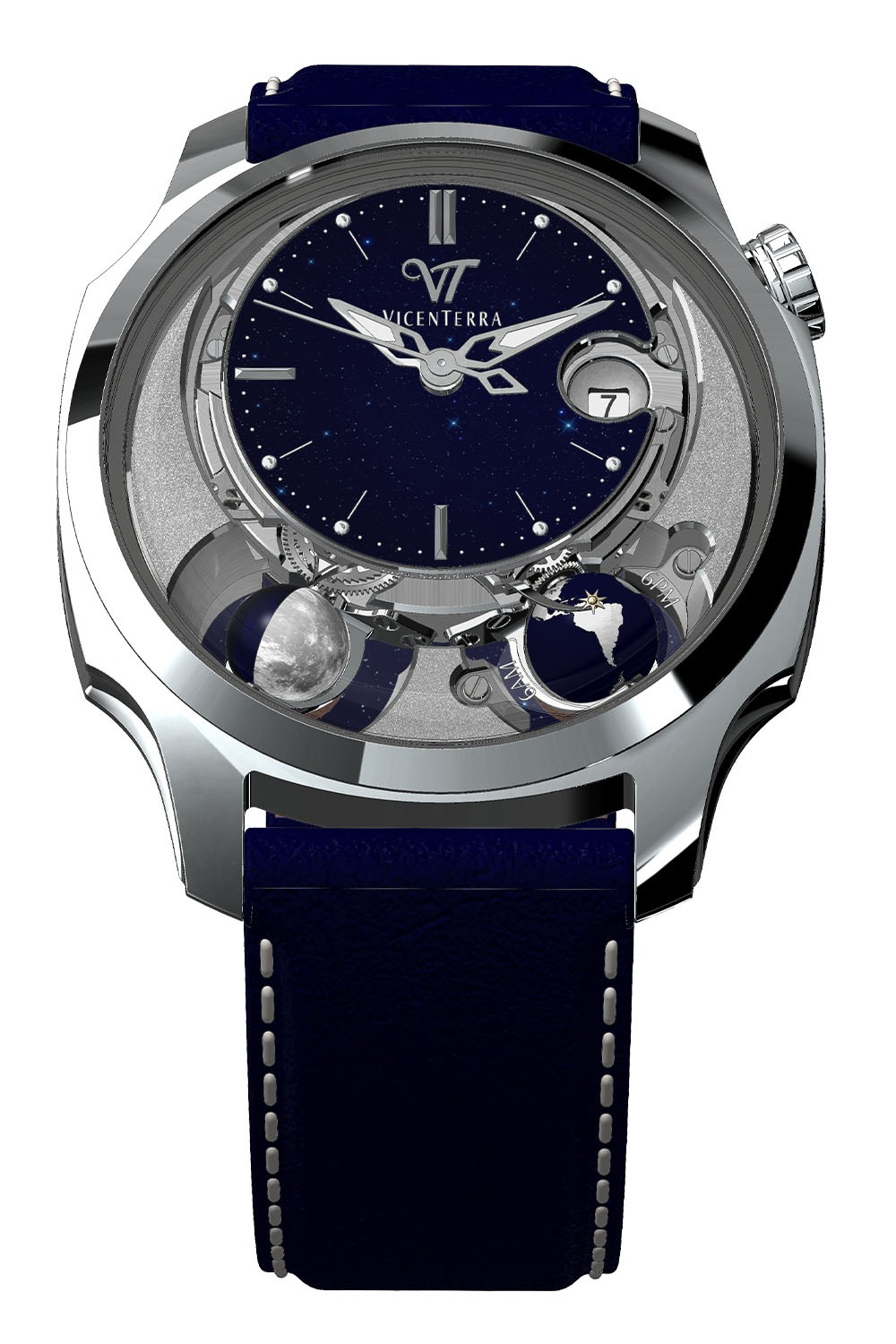
The collection comprises three lines. The GMT-3, the brand's founding model and the architectural root of everything that followed, is housed in a distinctive steel tonneau case beneath a large cylindrical glass, its multidimensional dial built around a rotating 3D Earth globe sharing the stage with a sun disc and moon to indicate day and night, alongside a retrograde date and an independent second time zone — five functions in total, with the globe set via a pusher at 4 o'clock across 24 independent positions. The Tycho Brahe, introduced in 2017 and named for the 16th-century Danish astronomer renowned for the most accurate naked-eye observations of his era, is the brand's more dress-oriented 'technical-dress' line: an off-centered dial in a 42.8mm Grade 5 titanium case, with the numeral five replaced by an oversized 'V' that doubles as a pointer marking the sun's zenith over the rotating, hand-painted globe, visually tracking daylight as it crosses the planet — limited to 99 numbered pieces per execution. AstroLUNA completes the collection with a different astronomical pairing: a three-dimensional Earth and Moon together on the dial, built around a perpetual moon-phase display, offered in aventurine 'Cosmos' executions and other numbered limited runs.