A. Favre & Fils
A. Favre & Fils is the living trunk of one of Switzerland's oldest watchmaking family trees — the direct historical predecessor of Favre-Leuba, revived and run today by the descendants of the original Favre family. The root reaches to 1718, when Abraham Favre began his apprenticeship with master watchmaker Daniel Gagnebin (an authentic document in the official archives of the Canton of Neuchâtel attests to it), becoming a recorded independent watchmaker in Le Locle by 1737 and Maître horloger du Locle around 1749. Four generations on, in 1792, the family workshop was formally registered as 'Abraham Favre et fils' and the first timepieces signed A. Favre et fils. From that single trunk grew two branches: in 1815 the family partnered with watchmaker Auguste Leuba, creating the famous Favre-Leuba name that the 5th and 6th generations carried across the world — above all to India — while the family firm's own story continued in parallel. The 8th generation's Henry A. Favre restored the dynasty's industrial might, acquiring Bovet Frères and Lavina, building a full manufacture in Geneva in 1964, and merging with Jaeger-LeCoultre in 1969 to form SAPHIR S.A., one of the most important Swiss horological groups of its day — until the quartz crisis and the closure of the Indian market forced its sale to Germany's VDO in 1976. Today the two lineages are distinct: Favre-Leuba belongs to private investors, while A. Favre & Fils is operated as an independent, high-end luxury brand by the Favre family itself.
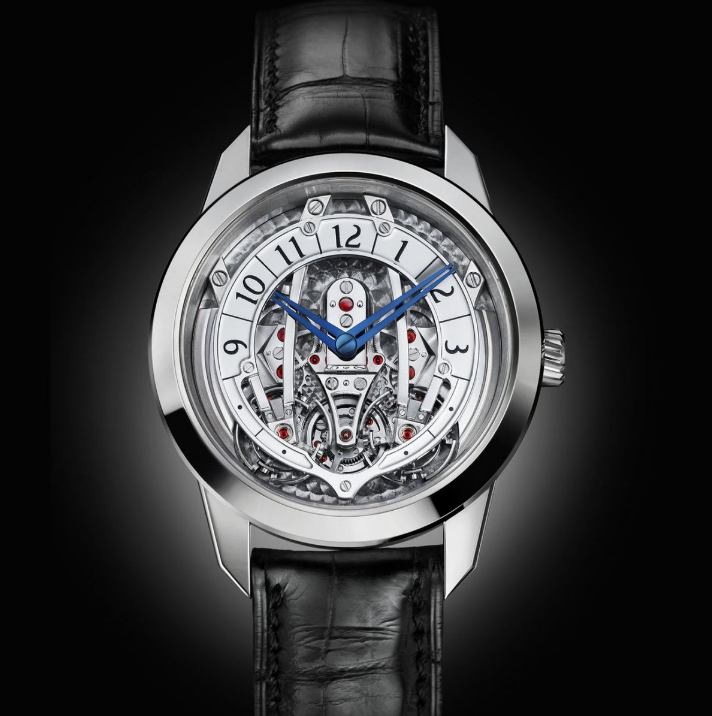
The reviver is Laurent Favre, 10th generation of watchmakers bearing the name. Raised on the old stories, he studied in the United States, served as communication and product development manager at one of Switzerland's great fine-watchmaking brands, and then took up what he calls the family challenge: ensuring the continuity of the tradition he was proud to inherit. His first creation appeared in 2010 with a perfectly chosen name — the Phoenix 10.1 (the '10' for his generation), followed by the pared-back Phoenix 10.2 and, in 2015 after five years of development, the definitive Phoenix 10.3: a harmonious blend of strong modernity and pure Art Deco aesthetics offered in variants like the Gatsby, Hugo, and Titanium. Its chronometric heart is a double regulator in the greatest horological tradition, and its finishing is superlative and deliberately unique — a wolf-teeth ratchet with eagle-beak pawl, a winged differential bridge, and terraced bridges with progressive angles that create a rare, precious mechanical landscape.
Laurent Favre's vision extends beyond the bench in two directions. Technologically, the house made headlines by teasing the world's first mechanical cryptocurrency 'vault' wristwatch — a cold-wallet timepiece securing a collector's crypto private keys within Swiss haute horlogerie. Ethically, he is a founding member and president of the Swiss Better Gold Association, which since 2013 has promoted a transparent, responsible gold value chain from mine to final consumer — an embodiment of his creed that 'creating value has no sense if you do not do good around you.' Eleven generations after an apprenticeship in Le Locle, A. Favre & Fils remains what it has always been: the Favre family, signing its own name — changing the world, as Watchonista put it, one watch at a time.