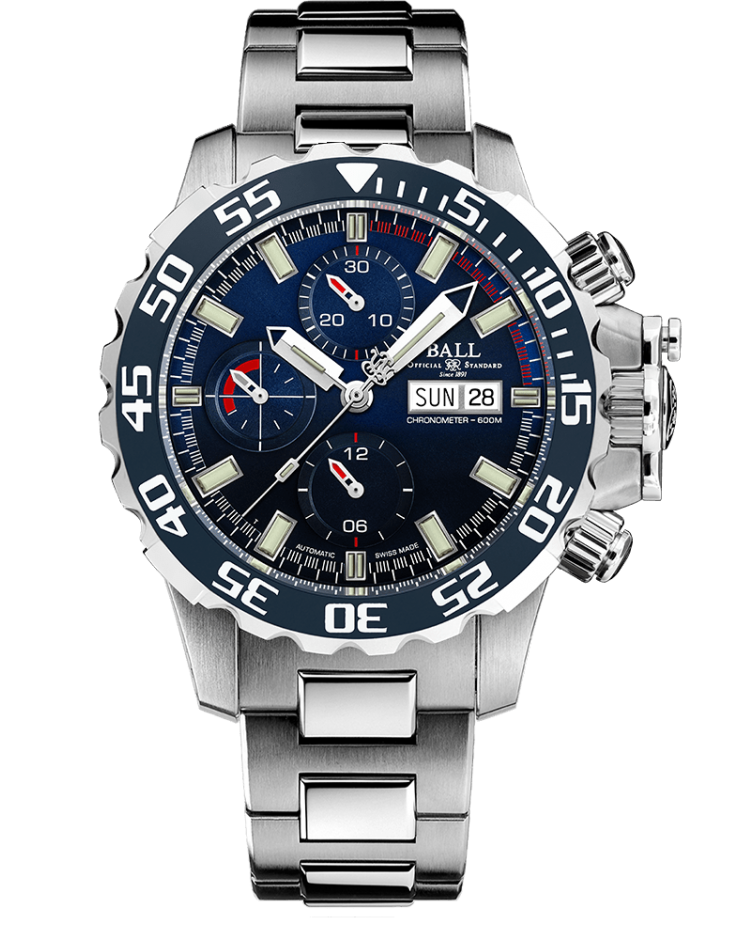
Ball Watch Company
BALL Watch Company traces its identity to one of American railroading's most consequential tragedies. Webster Clay Ball was born on 6 October 1847 in Fredericktown, Ohio, and built a reputation as one of Cleveland's leading jewellers before the Great Kipton Train Wreck, on 18 April 1891, when a conductor's pocket watch stopped for four minutes and then restarted, sending a fast mail train into a fatal head-on collision with a passenger express roughly 40 miles west of Cleveland. On 18 July 1891 Ball was appointed Chief Time Inspector for the Lake Shore & Michigan Southern Railway, and between April and September of that year he built an entirely new timekeeping system from scratch: drafting requirements, hiring and training inspectors, and preparing and inspecting some 2,300 watches for service. Under his system every passenger and freight train carried four Ball-certified watches — held by the conductor, engineer, fireman, and rear brakeman — each compared every two weeks against Standard Time from the US Naval Observatory in Washington, with any variance beyond 30 seconds requiring immediate readjustment or replacement. The Webb C. Ball Watch Company was formally established in 1894 to distribute railroad watches to this standard; Ball's rigour is widely credited as a forerunner of the modern COSC chronometer certification, and the phrase 'on the ball' is commonly traced to his name. The RR lettering stamped across the modern catalogue descends directly from that founding mission.
The scale of Ball's achievement grew steadily: by 1900 he had inspected more than 54 railroad companies and approved 37 different watch models for service; by 1908 he was overseeing roughly 180 railroads and regulating over a million railroad watches; and in 1921 the Horological Institute of America honoured him for the work. Ownership of the Ball name passed out of the family's hands in the 1990s, and the modern BALL Watch Company SA now operates from La Chaux-de-Fonds, Switzerland, under private investment ownership, building on milestones reached along the way: the first Skindiver timepiece in 1962, the Trainmaster automatic wristwatch on Swiss movements in 1978, and in 1980 recognition as the longest-continuously-operating retailer of railroad-marked watches. In 2001 Ball pioneered what it describes as the world's first mechanical watch illuminated by micro gas tubes, launched with the Engineer collection, followed in 2004 by the tougher Engineer Hydrocarbon series; in 2010, astronaut Captain Alan Poindexter wore his Engineer Hydrocarbon Spacemaster aboard Space Shuttle Discovery on a mission to the International Space Station. Ball's patented shock-protection systems followed the same trajectory of continuous refinement — SpringLOCK® for the balance spring in 2013, and the SpringSEAL Patented Regulator Anti-Shock System protecting the regulator assembly in 2017 — alongside a broadening use of unusual case materials, including the 904L stainless steel Engineer III Pioneer of 2018.
That same period brought Ball's real move into manufacture-grade movements. In 2017 the brand introduced Caliber 7309 in the Engineer M Challenger — by Ball's own account, its first true manufacture caliber, COSC-certified and engineered for a genuine 80-hour power reserve at full rate rather than achieving longevity by slowing the balance. The platform was refined further in 2021 with the RRM7309-CS, incorporating a silicon balance spring for improved performance, and again in 2022 with the RRM7337-C, Ball's first true GMT manufacture caliber. These movements are reserved for a distinct, separately branded tier — the Engineer M and Roadmaster M lines — which Ball markets explicitly as 'designed and built completely in-house,' positioned above a much broader catalogue (Engineer Hydrocarbon, Engineer Master II, Engineer II, Engineer III, Roadmaster, Trainmaster, Fireman) built on COSC-certified, extensively modified ETA and Sellita movements under Ball's own calibre-naming system. That structure — a wide range of accessible, chronometer-certified watches crowned by a smaller, clearly delineated range of genuine manufacture calibres — places Ball's engineering depth alongside independents such as Christopher Ward and Yema, whose own in-house efforts sit within similarly large catalogues. More than 130 years after a stopped watch cost nine lives in Ohio, BALL Watch Company still frames its entire purpose around the same promise Webb C. Ball first codified in 1891: accuracy under adverse conditions.