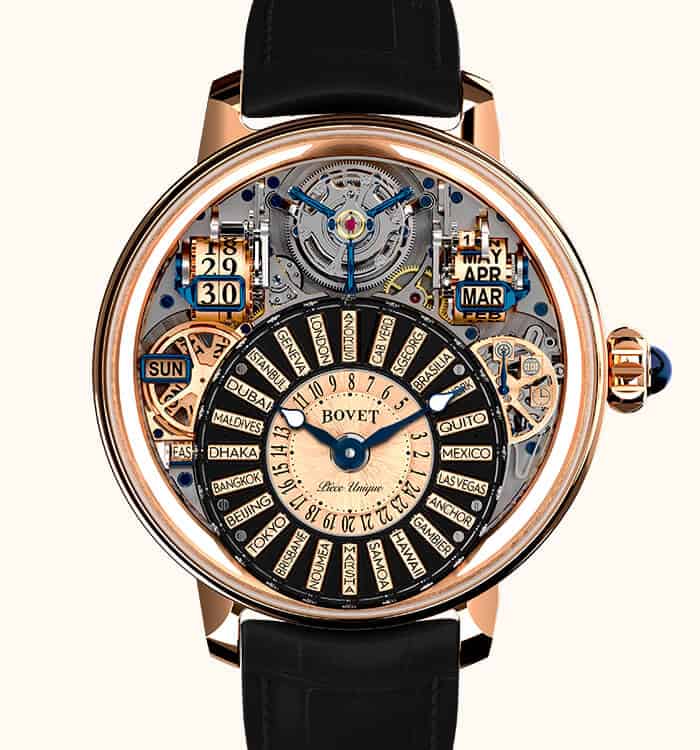
Bovet
Bovet was founded in 1822, with the original house straddling three points on the map at once — Fleurier in Switzerland, London, and Guangzhou in China — built on the export trade in highly decorated pocket watches for the Chinese imperial market, adorned with enamel miniature painting, cloisonné, hand-engraving, lacquer inlay, pearl-setting, and guilloché. The house passed out of family hands over the 20th century until 2001, when Pascal Raffy, a pharmaceutical entrepreneur and longtime watch collector, acquired it with the intention of restoring it to its former standing. In 2006, when the external supplier producing Bovet's tourbillon movements came up for sale, Raffy bought the manufacture outright rather than continue depending on it — a decision that made Bovet vertically integrated almost overnight. That same year the Canton of Neuchâtel invited him to acquire the 14th-century Château de Môtiers, where the Bovet family itself had lived for more than a century; the castle is now Bovet's headquarters, final-assembly atelier, and museum. Today the Tramelan manufacture produces more than 95% of the components in every watch in-house, including the hairspring and regulating organ — a level of vertical integration almost unheard of at Bovet's production scale of roughly 1,000 watches a year. Raffy, notably, is not a trained watchmaker; he designs every piece himself and has said that not knowing what is supposed to be 'impossible' has been an advantage, letting him approach each watch as a collector first.
Bovet's most consequential invention is the patented Amadeo convertible case system, unveiled in 2010 after seven years of development: with no tools, a single watch converts between a wristwatch worn on either face, a desk clock standing on its own folding bow, and a pendant or pocket watch, the lugs swiveling to double as a stand. It has since underpinned dozens of references across the collection, including the entry-level Miss Audrey. On the movement side, Bovet's Virtuoso II became the first movement not regulated by a tourbillon to be entirely developed and hand-finished in-house, while the Braveheart packed six patents into a single watch and a 22-day power reserve. The two main collections express the same DNA differently: Fleurier pieces carry the house's historic bow-and-crown-at-12 layout inherited directly from 19th-century pocket watches, while the Dimier collection moves the crown to a conventional 3 o'clock and is anchored by the Récital line — built around a distinctive sloped 'writing-desk' case, thicker at the top and tapering toward the wrist, designed expressly to stage the movement like a piece of theatre.
The Récital line carries most of Bovet's groundbreaking complications and nearly all of its recent awards. The Récital 22 Grand Récital, launched in 2018, combines a retrograde perpetual calendar, a miniature tellurium, and a double-sided flying tourbillon whose five sunbeam-shaped arms represent the sun while a rotating hand-painted globe shows a 24-hour day on one face and a three-dimensional hemispheric precision moon completes the celestial display — the watch was awarded the Aiguille d'Or, the Grand Prix d'Horlogerie de Genève's top overall prize, in 2018, the only time in the brand's history that distinction has been won. It was followed by the Récital 26 Brainstorm Chapter Two, which paired a flying tourbillon and precision moon phase with a novel world-time display to win the GPHG's Mechanical Exception prize in 2020; the Récital 20 Asterium, awarded Best Astronomical Timepiece in 2023; and the Récital 28 Prowess 1, which brought home a second Mechanical Exception prize in 2024. In all, Bovet has collected more than 70 international awards since 2006, including six GPHG prizes between 2018 and 2025 alone, and Raffy himself has been named Personality of the Year in Watchmaking. Bovet has also built unusual outside partnerships reflecting its design-led, non-traditional approach: an ongoing collaboration with the Italian design house Pininfarina since 2010, and a three-year engineering project with Rolls-Royce culminating in 2020 in two bespoke Amadeo-system timepieces built directly into the dashboard of the Boat Tail coachbuilt car — solving for vibration, noise, temperature, and crash safety along the way. Collectors seeking something fully personal can work through Les Ateliers BOVET, the house's bespoke commissioning program.