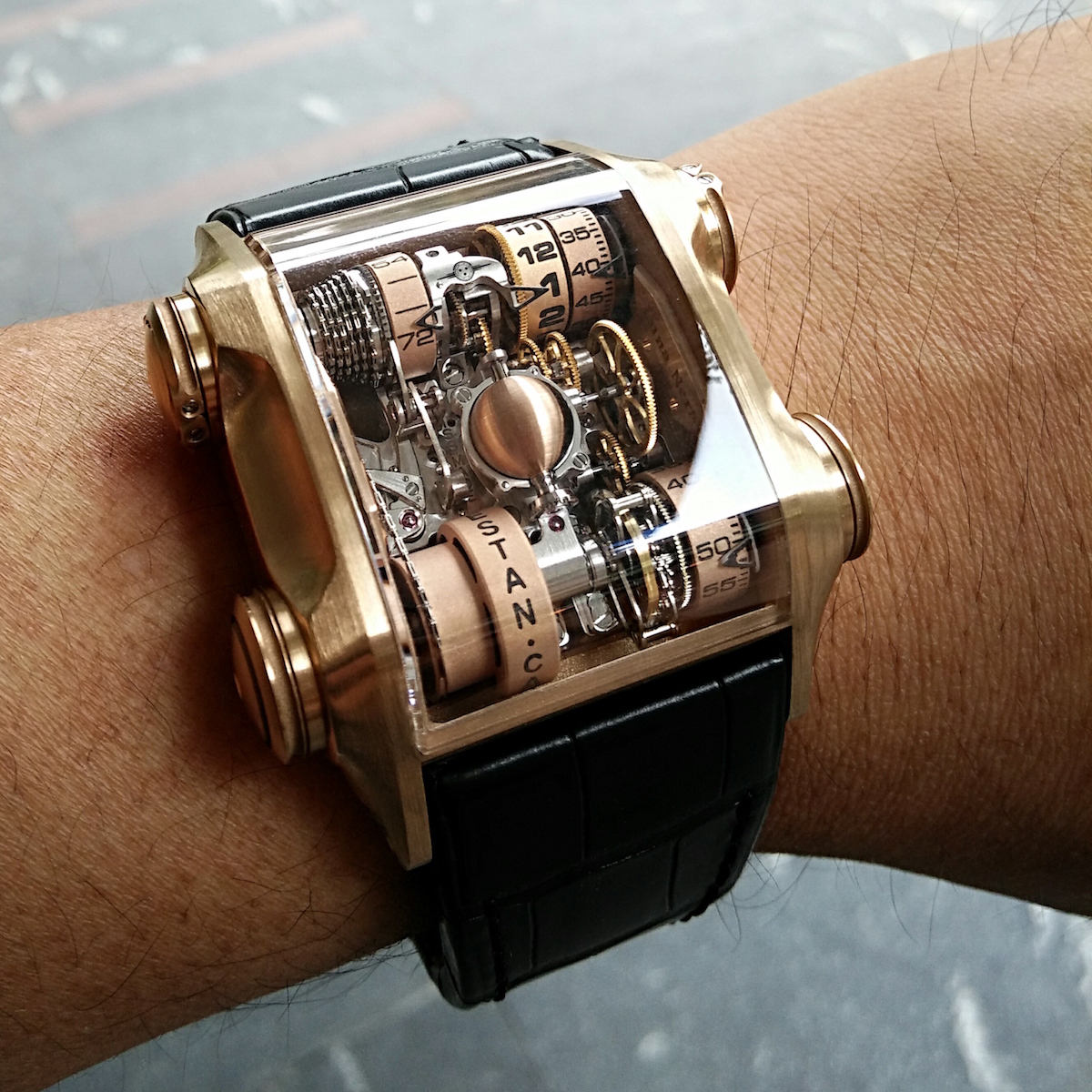
Cabestan
Cabestan was one of the most radical experiments of independent watchmaking's golden 2000s — a brand that turned the wristwatch on its side, literally, and whose dormancy since around 2020 has only sharpened collectors' appetite. The concept came from Jean-François Ruchonnet, the renowned designer and inventor (and founder of virtual-imaging firm DMC Group) whose credits include the TAG Heuer Monaco V4. Developed in 2003–2005 around a yachting theme, his idea combined elements no one had united before: a movement arranged vertically inside the case, read on rotating drums through the side of the watch; the fusee-and-chain transmission, the constant-force mechanism dating from the dawn of mechanical horology; a tourbillon mounted vertically along with the entire caliber; and a winding-and-setting system operated by a miniature capstan — the ship's winch used to tension ropes, which gave the brand its name in old French spelling. To realize it, Ruchonnet and banking partner Andreas Stricker formed Crealux in 2006, and the technical development was entrusted to none other than Vianney Halter; the first prototype of the Winch Tourbillon Vertical appeared in 2007. When Halter stepped away, an even more fitting successor arrived in 2008: Eric Coudray, the former Jaeger-LeCoultre master celebrated as the father of the Gyrotourbillon spherical tourbillon, who set up the production team in the Vallée de Joux.
The brand's history reads like a relay race of horological personalities. In 2009 Ruchonnet sold to Timothy Bovard, who reorganized it as Cabestan Watches and expanded the family: the Nostromo (2010) modernized the original with a trapezoidal case and sapphire crystals (the first WTV's U-shaped crystals had been plastic) and replaced the winch with two crowns while keeping the vertical caliber, chain drive, vertical tourbillon, and drum displays; the Scuderia Ferrari One by Cabestan (2010, 60 pieces) added an aerodynamic titanium-and-carbon case; and the Trapezium (late 2011) refined the design with twin sapphires and — remarkably for a watch dragging a chain — a full three-day power reserve. In 2013 a new team under CEO and owner Lionel Betoux took over and launched the Luna Nera, developed by Coudray, integrating a huge three-dimensional moonphase sphere into the vertical caliber. The apex came in 2015: the Triple Axis Tourbillon, its case inspired by the sleek athletic lines of a catamaran, presented at the GPHG — very likely the only triple-axis tourbillon ever made with a fusee-and-chain transmission, uniting Coudray's twin obsessions in one machine.
Under Betoux — an industry pragmatist who insisted creativity must also be profitable — Cabestan produced roughly 30 pieces a year, grew a significant bespoke business (clients could customize virtually anything on the outside, but 'the movement is ours'), and kept engineering focused on its signature: the chain, whose 1.5mm links must withstand three kilos of traction, with research into lighter exotic materials to extend autonomy further. Prices started at CHF 75,000 — a floor Betoux declared he would never go below, out of respect for the market and mechanical reality — and reached well into the hundreds of thousands. Around 2020 the company appears to have ceased activity, and the watches have passed into cult status: with celebrated collectors (like Singapore's Gavin Foo and his customized Luna Nera, profiled by Monochrome) and only a few hundred examples in existence across all references, Cabestan stands as a monument to the era when independent watchmaking dared to rebuild the wristwatch from its very axis.