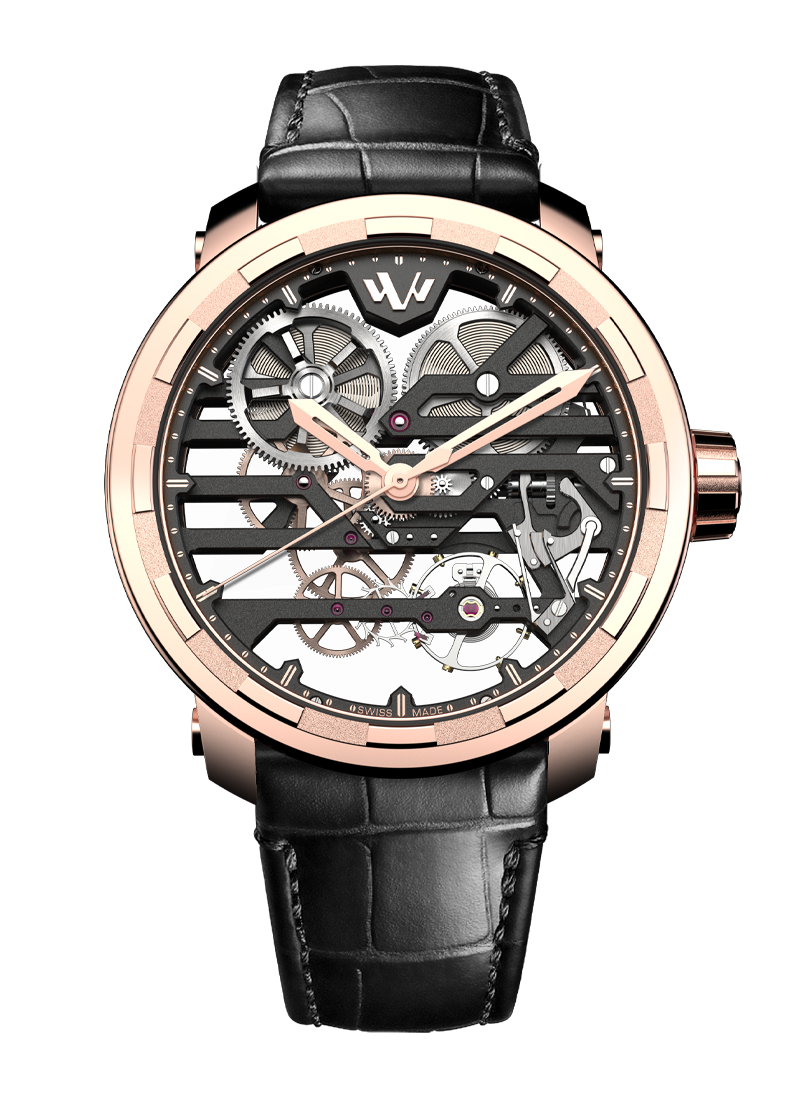
DeWitt
Founded in 2003 by Jérôme de Witt — a direct descendant of Napoleon Bonaparte and King Jérôme of Westphalia, and heir to an extraordinary imperial collection of timepieces built up over generations including by Napoleon III. The imperial family crest's 24 miniature columns became DeWitt's signature design element, adorning every bezel and case middle. His wife Viviane de Witt, former owner of a Paris auction house and author of four art books, joined in 2012 and co-runs the manufacture. One of very few watchmakers able to produce both in-house movements and in-house dials; 5,000 sqm across three floors, 60 employees, plus an in-house R&D department.
The onsite DeWitt Museum houses over 250 tools and machines from the 17th–early 20th centuries — among the world's largest private collections of watchmaking instruments, collected personally by Jérôme during his travels. GPHG 2005 Innovation Prize for the Tourbillon Différentiel Academia — then the world's first differential tourbillon. Collections: Academia (grand complications including constant force, perpetual calendar, minute repeater, jumping hour, tourbillon; showcases new movement and dial concepts); Twenty-8-Eight (named for Napoleon's proclamation date, 28th day of the 8th month; Art Deco radiator-grille aesthetic, tourbillons in manual, automatic, and skeletonized forms); Concept Watch X-1 (2015, flying tourbillon + patented automatic sequential winding). All watches handcrafted; bespoke watchmaking service available.
The timeline deserves precision: the company was established in Vandoeuvres in 2002, announced itself with the Pressy Grande Complication at Basel 2003, and moved into its purpose-built Vernier manufacture outside Geneva in 2007. The Academia line has since accumulated a museum's worth of mechanical eccentricity — the Chain Tourbillon, the Mathematical Watch with its multi-layered digit-strewn dial, and the Constant Drive, whose 'Eternal Screw' places a rotating screw at the exact centre of the dial that turns one direction as the wearer winds and slowly reverses as the 59-hour reserve runs down: gloriously unnecessary, and unlike anything else in watchmaking. Current Academia pieces run from roughly CHF 30,000 to CHF 185,000, and the manufacture has leaned into accessibility in two unusual ways: a certified pre-owned programme in which earlier DeWitts are bought back, restored in the Geneva workshops, and re-sold with a three-year warranty, and an on-demand production model in which iconic references can be built to order and customised. Combined with the full bespoke service — one-of-a-kind commissions designed with the client — this makes DeWitt one of the few haute horlogerie houses functioning almost like an atelier for its own back catalogue. The brand's cult following prizes exactly what the mainstream never quite embraced: imperial columns, industrial Art Deco geometry, and the sensibility of a Napoleon descendant who collects 17th-century watchmaking machines and builds 21st-century complications beside them.