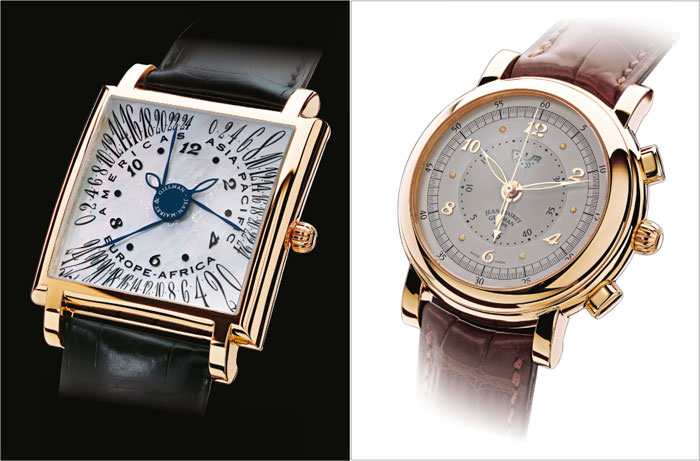
Jean-Mairet & Gillman
César Jean-Mairet was born in 1956 in Valencia, Spain, to a Spanish mother and Swiss father, and grew up between Barcelona and Geneva. He trained as an engineer, built power plants in Togo and Saudi Arabia, then earned an MBA at the University of Geneva and worked in finance before finally founding Jean-Mairet & Gillman in 1999, exhibiting at Baselworld by 2002. He carries genuine watchmaking lineage on both sides of his family: the Jean-Mairets settled in the Neuchâtel region in the early 16th century, where Jean-Henry Mairet invented both a seven-shot pistol and a watchmaking machine tool in 1566; Sylvain Jean-Mairet became a 19th-century maker of lever escapements and chronometers who invented a double stem-wind watch; and André Jean-Mairet, chief of workshops at the École d'Horlogerie du Locle in the 20th century, won 119 first prizes from the Observatoire de Neuchâtel and set two chronometer records. The Gillman side of his family traces to a family of Victorian-era scientist-travellers; César's great-great-grandparents were Robert Gillman and Caroline Bovet, of the celebrated Bovet family of Fleurier, renowned for pocket watches made for the Chinese market and for pioneering the display of the movement itself through skeletonised, decorative construction.
The house built a genuinely broad catalogue under its own name, spanning at least eight distinct lines: Clement Gillman, Hora Mundi, a functional world-timer with alarm, Chronograph Alexandre, Grande Date, a classical 41mm dress watch, Continentes, showing three retrograde timezones on a skeletonised dial, Lady Fiona, the women's line named for Jean-Mairet's daughter, Chronosport, a COSC-certified column-wheel chronograph, and the Tourbillon César Auguste, named directly after the founder himself.
One of the house's most distinctive pieces, the Continentes Night & Day, was limited to 200: a 43mm square, curved stainless steel case with independently adjustable triple retrograde continent world-time indications, its mother-of-pearl dial divided into three sectors for the Americas, Asia-Pacific, and Europe-Africa around a central world planisphere. The in-house Calibre JMG3101TR/1153 runs 40 jewels, adjusted to five positions, with fausses côtes decoration and a straight-line lever escapement. The Chronographe Alexander III, a monopusher chronograph also limited to 200 pieces, carries a two-tone silver dial with inner guilloché decoration, applied Breguet numerals, and subsidiary registers for the seconds and a 30-minute counter, run by the in-house Calibre 200GMP/5000 with fausses côtes and oeil-de-perdrix finishing across 21 jewels.